Where sampling bias enters an interview study, and how to catch it
Sampling bias enters an interview study at the recruit source, the screener, the incentive and the calendar. Here are the checks to run first.
Build an empathy map from interview transcripts so every note points to a real quote. What goes in each quadrant, and how to label your guesses.
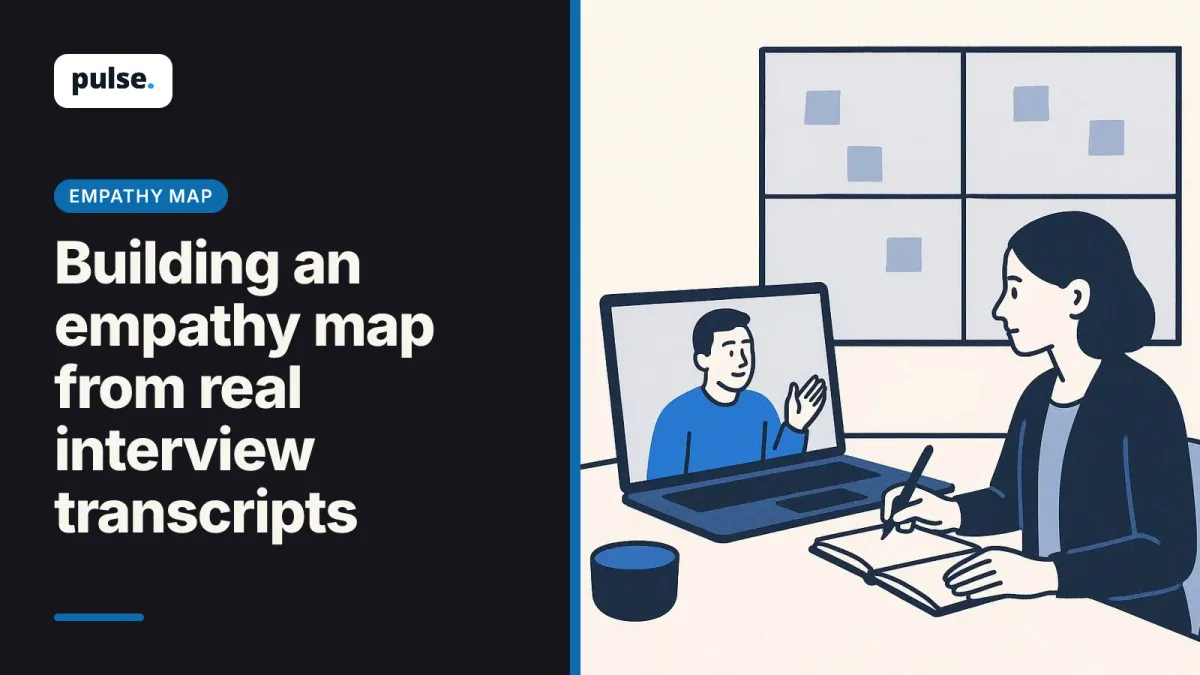
A product team runs an empathy map workshop, fills four quadrants with sticky notes, and then a stakeholder asks which customer said that. Nobody knows. An empathy map built from interview transcripts fixes this. Every note points to a quote and a participant, and anything the team guessed is marked as a guess.
A map built from memory shows what the team already believed. When it reaches a design review, those beliefs look like research, and a redesign gets built on them.
The quadrant rules and note format below tell you which notes belong on the map, which ones are guesses, and when the map is ready to show stakeholders.
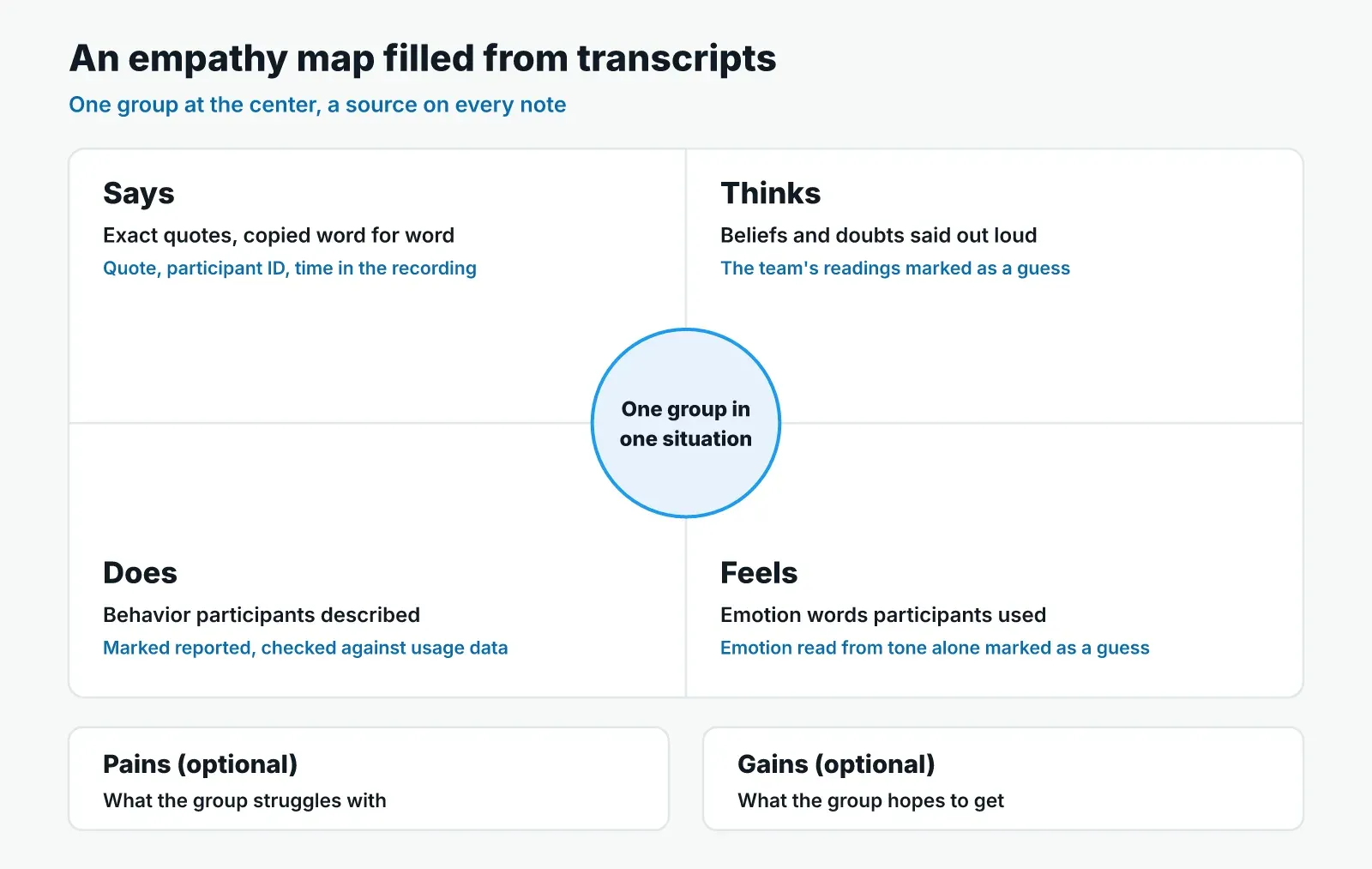
An empathy map is a one-page summary of one group of users, split into four quadrants: what they say, think, do and feel. Each quadrant takes a different kind of evidence from a transcript. Anything that goes beyond what a participant said is the team's guess, and the map should label it that way.
The group you are mapping sits in the middle, named precisely, such as "first-time investors in their first month". The map is a tool of empathy research.
| Quadrant | What counts as evidence | What does not count | How to mark the note |
|---|---|---|---|
| Says | Exact quotes, copied word for word | Summaries, or the interviewer's words | Quote, participant ID, time in the recording |
| Thinks | Beliefs and doubts the participant said out loud | Motives the team reads into an answer | Evidence, or a guess with the quote it rests on |
| Does | Behavior the participant described | Behavior the team assumes | Reported, and checked against usage data where you have it |
| Feels | Emotion words the participant used | Emotion read from tone alone | Evidence for a named emotion, a guess for tone |
Says is the strictest quadrant. It holds the verbatim quote, and a summary belongs somewhere else.
Thinks and Feels are where guesses creep in. "I wasn't sure the app would let me sell quickly" is evidence of a worry. "They don't trust mobile apps with money" is the team's reading of it. Both can go on the map, but the second one is marked as a guess, with the quote beside it.
Some versions of the canvas add two areas below the four quadrants. Pains holds what the group struggles with or fears. Gains holds what it hopes to get, or how it would judge success.
Both are optional, and both follow the same source rule. A pain the participant named, such as "I couldn't tell what the fee would be", is evidence. A pain the team expects the group to have is a guess, and it carries that label. Add the two areas when the map will feed a design decision about what to fix or what to promise. Leave them off when the four quadrants already answer the question.
Do most of the work before the session. Name one group in one situation, pull notes out of the transcripts with their sources attached, and only then sort them into quadrants together. The session then sorts evidence that is already on the table, and nobody fills a quadrant from memory of the interviews they happened to watch.
"First-time investors in the week after opening an account" can be mapped. "Customers" is too broad. The quadrants fill with notes that contradict each other, and the map cannot show why.
Each researcher reads different transcripts and pulls out every passage about that group and situation. This is the same first pass as analyzing user interviews. Working alone first stops the loudest voice in the room from setting the first draft.
A note has four parts: what was said, the participant ID, the time in the recording, and a label saying evidence or guess. Anyone who doubts the note can open the transcript at that minute and read the words for themselves.
Ask one question of every note: can you point to the words the participant used? If yes, it is evidence. If you are reading between the lines, it is a guess. Keep the guess, label it, and put the quote it rests on beside it.
After everyone has written their notes, group similar ones together. Next to each group, write how many participants it draws on. A group resting on one vivid interview then looks like what it is.
If some people check prices daily and others never look, put both on the map with their sources. Blending them into "checks now and then" describes nobody, and the split may be the most useful thing the map shows.
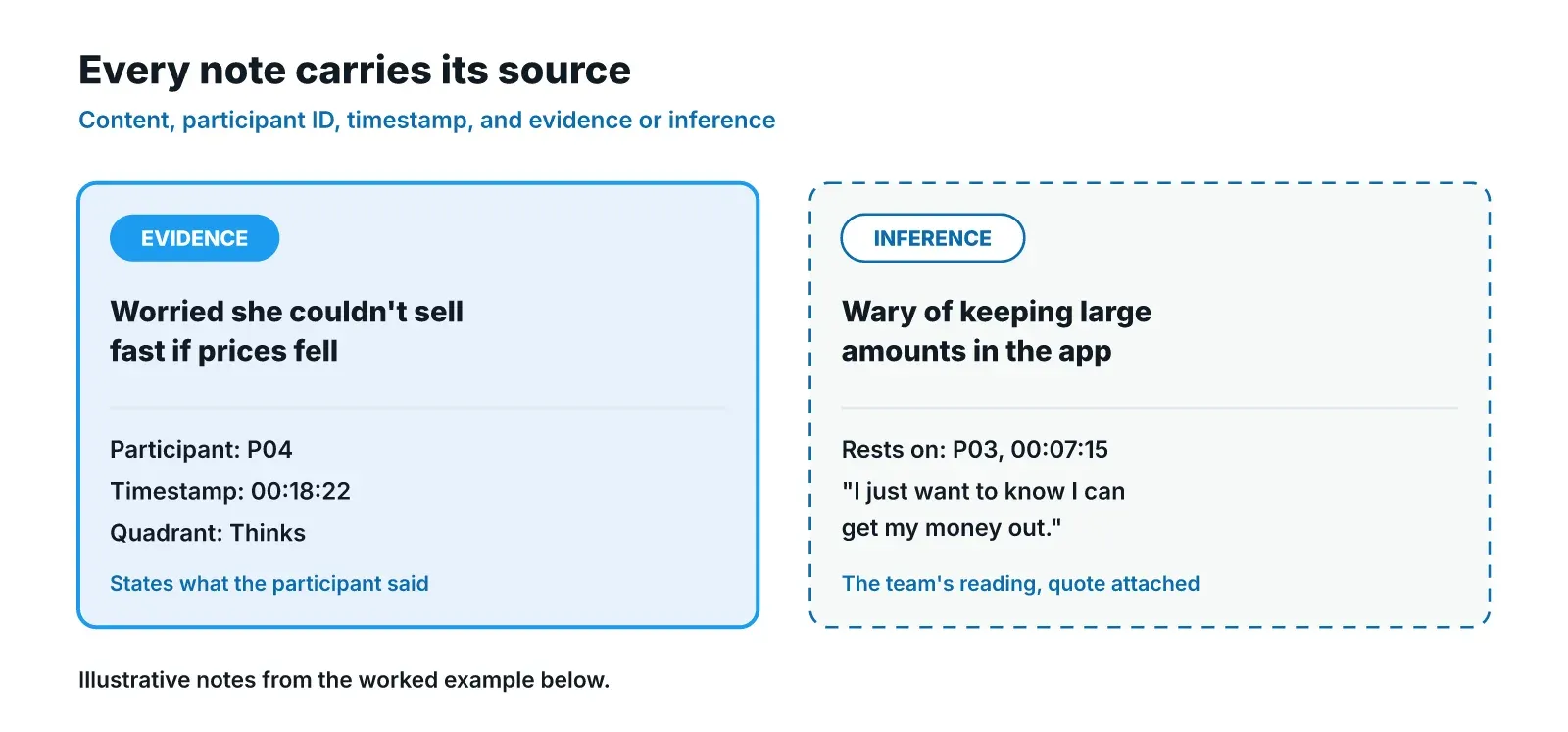
Illustrative example: the insights team at a large brokerage plans a change to the order screen. The business question is what first-time investors worry about in their first month, and whether the new screen answers it. The quotes and investors below are invented to show the format, and a real map would add the time in the recording to each source.
The team has three options. A workshop map from memory is fast, but nobody can trace its notes. A survey can count how many new investors feel nervous, but it cannot say what they are nervous about. A map built from the transcripts of recent interviews shows the worries in the investors' own words, with a source on each one. The team picks the transcripts, because the redesign needs the reasons, and a later survey can count them.
Here is the worked map, with two notes per quadrant and the source and label on each one.
| Quadrant | Note | Source | Label |
|---|---|---|---|
| Says | "I just want to know I can get my money out." | Investor C | Evidence |
| Says | "I read the order screen over and over before I pressed buy." | Investor G | Evidence |
| Thinks | Unsure whether an order fills at the price on screen | Investor E | Evidence |
| Thinks | Wary of keeping large amounts in the app | Investor C | Guess, relabeled in review |
| Does | Says she checks her portfolio every morning | Investor G | Reported |
| Does | Says he has not opened the app since his first purchase | Investor K | Reported, contradiction kept |
| Feels | "Nervous. It's real money." | Investor B | Evidence |
| Feels | Relieved once the first order went through | Investor E | Evidence |
The second Thinks note first went up as evidence that investors distrust the app. In review, the team reread Investor C's quote, saw it said nothing about trust, and relabeled the note as a guess.
The two Does notes contradict each other, and both stay. One investor checks daily and another has not come back. The team's next decision follows from the map: it will show the fill price clearly on the new order screen, and probe the two behaviors in the next round of interviews before it designs for either.
Put a date, the study name and the group on the map. Keep the evidence and guess labels visible in the version stakeholders see, and update the map when new interviews arrive. A cleaner slide without the labels turns every guess into what looks like a fact.
Don't let the map harden into a persona either. An empathy map is a snapshot of one group in one situation, taken from one set of interviews. A persona is a lasting profile of a type of user, built across several studies, and the map is one of its inputs.
Use one rule before the map goes out. Show the map to stakeholders only when every note has a source and every guess carries its label. If a note has neither, take it off.
The source rule is easier to follow when every interview comes back traceable. Pulse runs AI-moderated customer interviews and delivers each one as a transcript and a recording, so every note has a minute to point to. The AI moderator asks a follow-up when a reply is vague, which gives Thinks and Feels more of the participant's own words.
Pulse also groups answers into themes with each quote traced to its transcript. Any theme the map draws on can be checked the same way, the method in auditing interview themes back to the exact quote. Your team's time goes to the map itself: deciding what the evidence means for the design.
To see how a study like this would run, book a demo.
An empathy map is a one-page summary of one group of users, with the group in the middle and four quadrants around it for what they say, think, do and feel. Teams use it to share one picture of the people they design for. Built from interviews, each note links back to the quote it came from.
An empathy map is a snapshot of one group in one situation, drawn from one set of interviews and updated as new ones arrive. A persona is a longer-lasting profile built across several studies to stand for a type of user. A team can use empathy maps as input when it builds or revises a persona.
Yes for Says, Thinks and Feels, which come from what participants said. Does is weaker, because people report their behavior in an interview and you do not see it. Mark those notes as reported. Where you have product or transaction data, use it to check what people said they did, as in pairing behavior data with interviews.
No single number fits every map. You need enough interviews with the group you are mapping that new ones stop adding new notes to the quadrants. A narrow group in one situation needs fewer than a broad one. The guide to how many user interviews you need explains what moves the number.
Sampling bias enters an interview study at the recruit source, the screener, the incentive and the calendar. Here are the checks to run first.
Monadic pricing shows each respondent one price. See when that beats price laddering, what it costs in sample, and how interviews explain the result.
Purposive sampling picks B2B participants on purpose. Set criteria tied to the decision and explain the choice to stakeholders who expect random.