
Where sampling bias enters an interview study, and how to catch it
Sampling bias enters an interview study at the recruit source, the screener, the incentive and the calendar. Here are the checks to run first.
Monadic pricing shows each respondent one price. See when that beats price laddering, what it costs in sample, and how interviews explain the result.
Monadic pricing is a way of testing a price in which each respondent sees one price, and only one. Separate, matched groups each see a different price, and you compare how many people in each group would buy. It matters because once people see a second price, they start comparing prices instead of judging your offer.
That difference shows up in the number you take to the pricing committee. A respondent who has just seen a higher price will call a mid-range price fair. A buyer reading a single quote has no higher price to lean on. A monadic test measures the reaction that buyer will actually have, which is why it is worth understanding before you choose a design.
Every group sees the identical offer: the same product, the same description, the same terms. Only the price changes from one group to the next. You then compare the outcome, such as purchase intent or choice, across groups. Because the price is the only difference, a gap between balanced groups can be read as a reaction to price.
These groups are called cells. Quirk's glossary of marketing research terms defines the monadic method as a test "in which a respondent evaluates only one product." Applied to pricing, the product is the offer at a single price point. It is the same design concept testing uses when each respondent sees one concept, with price as the variable.
The setup takes four steps:
Showing several prices to one respondent turns the first price into a reference point for the rest, and it signals that price is the variable under test. Both change how people answer. In return, every respondent reacts to every price, so the design needs a smaller sample than one cell per price.
A mid-range price looks cheap after a high one and expensive after a low one. Rotating the order spreads this effect across the sample, while each respondent's answers still carry it. Order effects are one of the common types of bias in research, and rotation is the standard control for them.
By the second or third price, respondents can tell that price is the thing under test. Answers given with that knowledge read less like a purchase decision and more like a view on what the price ought to be.
Each respondent gives a reaction at every price, so you can draw a curve per segment from fewer people. When the audience is hard to reach, such as senior buyers in one industry, that can decide the design.
Monadic price testing wins when the first reaction to a price is what you need to measure and anchoring would distort it. Showing several prices wins when the real buying context is a list of prices, or when budget and audience size rule out a cell for every price. The deciding question is how the buyer will meet the price.
Use one price per respondent when you are setting the price of a single offer that buyers will meet alone, on a quote or a shelf. Show each respondent several prices when buyers will see a price list in real life, or when your sample cannot fill a cell for every price in every segment.
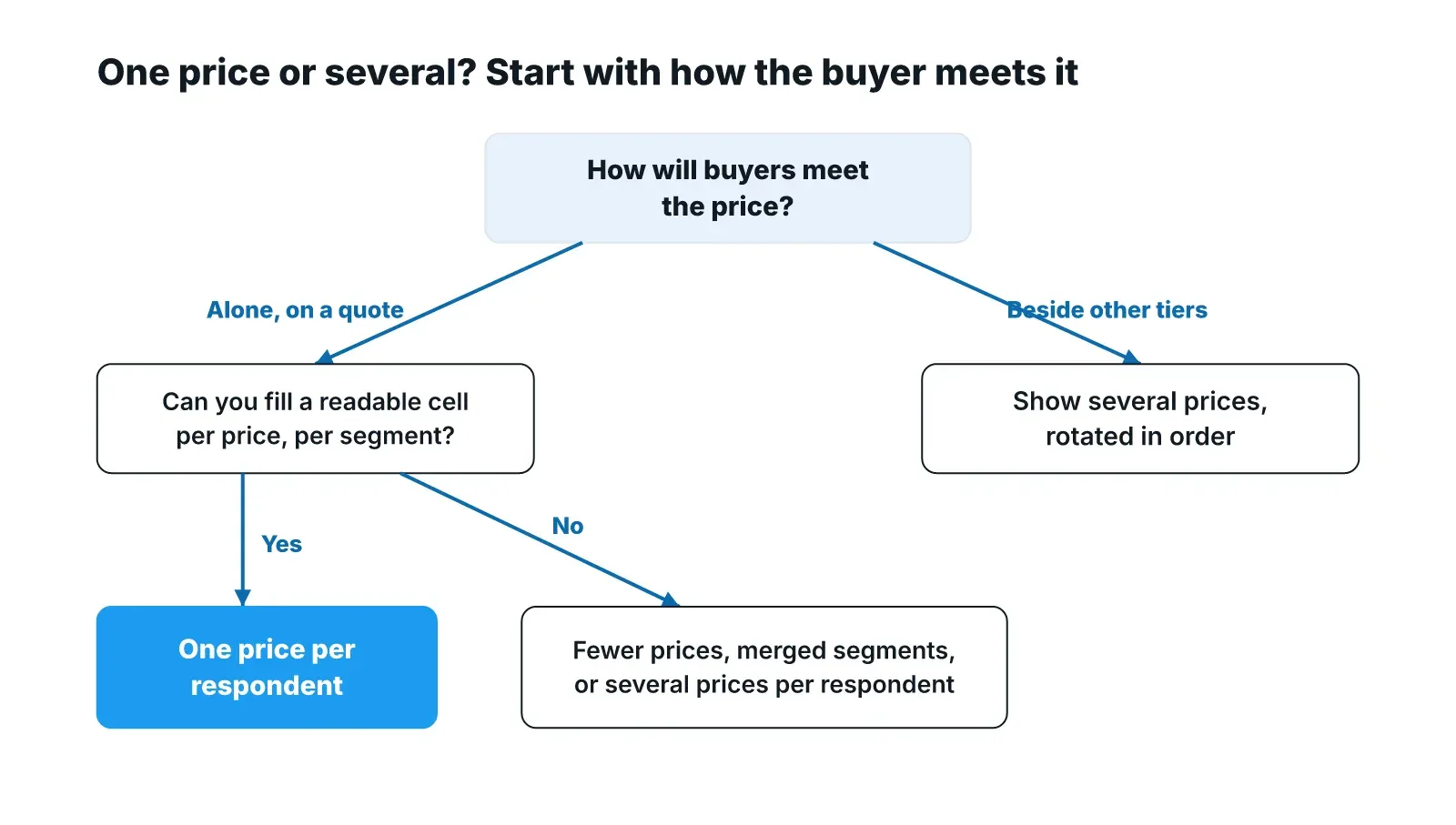
Monadic cells win on clean first reactions and on realism for a single quoted price. Several prices per respondent win on sample efficiency and on realism for a visible price list. The table sets the two side by side on the questions a steering committee will ask before it accepts the result.
| Dimension | One price per respondent | Several prices per respondent |
|---|---|---|
| Decision it fits | Setting the price of one offer | Choosing among tiers or narrowing a range |
| Sample needed | A readable base per price, per segment | Fewer respondents for the same number of prices |
| Anchoring between tested prices | None | Present; rotation spreads it |
| Realism | Close to a quote or a single shelf price | Close to a pricing page with tiers |
| Output | Intent at each price, compared across cells | A reaction to every price from each respondent |
| Enterprise example | Launch price for one product line; renewal price for an installed base, read by contract size | A tier page that self-serve buyers see all at once |
Four conditions inside a large organization tip the choice: the number of cells that segments and markets create, several business units sharing one study, the questions procurement and legal ask, and the channel the price will live in. Each can make a monadic design impractical, or make it the only design a committee will accept.
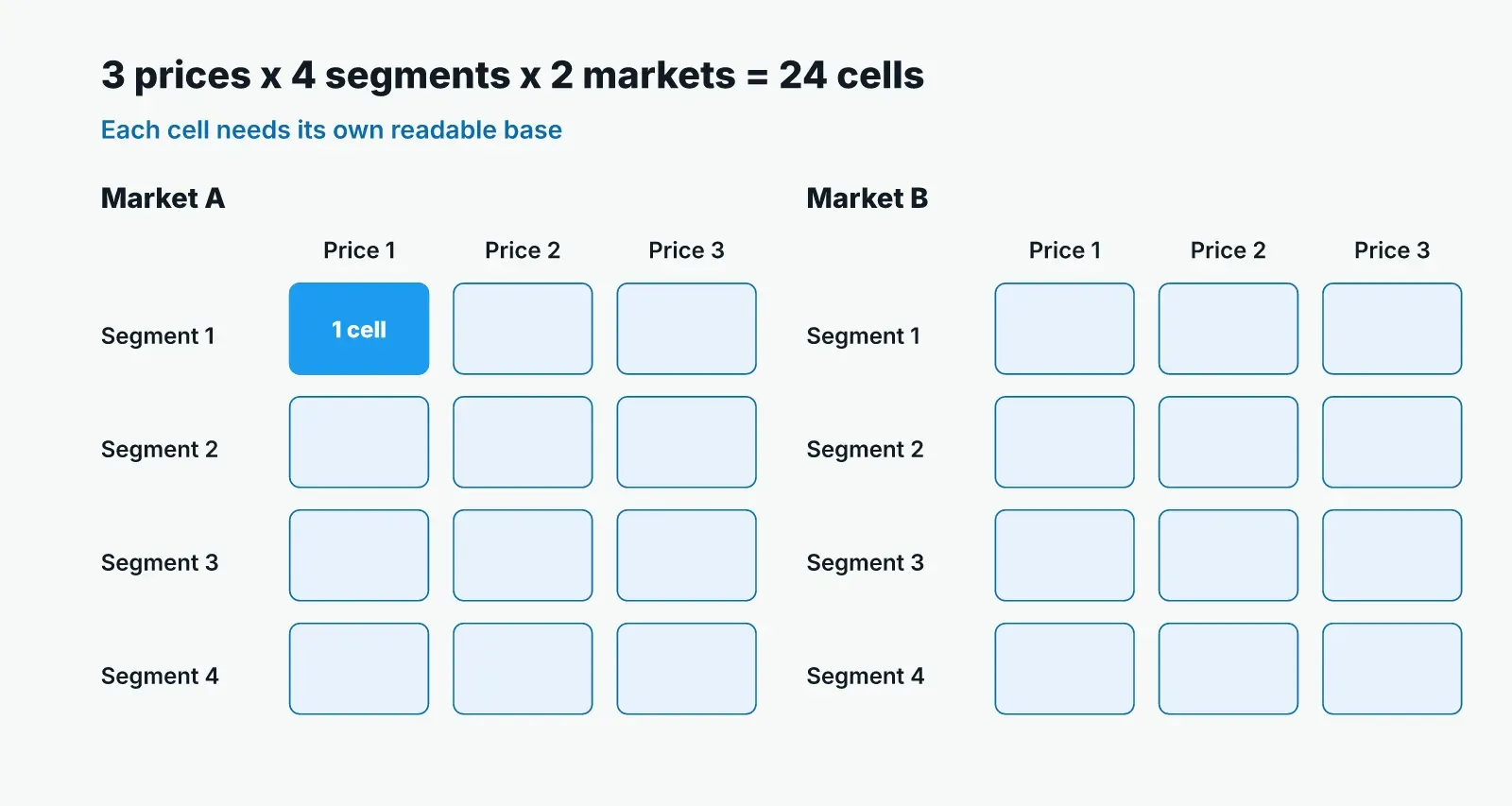
Three prices across four segments and two markets is 24 cells, and each needs a base large enough to read. If that sample is out of reach, test fewer prices, merge segments that behave alike, or use a multi-price design and record the trade-off in the brief.
When two business units share a study, every cell must show the same concept card and use the same outcome measure. Otherwise the cells cannot be compared across units.
Stakeholders outside research often ask whether customers were shown different prices. A survey cell is a hypothetical offer to a respondent, and the brief should say that in plain words.
A sales-led enterprise quote is close to monadic exposure, because the buyer sees one number. A self-serve pricing page is close to seeing every price. Match the design to the channel.
A monadic result tells you purchase intent fell between two prices. It does not tell you whether budget, a cheaper alternative or doubt about value explains the drop. Add one open question or a short interview after the price in each cell, asked the same way in every cell, and read the reasons cell by cell.
Pulse runs surveys alongside AI-moderated voice interviews that ask a follow-up when an answer is vague, and traces each theme to its transcript, so the reason for a drop sits next to the cell result.
A reason that appears only in the higher-price cells is the explanation for the threshold. It also tells the pricing team what would have to change for buyers to accept the higher price.
A monadic price test measures reactions to a hypothetical offer, and nobody is charged a different price. Live price variation, where real customers pay different amounts for the same item, is a separate exercise with separate exposure, because customers and investigators can detect it and report it. Keep the research cell inside the questionnaire.
In an investigation published in December 2025, Consumer Reports and Groundwork Collaborative had 437 volunteers shop simultaneously in September and found that some grocery prices on Instacart differed by as much as 23 percent per item from one customer to the next. A survey cell carries none of that exposure, because the price exists only inside the survey.
Use a monadic design when you are pricing a single offer that buyers will meet alone and you can fill a readable cell for each price in each segment. Use price laddering, where each respondent reacts to several prices, when buyers will see a price list in real life or the sample is too small for separate cells.
It depends on the smallest difference in purchase intent you need to detect, how much answers vary, and how many segments you will read separately. Each segment you report needs its own readable base in every cell. A sample size calculator turns those inputs into a number for your study.
Interviews explain the reaction to a price: the budget behind it, the alternative the buyer had in mind, the doubt about value. The cell comparison measures how large that reaction is across a market. Pulse runs both, so the measure and the explanation come back together.
Sampling bias enters an interview study at the recruit source, the screener, the incentive and the calendar. Here are the checks to run first.
Build an empathy map from interview transcripts so every note points to a real quote. What goes in each quadrant, and how to label your guesses.
Purposive sampling picks B2B participants on purpose. Set criteria tied to the decision and explain the choice to stakeholders who expect random.