6 reasons a user research repository goes unused
Why a user research repository goes unused after launch, and six habits that bring product teams back to check it before new research.
Plan a customer feedback survey where every low score points to one part of the experience and the team that can fix it, then turn results into fixes.
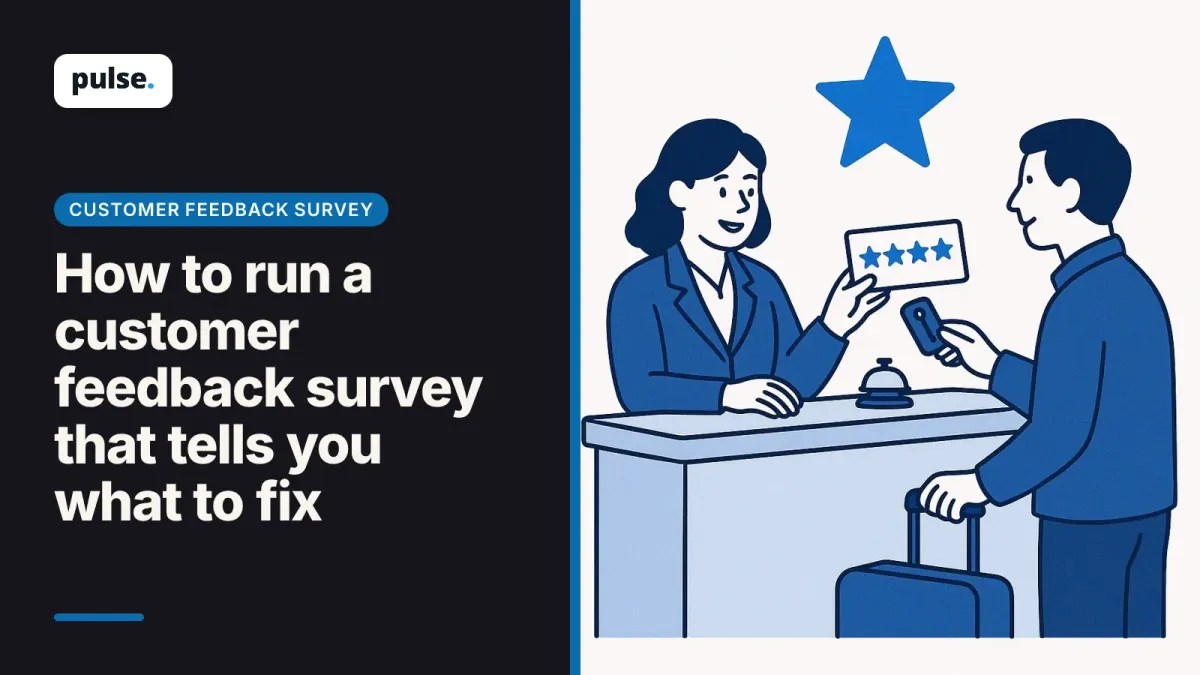
Your team just sent a survey to guests after their hotel stays. The average score looks fine. But nobody can tell the front desk or the cleaning team what to change. So what should the survey have asked?
That set of questions is a customer feedback survey, and how you build it decides what you get back.
Ask about each part of the stay that one team owns. Send it while the stay is fresh, and ask what happened after a low score. That way, each low score lands with the team that can fix it.
You can do this in four steps: plan the survey from the fixes, write questions that point to one team, send it while guests remember, and read the results one stage at a time.
An overall "How was your stay?" score can drop, and still nobody knows which team should act. So plan the survey from the other end. Start with the changes your teams could make, then write one question for each part of the stay.
A stay has a few stages a guest would recognize, and each stage has a team that owns it. The table shows who owns each stage and what that team could change if its score drops.
| Stage of the stay | Team that owns it | What that team could change |
|---|---|---|
| Booking | Reservations team | The booking page, the confirmation email, how room types are described |
| Arrival and check-in | Front desk | Staff on the desk at busy hours, how fast rooms are ready, key cards |
| The room | Cleaning team and maintenance team | Cleaning checks, repairs, which rooms are given out first |
| Breakfast | Restaurant team | Opening hours, the food on offer, how long guests wait for a table |
| Checkout | Front desk | Mistakes on the bill, how long checkout takes |
Then test every question against one rule. If a low answer would not lead to a change someone can make, cut the question.
Say your survey asks "How satisfied were you with your stay?" A low answer tells you that something went wrong. "How easy was it to check in?" tells the front desk manager that it went wrong at their desk, so only the second question starts a fix.
This matters more as a hotel chain grows. When every hotel asks about the same stages in the same words, head office can compare one hotel's check-in with another's.
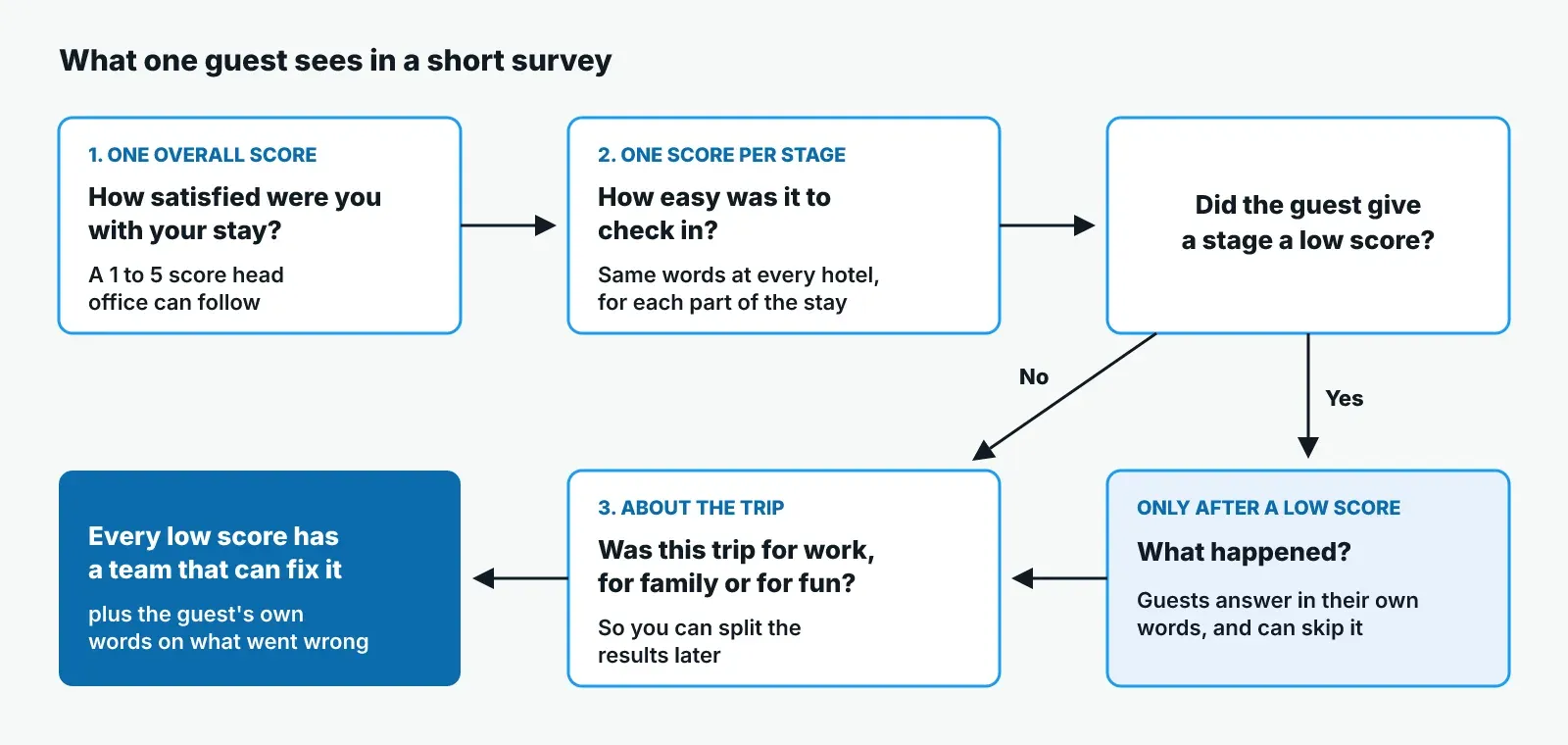
Long surveys full of vague questions get vague answers, because guests get tired and click through. So keep the survey short: one question per stage, plus a few that help you read the results.
Head office will want one number to follow across hotels, so start with an overall score. Often this is a satisfaction score, such as "How satisfied were you with your stay?" on a scale from 1 to 5. Some teams use the "How likely are you to recommend us?" question instead, scored from 0 to 10, which is called the Net Promoter Score (NPS).
Next, ask one score for each stage, in the same words at every hotel, such as "How easy was it to check in?". These are the questions that give every low score an owner.
When a guest gives a stage a low score, ask one open question: "What happened?" The guest types the answer in their own words, so you hear the problem as they lived it. Show this question only after a low score, so guests who had a good stay finish quickly. Survey tools call this skip logic, which means the next question depends on the last answer.
Add one question about the trip, such as "Was this trip for work, for family or for fun?" Work guests and families need different things from the front desk, so this question lets you split the results later.
Some questions look fine and still hide the fix. The table shows three common mistakes, a better version of each and the team the better version helps.
| Mistake | Weak question | Better question | Team it helps |
|---|---|---|---|
| Two things in one question | "Was your room clean and quiet?" | "How clean was your room when you arrived?" and, as a separate question, "How quiet was your room at night?" | Cleaning team for the first, maintenance team for the second |
| Wording that leads the guest | "How much did you enjoy our breakfast?" | "How would you rate breakfast?" | Restaurant team |
| Forcing every answer | Every guest must explain every score before they can finish | "What happened?" shown only after a low check-in score, and guests can skip it | Front desk |
If you want more wording to start from, this list of more feedback question ideas works for a hotel once you swap in the stages of a stay.
A survey that arrives a week after checkout asks about a stay the guest half remembers. So send it within a day of checkout, while the wait at the desk or the noise at night is still clear.
For long stays, add a one-question check during the stay. Say a guest is staying five nights for work. A short message on the second morning asking "How is your room so far?" lets the maintenance team fix a broken air conditioner while the guest is still there.
Send the survey where the guest already hears from you, such as email, a text message or the booking app. And limit how often one guest is asked, because a frequent guest who gets a survey after every stay soon ignores it.
Keep in mind who answers. Guests who had a very good stay or a very bad one are often more likely to reply than guests who felt fine. So use the results to see where to look, because they can't tell you how every guest felt. Pushing for more replies won't change that on its own, since more finished surveys don't mean better answers.
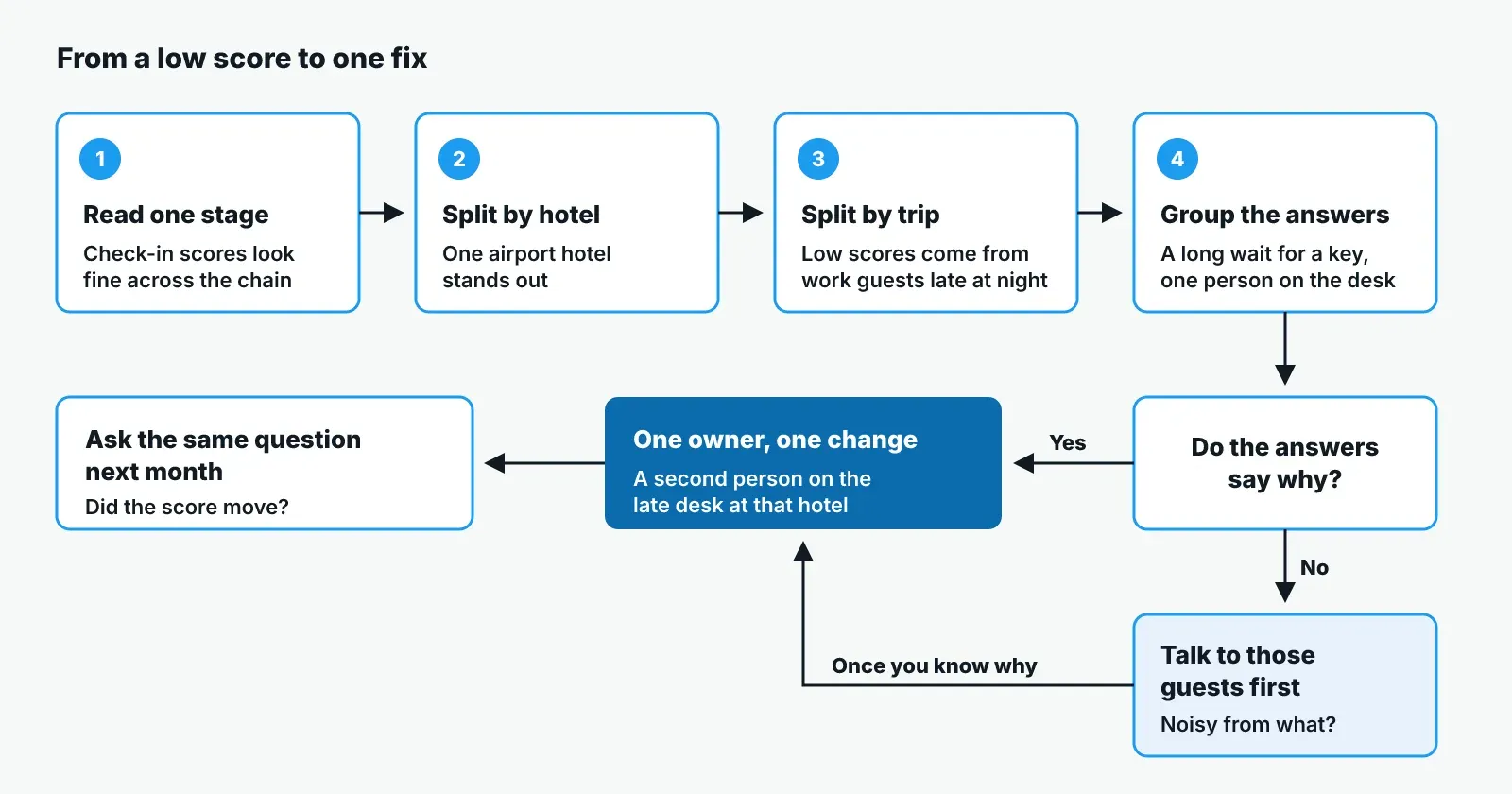
An average across every hotel hides problems, because one slow check-in desk disappears inside the chain's average. So read the results one stage at a time. Then split each stage by hotel and by type of trip, and look for the places where low scores bunch together.
Suppose check-in scores look fine across the chain. Split them by hotel, and one airport hotel stands out. Split that hotel by type of trip, and the low scores come from work guests who arrived late at night. Now the front desk manager at that hotel has a clear question to answer: who is on the desk late in the evening?
Next, read the "What happened?" answers for that stage and group the ones that say the same thing. Answers about a long wait for a key and answers about one person on the desk belong in the same group. Researchers call these groups themes, and a theme is one reason that comes up again and again.
Then turn each theme into one owner, one change and the same question asked again next month, word for word. If the airport hotel adds a second person to the late desk, next month's score for late arrivals shows whether anything moved. Where you can, tell guests what changed.
A score without an owner is a number nobody acts on.
Sometimes the typed answers don't say why a stage scores low. Suppose the room stage scores low at a city hotel, and most answers say "noisy". Noisy from the street, the air conditioning or the room next door? Each one needs a different fix, from new windows to a repair to a change in which rooms are given out first.
Typed answers tend to stop at the first reason, because nobody is there to ask "Noisy from what?". A short conversation with some of those guests can ask that question and find the cause.
Earlier posts explain why typed answers stop at the first reason and why a score needs a conversation behind it. If your overall score is the 0 to 10 recommend question, you can turn low recommend scores into real reasons the same way.
If a low score points to one stage and the guests' words say what went wrong, give it to that team and ask the same question next month. If it points to a stage but you can't say why, talk to those guests before you change anything.
Talking to guests takes the longest, because each call needs a time that suits the guest. Pulse runs surveys alongside AI-moderated interviews, so the score and the reason behind it come from one study.
You can upload your own guest list or share a link, and guests answer on a phone or laptop with no call to schedule. When an answer is vague, such as "noisy", the AI moderator asks a second question. Every theme carries the quotes behind it, and each quote links to the transcript it came from.
Your team still decides what to ask and which fix to make, and Pulse brings back the reasons to decide with. If you'd like to see it on your own guest survey, book a demo.
A customer feedback survey is a short set of questions you send to customers after they use your product or service. For a hotel, that means guests after a stay. A single satisfaction score tells you how a guest felt overall, while a good feedback survey also shows which part of the stay went wrong and who can fix it.
Good questions ask about one part of the experience at a time, in plain words. For a hotel, that could be "How easy was it to check in?", "How clean was your room when you arrived?" and "How would you rate breakfast?". After a low score, add "What happened?" so the guest can explain in their own words.
CSAT stands for customer satisfaction score. A CSAT survey asks one question, such as "How satisfied were you with your check-in?", on a scale from 1 (very unsatisfied) to 5 (very satisfied). The score is usually the share of people who chose 4 or 5. Asking it for each stage of a stay shows where satisfaction drops.
They show where the experience goes wrong in places you can't watch yourself, because a hotel chain can't stand at every check-in desk. A survey asked in the same words at every hotel shows which stage and which hotel need attention first. So each team knows what to fix, and can check next month whether the fix worked.
Why a user research repository goes unused after launch, and six habits that bring product teams back to check it before new research.
Customer exit interviews find the reason behind 'too expensive'. When to reach people who cancelled, how to invite them and how to turn answers into fixes.
Data collection methods compared: what surveys, interviews, observation and records each tell you, and three checks to pick the right one for you.