When a concept test says yes and the launch still fails
Concept test results overstate demand when a yes costs the respondent nothing. How to read them, what to check before launch, and what to ask after.
Map the B2B buyer research process by interviewing each buying committee role about the same purchase, then reconcile what each of them saw.
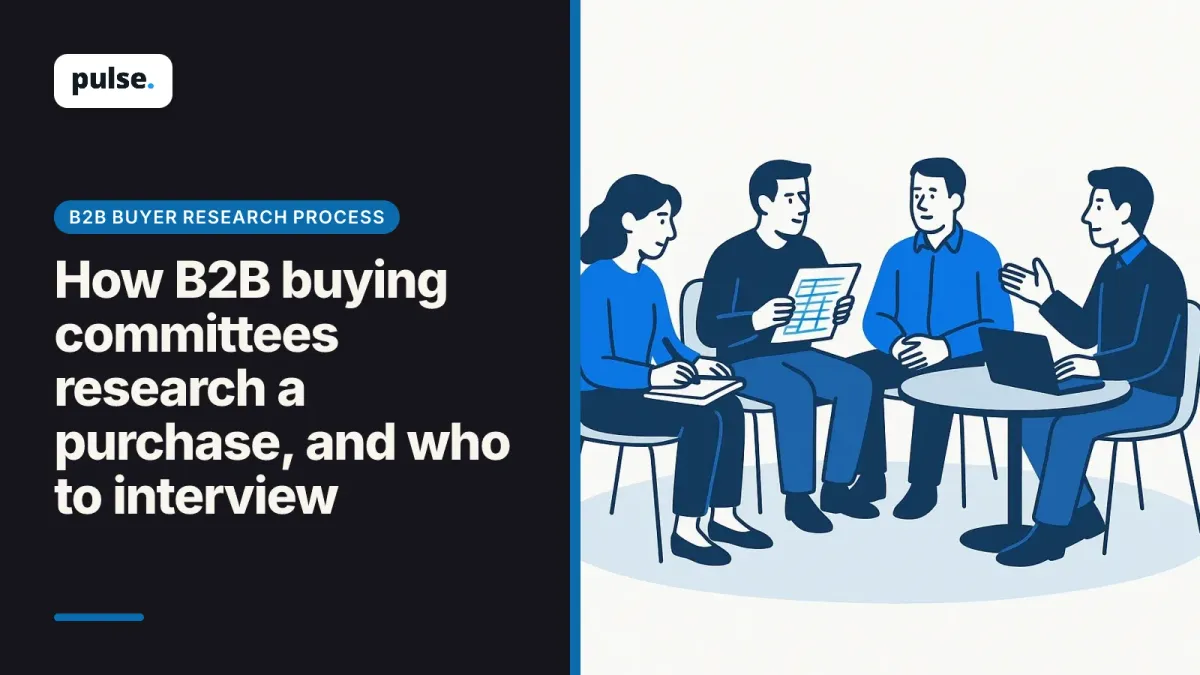
Illustrative example: a client's champion tells you they bought for the features. Then the CFO who signed says it was the contract terms. The B2B buyer research process runs across a whole group of people. So study one purchase at a time. Interview every role that shaped it, and treat the gaps between their stories as the finding.
Below, you'll find who to recruit, what to ask each person and how to read their stories side by side.
The B2B buyer journey is the seller's name for the stages a business buyer goes through. It runs from spotting a problem to signing and rolling out. The buying process is the same purchase seen from inside the buyer's company. It shows who did the work at each stage, what proof each person needed and where they disagreed.
A buying committee is the group of people who shape one purchase. Each wants a different proof: a business case, a technical fit or terms that pass review. So the inside view lives in several heads at once.
Asking only the champion is a bit like reviewing a film after the first half hour. You'll get the setup right and miss the ending.
Most purchases pass through the same broad stages. The order varies, and some stages repeat:
Each stage has a different owner, who often knows little about the next one. The table shows what each role owned, what only they can tell you and where their view stops.
| Role | What they owned | What only they can tell you | Where their view stops |
|---|---|---|---|
| Champion | The problem and the case for change | Why the search started, and who they had to win over | Reviews they did not sit in |
| Economic buyer | The budget and the final yes | What the purchase had to prove, and the cost of doing nothing | How the shortlist was built |
| Evaluator | Testing fit against the criteria | How the shortlist was cut, and which criteria were real | The business case |
| End user | Daily use after the purchase | What they were asked, and what they ignored | Why the money moved |
| Procurement | Terms and the vendor process | The terms that nearly broke the deal | What the product does day to day |
| Legal or security | Risk sign-off | Which reviews added time, and why | The pressure behind the deadline |
| The person who argued against | The objection | What the other option offered, and what would have changed their mind | How the final trade-off was made |
The economic buyer is the person who controls the budget. The evaluator is the person who tests whether the product fits.
For illustration, take a large insurer buying claims software. The claims director championed it. Procurement rewrote the liability terms. Only the claims director can say why the search began. Only the procurement lead can say which clause held up the contract.
Every company builds its group a little differently, so ask the champion who was involved.
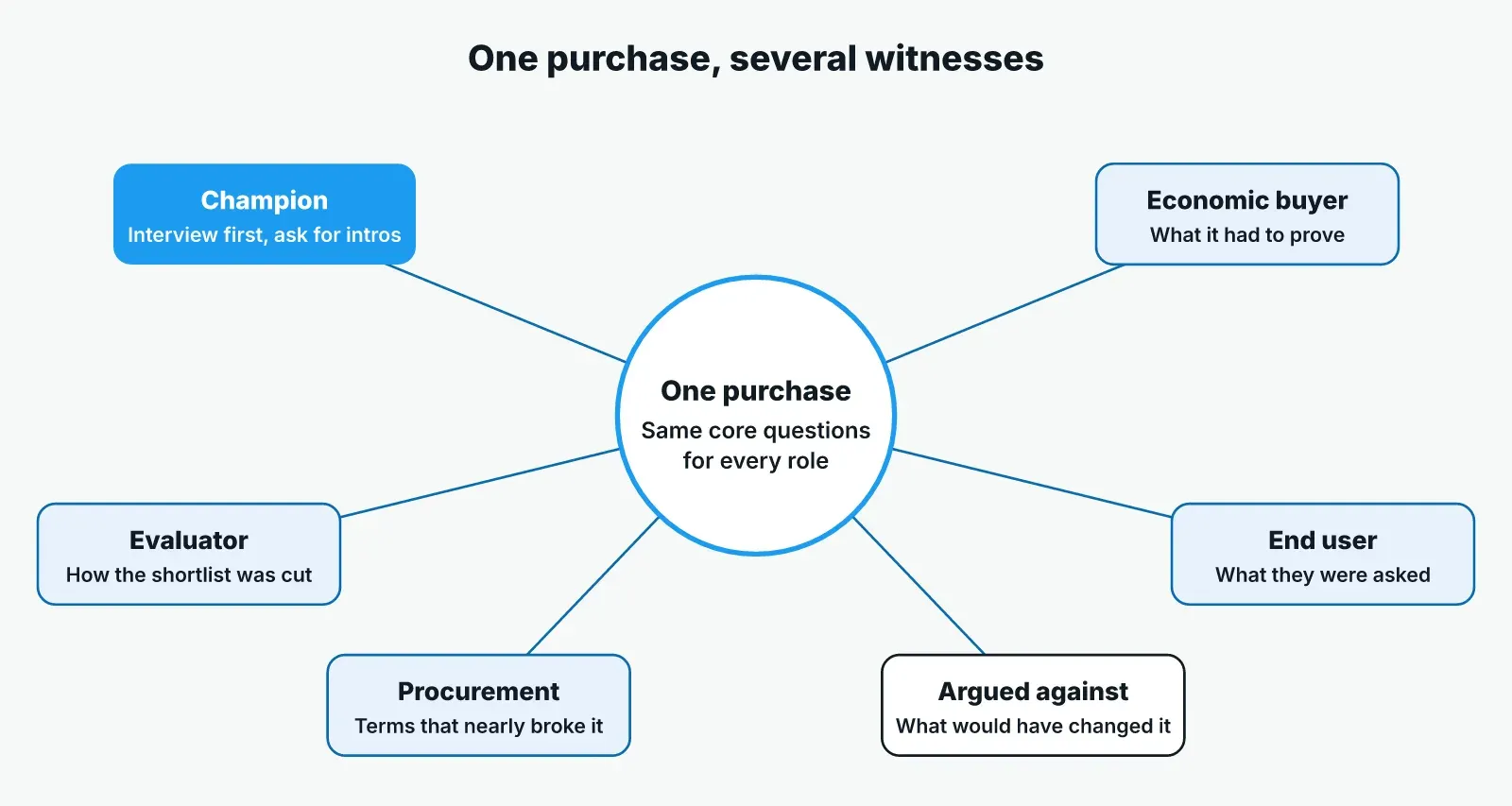
Recruit by purchase. Start with the champion, ask for introductions and give every role the same core questions. Then add a short block about each person's part, and make the interview easy to fit into a busy week.
First, agree the rules with the person who owns the account on your side. They sign off on who you contact. There's no selling and no sales follow-up. Each person agrees to the recording and to any quote being used. And no one's answers reach their colleagues in a form that names them.
These rules protect the relationship, and that's what gets you the next introduction.
The champion can name the other people involved and the moments that mattered. At the end, ask who else you should speak to and whether they'll introduce you. Then your request comes from someone the others already know.
Deals you won show the argument that won. Deals that went elsewhere or stalled show the objection that carried the room. The person who argued against may be easier to reach once the decision has passed. Find them through your CRM and the account team.
These follow the purchase from start to finish, so the answers line up when you compare them:
Here's a before and after. "Why did you choose us?" invites a polite summary. "What started this, and who was involved when?" gets the order of events, which you can check against the next person's story. For the structure around these questions, see how to structure an interview guide.
The role block goes deeper where only that person saw the work. Ask the economic buyer about the business case and the cost of doing nothing. Ask the evaluator how the criteria were set. Ask the end user what they were asked about. Ask procurement and legal which terms and reviews added time.
Then ask every role for documents, such as the evaluation spreadsheet or the email that moved the decision. Memory blurs after a few months. A dated document pins down the order of events.
Ask what happened before you say what a colleague told you. And watch for leading questions and other interviewer bias.
Five people at one account have five calendars, so a study can stall before anyone says no. An asynchronous interview is one the person completes when it suits them, so nobody needs a shared hour. Keep a live slot for the economic buyer if they prefer one. Formats can differ, as long as the core questions stay the same.
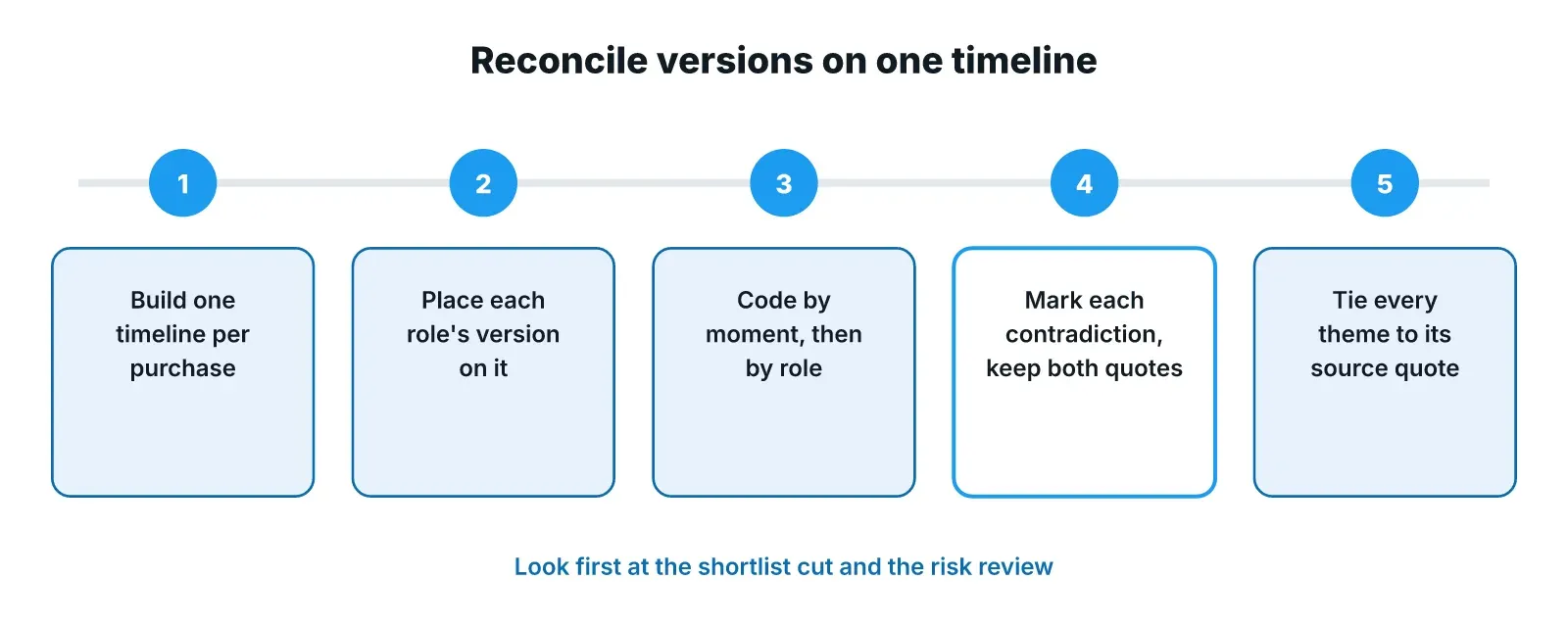
Lay each purchase out as a timeline, and place every role's story on it. Where stories clash, you see how the decision was made. So keep both versions. The champion's reason and procurement's reason can both be true from where each person sat.
Start from the champion's interview and the documents. Mark the trigger, the shortlist, the risk checks, the terms review and the signature. Add a date to each one where you have it.
Put what each person said about each moment beside that moment. Leave gaps empty. A blank cell for the end user at the shortlist stage means nobody asked them.
To code the transcripts means to tag each passage with a short label, so you can group like with like. Tag by the moment in the decision first, then by role. That way you see which role owned which step.
When two people disagree about the same moment, put both quotes side by side. Look first at the shortlist cut and the risk checks. In many purchases, those are the stages where roles see the least of each other's work.
Before anyone acts on a theme, they should be able to click through to the words behind it. Auditing themes back to the exact quote shows how to run that check.
Illustrative example: the insights team at a large payments provider wants to know why mid-size retailers moved their card payouts to it last year. Product thinks it was the integration. Sales thinks it was price. Next year's roadmap depends on who's right.
The team has three options, and each one answers a different question.
| Option | What it can tell you | What it can't tell you |
|---|---|---|
| Survey of retailers that switched | How common each stated reason is | How the reasons worked together in one decision |
| Champion interviews at many retailers | The story of the problem, told many times | What happened in reviews the champion missed |
| Group interviews at a few retailers | How the decision moved from role to role | How common that pattern is across all retailers |
The question is how the decision got made, so the team picks group interviews. At each retailer it talks to the finance lead who championed the switch and the CFO who signed. It adds the IT lead who ran the integration review and a store manager who reads the payout reports. It also adds two retailers that looked at the provider and stayed put.
Now suppose the CFO credits the pricing terms, while the IT lead credits the integration review. Read together, the stories suggest the CFO only saw providers that had already passed IT. Integration was the gate, and price picked between the two that got through. So the product team would share integration documents earlier in a deal and save pricing work for the end.
A study like this asks a lot of busy people. Five roles need the same core questions, plus a follow-up when an answer is thin. Pulse runs that fieldwork through AI-moderated voice interviews. Your time goes to picking the purchases and reading the clashes.
It also takes the calendar puzzle off your plate. Each person takes the interview by opening a link on a phone or laptop, so there are no calls to schedule. Every interview arrives as a full transcript alongside its recording. That makes it easy to put the CFO's story and the IT lead's on the same timeline.
Recruiting follows the purchase. You can invite your own customers from a list you upload, such as the people the champion introduced. For buyers outside your accounts, have participants recruited to the profile your brief describes. Every participant goes through fraud checks.
Here's the rule to work by. If your question is how a decision got made, interview the whole group for a few purchases. If your question is how common a pattern is, run those interviews first. Then survey, in the words buyers used.
To see how a study like this runs, book a walkthrough.
The buying experience covers everything up to the signature, from the search to the talks on terms. The customer experience starts after it, with onboarding and daily use. The end user's story links the two, because they judge the purchase by what came after.
Interview every role that shaped the decision you're studying. The champion can usually name them. Keep adding people until a new interview stops changing the timeline for that purchase. No fixed number fits every study.
Ask for their reasoning, and start with what they were trying to protect. That might be a budget, a team or a system that worked. Then ask what the other option offered and what would have changed their mind. Tell them at the start that their answers stay unnamed inside their own company. That promise is what makes an honest answer possible.
Concept test results overstate demand when a yes costs the respondent nothing. How to read them, what to check before launch, and what to ask after.
How do AI interviews work in customer research? Follow one session from screener to follow-up question to a theme traced to its transcript.
Jobs to be done research gets harder when one account has many roles and business units. How to recruit, interview and merge jobs across them.