Participant recruitment methods: 5 ways to find people
Participant recruitment methods compared by who you need: your own list, panels, referrals, networks and recruiters, plus a check before you set a date.
How to use AI in market research: where it helps at each stage of a study, what studies of AI-led interviews show, and what researchers still decide.

"Can AI help us do this faster?" Your manager asks this about the next guest study. You work on the research team at a hotel chain. The study asks why some guests stay once and never book again. So where in that study can AI really help?
That question is about using AI in market research. It means letting software do some of the slow work inside a study.
AI helps most with the slow jobs. It can draft the questions, run many interviews at once and sort the answers into themes. Your team still picks the question, checks each theme against what guests said, and decides what to do.
Here is how that works at each stage of the hotel study.
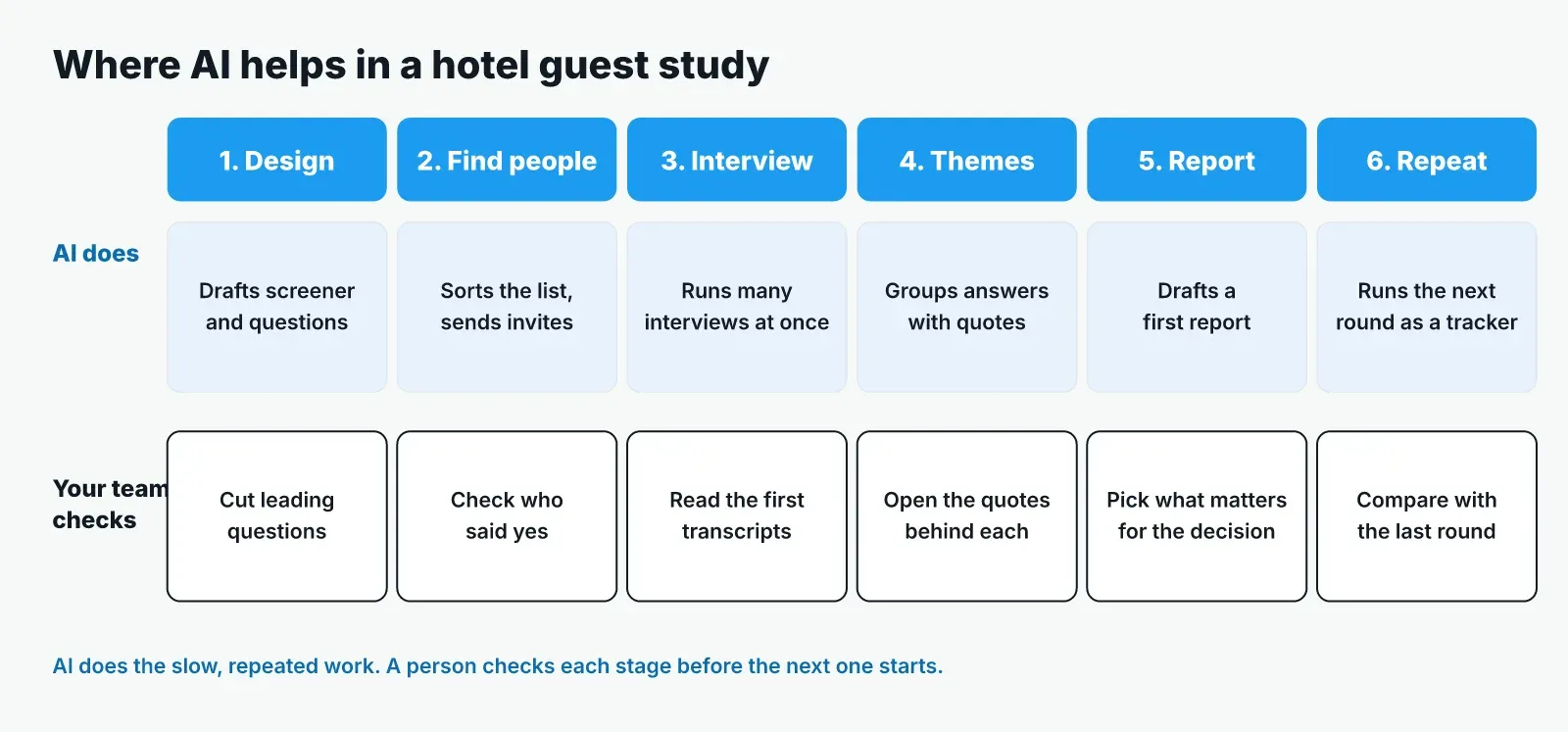
AI can help at every stage of a market research study. It drafts the questions, finds and screens people, runs interviews, sorts answers into themes, writes a first report and repeats the study later. At each stage, a person on your team checks the work.
You start with the business question: why do some guests not come back? You add who to talk to and what to cover. From that, AI can draft a screener and a discussion guide. A screener is a short quiz that checks someone fits the study. A discussion guide is the list of questions for each interview.
Then you edit the draft. Cut any question that pushes guests toward an answer. Check that every question links back to the decision.
AI can sort a long guest list by the traits you set. For the hotel, that might be guests who stayed once in the past year. It can also send invites and reminders. You check that the people who said yes match the people you need.
AI can run many interviews at the same time. Guests answer when it suits them, on a phone or a laptop. You read the first few transcripts early. If a question confuses people, you fix it before the rest start.
AI groups what guests said into themes, such as "the room felt noisy" or "the price went up at checkout". Each theme should come with the quotes behind it. You read those quotes before you trust the theme.
AI can draft a first report from the themes. You decide which findings matter for the decision and which are just interesting.
A tracker asks the same questions again every few months. AI makes each round faster to run. You compare each round with the last, so a change stands out.
Early studies suggest AI-moderated interviews can match human ones on depth, but the evidence is still small. An AI-moderated interview is one where software asks the questions from one guide, listens, and asks a second question when an answer is vague. So every person gets the same well-asked questions.
Researchers have started to test this. In a 2026 study from arXiv, 41 university students were picked at random for a chat interview. Some were interviewed by trained people, and some by an AI. The AI interviews drew about 65% more text from each person. Answers to single questions were a little longer with people, but that gap was not clear once the authors checked it properly. Only people in the AI group skipped questions.
That is one small study of students, so treat it as a signal, not proof.
A second 2026 study was run with three companies. People were picked at random for an AI-moderated interview (139 people), a fixed list of questions (154 people) or an interview with a trained moderator (24 people). The authors found AI matched the human moderators on depth and found more of what customers need. People did seem more emotionally engaged with the human moderator.
So for the hotel study, AI interviews are a fair way to hear from many guests. The post on AI-moderated and human-moderated interviews compares the two in more detail.
You check AI findings the same way you check any research: by going back to what people said. Every theme should link to the quotes behind it. Every quote should link to its full interview. If a theme has no quotes you can open, don't build a decision on it.
Say the AI report from the hotel study says "guests felt the price was unfair". Open the quotes. Maybe most guests talk about a surprise fee at checkout, and not the room rate. That changes the fix. The post on checking AI themes against the exact quotes shows how to do this step by step.
Two more habits help: run surveys and interviews together, and repeat the study as a tracker.
First, run a short survey beside the interviews. Interviews tell you why guests leave. A survey tells you how many feel the same way. If the checkout fee comes up in interviews, the survey shows how common it is.
Second, repeat the study as a tracker. When the next round runs, compare it with the first. If complaints about the fee drop after the hotel changes its pricing, you can see it.
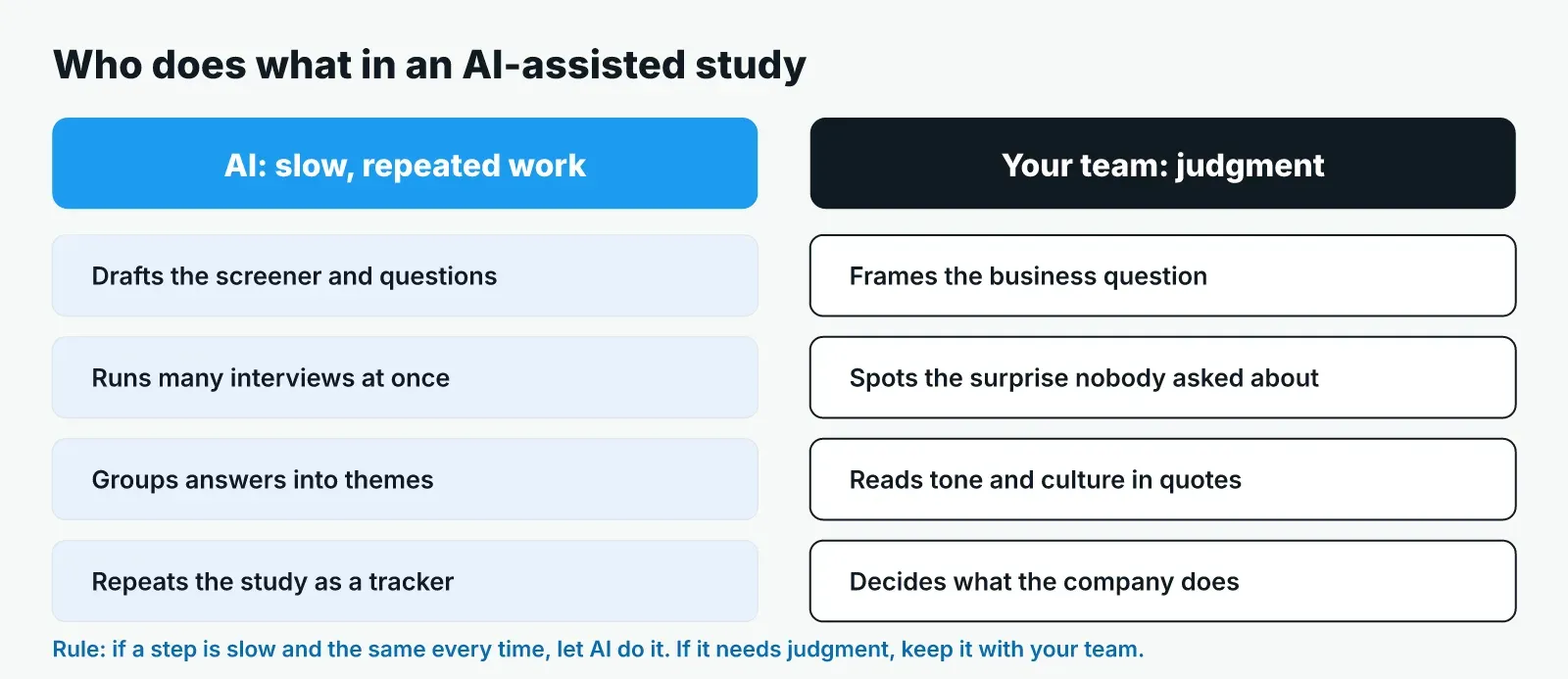
AI can do the slow, repeated work, but some parts of a study need a person. Your team frames the question, spots the answer nobody expected, reads tone and culture, and decides what the company should do. That split lets the team spend its time on the parts that need judgment.
AI drafts from the question you give it. If the question is wrong, every answer will be about the wrong thing. "Why don't guests come back?" is a better start than "Do guests like our rooms?"
Sometimes the real finding is off the script. A few guests might say they stopped booking because the loyalty app logged them out. Nobody asked about that. A person on your team notices it matters.
Guests from different countries say things in different ways. Some joke when they complain, and some stay polite when they are upset. Your team reads the quote in context before trusting the theme.
The study tells you what guests said. Someone still has to choose: change the fee, fix the app, or test both. That choice belongs to your team.
So here is a simple rule for the hotel study. If a step is slow and the same every time, let AI do it. If a step needs judgment about what matters, keep it with your team.
The hotel study needs many guest interviews, fast, with every theme easy to check. Pulse builds the interview from your brief, and you can review and edit the questions before it starts. It runs AI-moderated interviews that guests take on a phone or laptop, with no calls to schedule. The AI moderator builds follow-up questions on what a guest said earlier, and asks a second question when an answer is vague.
A survey can run in the same study, so you get the reasons and the counts together. Each theme comes with its quotes, and every quote links to its transcript. The report builds as each interview finishes, ready minutes after the last one. Findings stay in the Insights library, which you can search across studies, and a tracker repeats the study over time. One study can also run across several markets, in 240+ languages enabled on request.
To try it, start on the $0 Explorer plan or ask for a free study. Or book a demo to see Pulse run a study like the hotel one.
AI can reduce one kind of bias: interviewer bias. That is when different interviewers ask the same question in different ways, or lead people toward an answer. An AI moderator asks every person the same questions from one guide. But AI can't fix a biased sample or a leading question you wrote, so your team still checks both.
Most researchers expect AI to change their work, not take it. In a 2025 survey by MRII of 426 market researchers around the world, 71% said AI will improve their job in the coming years. The parts that need judgment, like framing the question and making the call, stay with people.
Let AI run the interviews and do the first sort into themes. Then the team spends its time on the brief at the start and the decision at the end. Many interviews can run at once, so the number of interviews no longer depends on how many people can sit in on calls.
Pick a study your team has run before, such as a guest exit study or a brand check. You already know roughly what people said last time. So you can compare the AI-run study with the old one and see where it matches, and where it finds something new.
Participant recruitment methods compared by who you need: your own list, panels, referrals, networks and recruiters, plus a check before you set a date.
Semantic vs latent themes, from Braun and Clarke's paper "Using thematic analysis in psychology", shown on real-life quotes, with when to use each.
How to choose a transcription service for research interviews: test each option on your own audio with five simple checks, from accuracy to data safety.