Participant recruitment methods: 5 ways to find people
Participant recruitment methods compared by who you need: your own list, panels, referrals, networks and recruiters, plus a check before you set a date.
How to use WhatsApp for market research: when it fits, how to invite customers they trust, which interview format to use and how to protect privacy.

Imagine you work at an energy supplier company. After every meter visit, your team emails customers a short survey. Hardly anyone in the smaller towns replies. Yet the same customers message the company on WhatsApp within minutes when the power goes out. So could you talk to them there instead?
That idea is WhatsApp market research. It means asking customers your research questions on WhatsApp, the app they already use, rather than by email.
WhatsApp works well for research when your customers already talk to you there. Send the invite from the business number they know, and say who you are and why you're asking. Ask permission first. Then pick a format: a short text chat, voice notes, or a link to a full voice or video interview. Ask everyone the same questions, so you can compare the answers.
The energy supplier's study shows how each step works.
Use WhatsApp for market research when your customers already message you there and answer it faster than email. It suits short interviews, quick follow-ups after a service visit, and people who prefer their own language. For long sessions or material that needs a big screen, send a link to a full interview instead.
For the energy supplier, the signs are clear. Customers in smaller towns ignore the email survey, but they report power cuts on WhatsApp. So WhatsApp is where they will answer a question about the last meter visit.
There's one catch to know about first. When people search for "WhatsApp interviews", most results are about job interviews, and many warn about job scams. So customers have learned to be careful with unknown messages. In this post, WhatsApp interviews means research interviews with customers, not hiring. Your invite has to make that plain from the first line.
WhatsApp is a weaker fit in two cases. If you need to show a long video or a detailed design, the phone screen is small. And if your customers rarely use WhatsApp, an invite there will feel odd. In both cases, email or a link to a full interview works better.
Invite customers from the company's verified business number on WhatsApp, the one they already know. In two or three lines, say who you are, why you're asking and how long it takes. Say what they get for it, too. That thank-you gift is called an incentive. Only message people who agreed to hear from you there, and give them an easy way to say no.
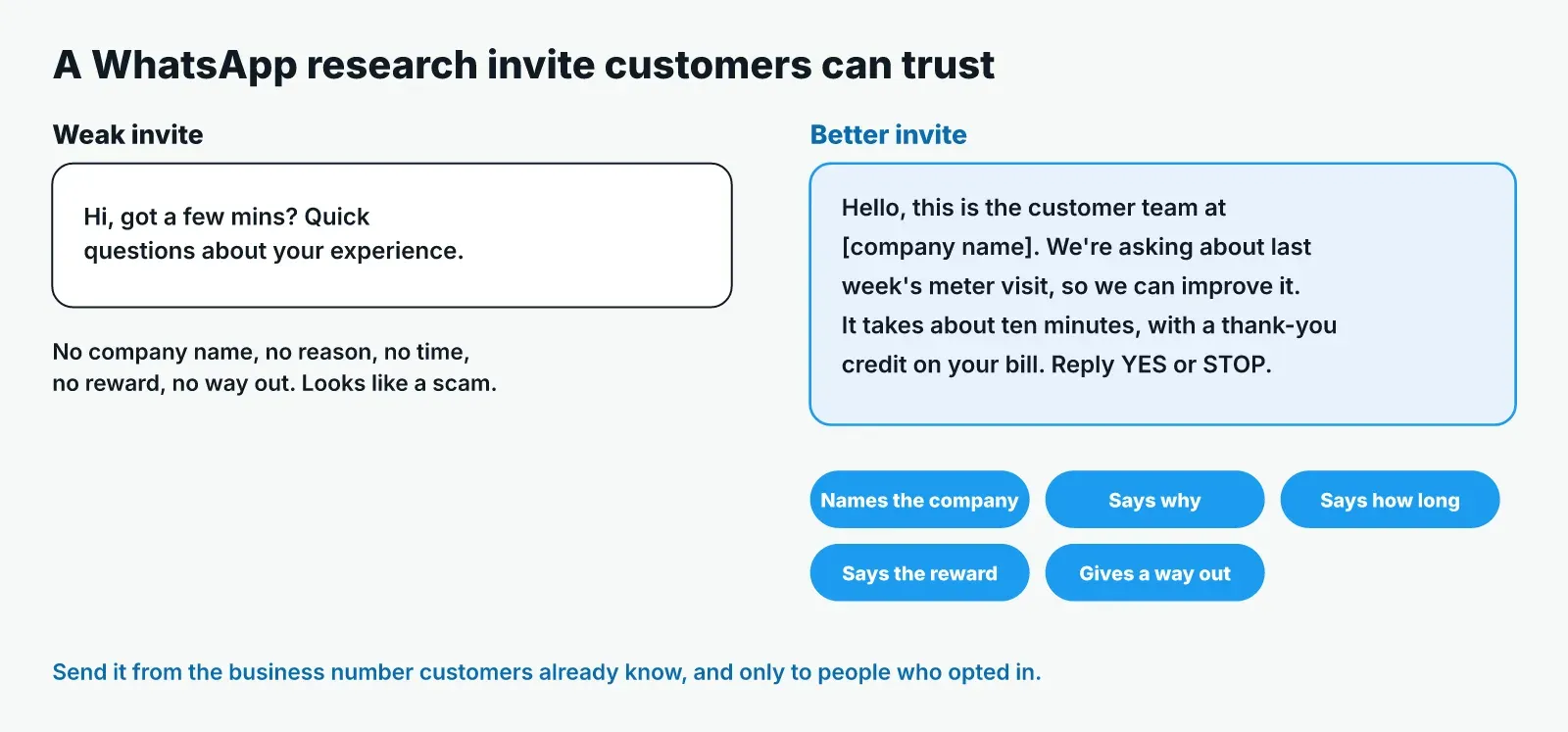
Here is what a weak invite and a better invite look like for the energy supplier.
Weak invite: "Hi, got a few mins? Quick questions about your experience."
Better invite: "Hello, this is the customer team at [company name]. We're asking customers about last week's meter visit, so we can improve it. It takes about ten minutes, and you'll get a thank-you credit on your bill. Reply YES to start, or STOP if you'd rather not."
The better invite names the company, the reason, the time and the incentive. It also gives a clear way out. That is what makes it look like research and not a scam.
Don't send research invites from a personal phone. Use the company's verified business number, so the name shows up the way customers expect.
Message only customers who agreed to hear from the company on WhatsApp. Your legal team can tell you what counts as agreement where you work.
You can upload a list and message each person. You can also share a link or a QR code, for example on the meter visit card.
One reminder is usually enough. More than that feels like spam, and people may block the number.
You can run WhatsApp interviews in three ways. You can chat by text in the thread. You can swap voice notes. Or you can send a link that opens a full voice or video interview on the phone. Pick the format by what you need to learn. Text suits a few quick questions. Voice gets longer, more natural answers about why.
Format | How it works | Best for |
|---|---|---|
Text chat | You ask, they type, in the WhatsApp thread | A few quick questions, such as a rating and one reason |
Voice notes | You ask, they reply with a voice message | Short stories in their own words, at their own pace |
Link to a full interview | They tap a link and answer a voice or video interview on their phone | The full story of why, with follow-up questions |
For the energy supplier, text works to ask "How was the meter visit?" But to learn why some customers still don't trust their bill, a voice interview works better. People explain more when they can talk. The post on voice and text interviews explains why.
Whatever the format, use one interview guide for everyone. An interview guide is the list of questions you ask each person, in order. If each person gets different questions, you can't compare what they said.
When an answer is vague, ask a follow-up. Say a customer writes "the bill was confusing". Ask which part, and what they did next.
Let people answer in their own language. A customer who speaks a local language at home will say more in it. Write down which language each interview used, so you can read the answers in context later.
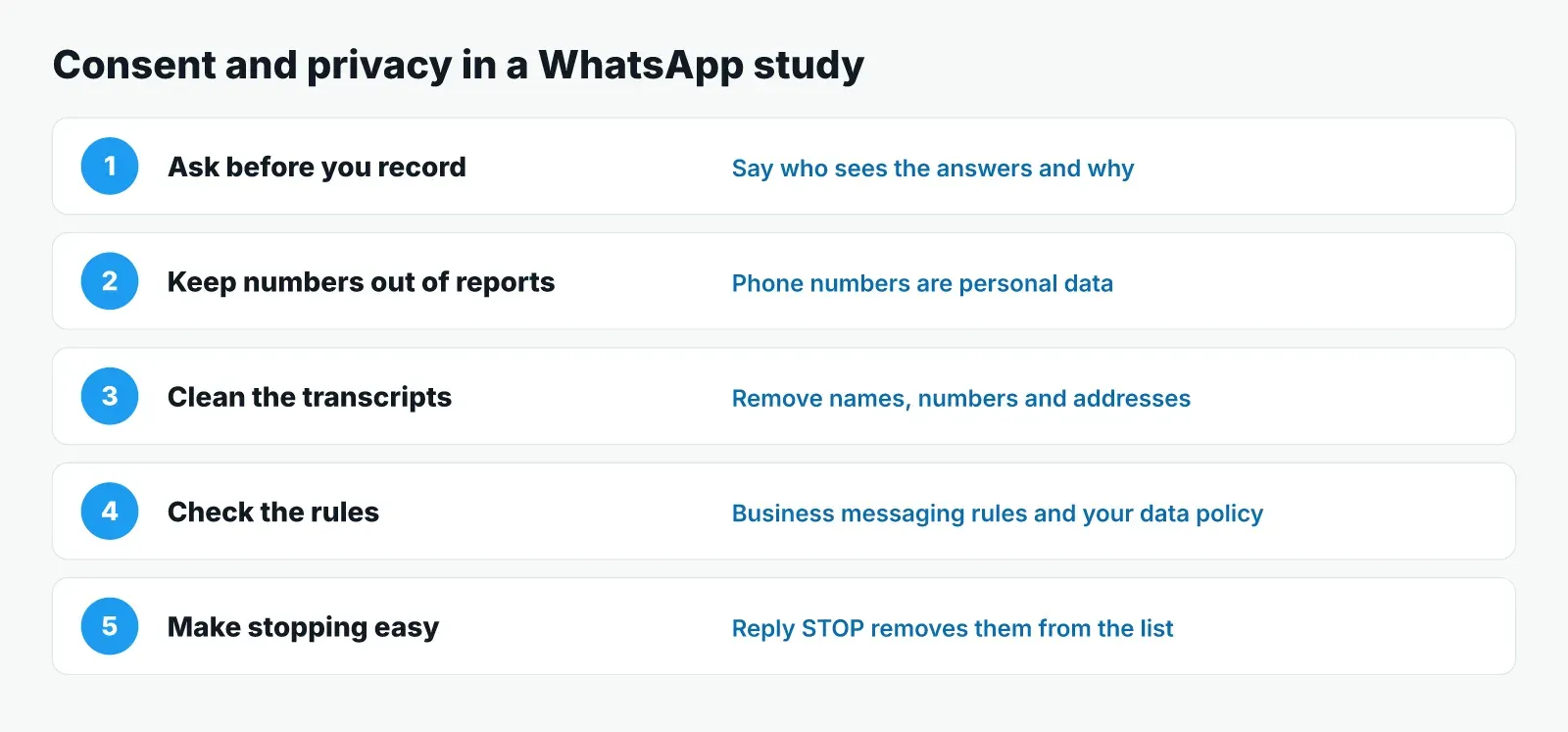
Get consent before the first question. Tell people, in plain words, that you'd like to record their answers and how you'll use them. Phone numbers are personal data, so keep them out of reports and remove names and numbers from transcripts. Check with your legal team before your first WhatsApp study.
Here is what to cover, in order.
Before the first question, ask if you can record or save the answers. Say who will see them and why. Wait for a clear yes.
Your team can see each customer's phone number in the chat. Keep that number out of any report. Remove names, numbers and addresses from transcripts before you share them.
WhatsApp has its own rules for how businesses can message people. Your company also has its own data policy. Ask your legal team to check both before the first study.
Tell people they can stop at any time, and how. If someone replies STOP, take them off the list and don't message them again about research.
So here is a simple rule for the energy supplier. If customers answer WhatsApp faster than email, run the study there. Use text for quick questions, and a voice interview link when you need to know why.
The energy supplier needs to reach customers on WhatsApp, ask everyone the same questions, and still get the full story behind each answer. Pulse runs AI-moderated interviews by voice, video, text chat, phone call or WhatsApp. You can invite your own customers by uploading a list, sharing a link or a QR code, or inviting them on WhatsApp.
The AI moderator asks every customer the same questions from one guide. It builds follow-ups on what each person said earlier, and asks again when an answer is vague. Interviews can run in 240+ languages, enabled on request, including every Indian language. One study can also run across several markets from one brief.
Personal data is redacted from transcripts, and Pulse is GDPR compliant. Every theme comes with the quotes behind it, and each quote links to its transcript.
To try it, start on the $0 Explorer plan or ask for a free study. You can also book a demo to plan a WhatsApp study with the Pulse team.
Research interviews on WhatsApp are legitimate when a real company runs them with customers who agreed to hear from it. The warning signs are the same as for job scams: an unknown number, no company name, or a request for money or bank details. A real research invite names the company and never asks for payment.
A small thank-you is common and fair, because people give you their time. For the energy supplier, that could be a credit on the next bill. Say what the reward is and when it arrives in the invite, so nobody feels tricked later.
Keep a chat in the thread short, to a few questions. People answer between other messages, and long threads get dropped. If you need more time, send a link to a full voice interview, and say in the invite how long it takes.
Yes, for a few short questions, such as a rating and one reason. Longer surveys work better as a link that opens in the phone's browser. A short survey tells you how many customers feel a certain way. Follow it with a few interviews to learn why.
Participant recruitment methods compared by who you need: your own list, panels, referrals, networks and recruiters, plus a check before you set a date.
Semantic vs latent themes, from Braun and Clarke's paper "Using thematic analysis in psychology", shown on real-life quotes, with when to use each.
How to choose a transcription service for research interviews: test each option on your own audio with five simple checks, from accuracy to data safety.