Where customer research belongs in new product development
New product development needs a different research question at each stage. The question, the method and the evidence each gate review needs.
Transcription in qualitative research shapes what your analysis can prove. Pick a style, set a spec, check it against audio and keep quotes traceable.
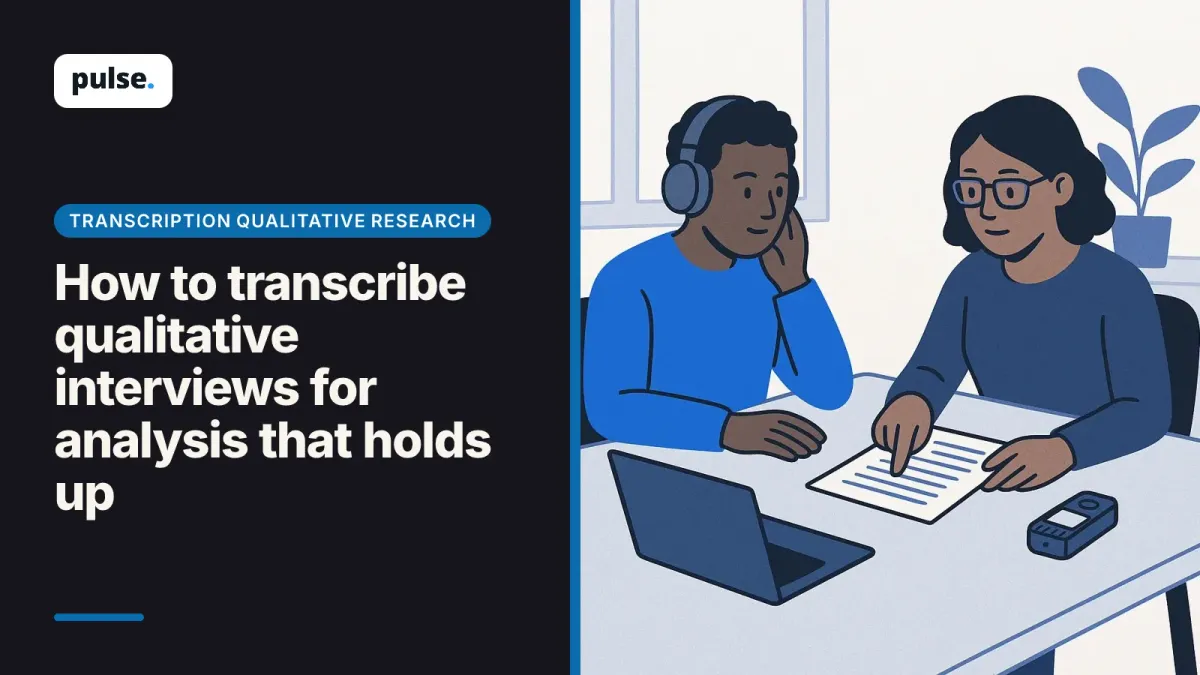
A steering committee asks where a quote in the readout came from, and nobody can find it in the recording. Transcription in qualitative research turns interview audio into text that analysts can code and quote. Pick the format from your analysis, give every transcriber one spec, check the text against the audio, and link each quote to its recording.
In a study that runs across several markets and vendors, small transcript choices add up. One vendor drops the pauses, another uses first names, a third gets wrong who said what. Coders then compare files that do not match, and a quote can end up under the wrong speaker.
The four parts below tell you which transcript style to order, what to put in the vendor spec, and what to check before coding starts.
Intelligent verbatim fits most business interview studies. It drops fillers and repeats but keeps the person's own words and meaning. Use full verbatim when how people speak is the data. Keep edited or summary text out of your evidence, because it cannot supply a quote. Decide before fieldwork, so coders never work on two kinds of text.
| Style | What it keeps | What it drops | Use it for |
|---|---|---|---|
| Full verbatim | Every word, filler, false start, pause, laugh and overlap | Nothing | Studies of how people talk, where the way something is said is the finding |
| Intelligent verbatim | The person's words and meaning, plus tags for pauses or laughs that matter | Fillers, repeats, false starts | Coding interviews for themes and reasons, as in most business research |
| Edited or summary | The gist of each answer | The person's own wording | Field notes and internal recaps, never a source of quotes |
Writing a transcript involves choices. Keeping an "um", marking a long pause or splitting a run-on answer changes what an analyst sees later. For illustration, a bank customer who pauses before saying they trust their lender has said something different from one who answers at once. A cleaned-up transcript can erase that difference.
So add two things to intelligent verbatim. Tag hesitation, long pauses and laughter where they change how an answer reads, with one fixed set of tags. And keep the audio for every interview, so anyone can check a disputed passage word for word.
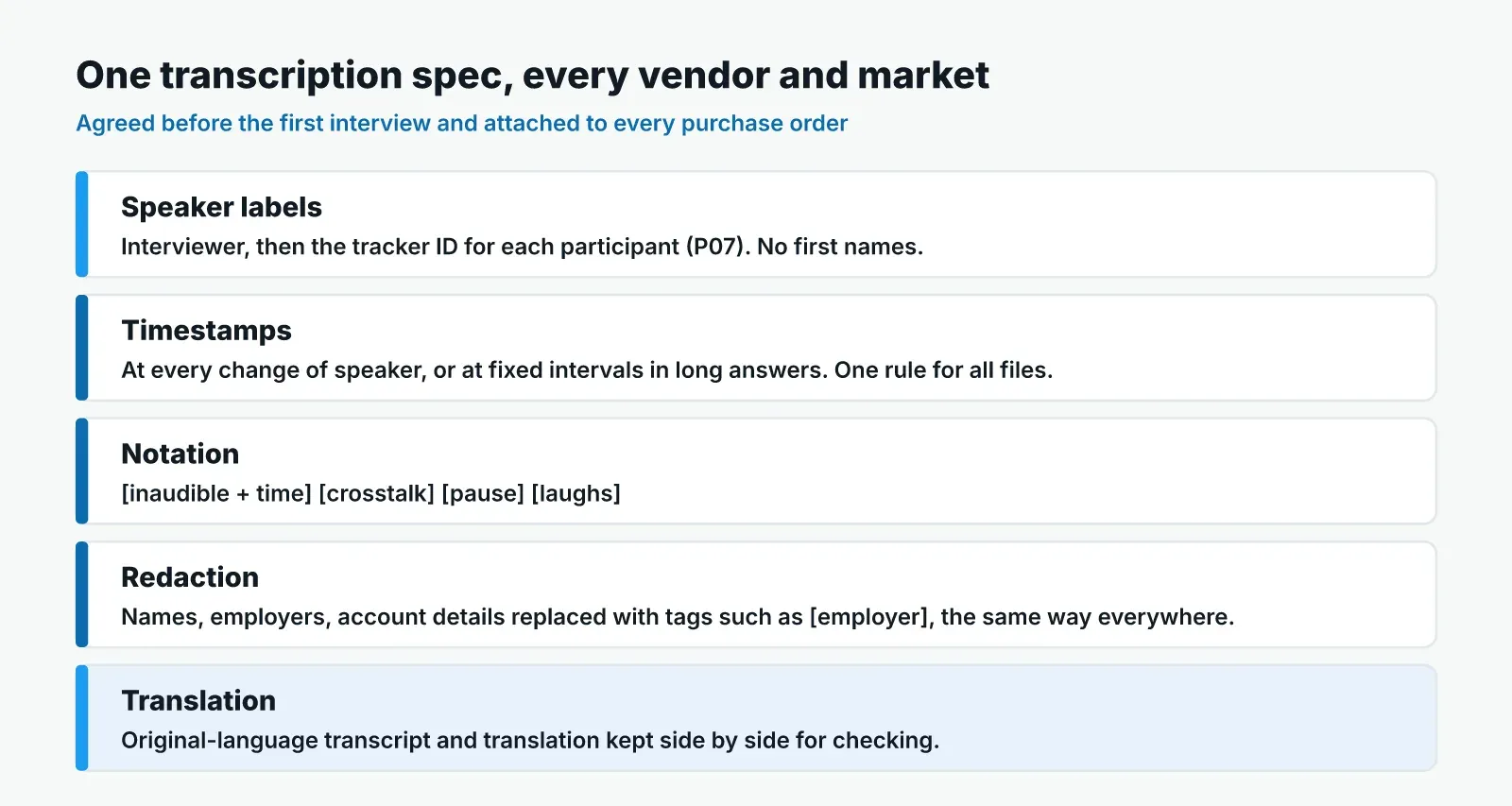
A transcription spec is one page of rules that every transcriber, vendor and market follows. Agree it before the first interview and attach it to every purchase order. It fixes speaker labels, timestamps, tags, redaction and translation, so files from different vendors read as one dataset and a coder can compare them line by line.
Label the interviewer "Interviewer" and each participant by the ID from your recruitment tracker. Never use first names. When the tracker and the transcript share an ID, details like market and customer tier follow the person into analysis.
Put a timestamp at each change of speaker, or at fixed gaps in long answers. Pick one rule and use it in every file. The timestamp is what lets a reviewer jump from a quote to the right moment in the recording.
Use [inaudible] for a word nobody can hear, [crosstalk] for two people talking at once, [pause] for a silence that matters, and [laughs] for laughter. Add a timestamp to every inaudible tag, so someone can listen to that passage again.
Decide up front what gets removed: names, employers, account numbers, addresses, and anyone the participant mentions. Replace each with a tag such as [employer] or [colleague name]. If each vendor decides file by file, the gaps will differ from one market to the next.
For interviews in other languages, keep the original transcript and the translation in paired columns or paired files. A reviewer in that market can check that the translation kept the meaning. And a readout quote can be traced to the words the participant spoke.
Automatic speech recognition gives a fast first draft, but its accuracy changes with the speaker, the setting and the words used. So check every transcript against the audio before anyone codes it. An error found after coding means recoding. An error found after the readout means correcting a finding in front of the people who acted on it.
A 2025 study by researchers at VNS Health and Columbia University, published in Innovation in Aging, shows why. In an analysis of 4,002 utterances from home healthcare audio, one commercial system had a word error rate of 0.26 on clinician recordings versus 0.19 on research-assistant recordings, a statistically significant difference. Word error rate counts the system's mistakes per word spoken, so lower is better. The clinician recordings were in-person visits, and the research-assistant ones were phone calls.
That is one clinical setting, and customer interviews are not home visits. It still shows that one system can transcribe two kinds of recording at different accuracy in a single study. A tool's headline accuracy figure tells you little about any one file.
In every automatic transcript, check these by hand:
The speaker label matters most. A misspelled product name is easy to spot. A sentence the interviewer said, filed under the participant, becomes a finding the participant never voiced. For where automation fits in the rest of a study, see how AI is changing qualitative analysis.
Play a stretch of every transcript against its audio. Check more of the first files from each new transcriber or market, because early files show whether the spec was understood. Once a vendor's files come back clean, you can check less.
Every quote planned for a deck, report or highlight reel gets matched word for word against the audio, with its speaker label confirmed. Do this even when the file passed its check, because a quote is the one line a stakeholder reads in full.
Count the [inaudible] tags in each file, and return a file dense with them before coding. Gaps decide who gets quoted. Clear speakers end up in the readout, and hard-to-hear ones drop out of the evidence.
Record who checked each file, when, and what they changed. When legal or procurement asks how a quote was verified, the log answers without a meeting.
Illustrative example: an insights team at a software company runs one churn study in Brazil, Germany and India. The business question is why enterprise customers cancel, and the findings go to a steering committee that will decide which retention fixes to fund. One vendor transcribes Portuguese and German, and a second covers Hindi and English.
The team has to choose how the transcripts are made. Each option settles some things and leaves others open.
| Option | What it gives the team | What it leaves open |
|---|---|---|
| Automatic transcripts, no check | Fast text for every file | Whether names, numbers and speaker labels are right |
| Two vendors, each with its own house style | Human transcripts in each language | Whether files from the two vendors can be compared |
| Two vendors with one shared spec and an audio check | Files that read as one dataset, with checked quotes | Only the days the check takes |
The team weighs the cost of a wrong quote in front of the steering committee against a few days of checking, and picks the third option. Both vendors get the same spec. A translated segment of one German file comes back like this:
[CHURN26_DE_P07 | Market: DE | Tier: Enterprise | Guide Q4: Reasons for canceling]
00:12:41 Interviewer: What made you start looking at other providers?
00:12:46 P07: It was the invoice, really. [pause] Our finance lead, [colleague name], flagged it twice.
00:13:02 P07: Then the [employer] contract came up for renewal, so [laughs] that was that.
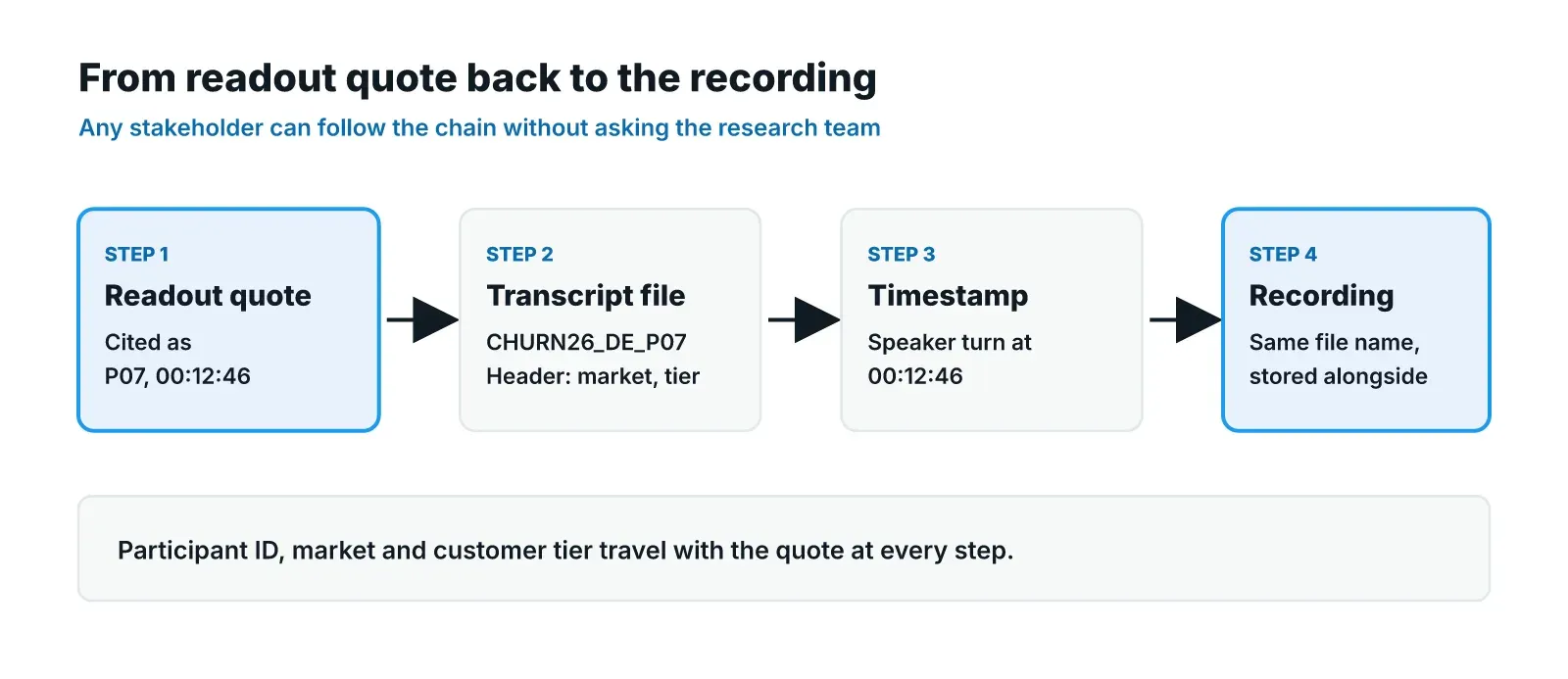
The header carries the participant ID, market, tier and guide question. In this example, each file is named with the study code, market and ID, such as CHURN26_DE_P07, and stored beside its recording under the same name. In the readout, each quote is cited by ID and timestamp. That gives a chain from the slide to the file, to the timestamp, to the moment in the audio.
The next decision is the handover. Coders get one file per interview, with segments marked by the guide question they answer, so a coder can pull every answer to Q4 side by side across the three markets. Plan the question numbers when you write the interview guide, and agree the spec with whoever builds the codebook. From there, qualitative data analysis takes over, and the steps for analyzing qualitative data pick up where the transcript stops.
Pulse fits the traceability part of this work. It runs AI-moderated customer interviews, turns each one into a transcript, and groups the answers into themes. Every theme is traced back to the quotes and interviews behind it, so a reviewer can follow a finding to the words the participant spoke.
The checks in this post stay with your researchers: choosing the style, agreeing the spec with the codebook owner, and reading themes against transcripts before a decision rests on them. Pulse runs the fieldwork and the first synthesis, so that review is where your team's time goes. The same chain is what you need to audit AI-generated interview themes back to the exact quote.
Keep one rule for the readout. If a quote cannot be played back from its ID and timestamp, leave it out. To see how that chain looks in a Pulse study, book a demo.
It helps, because the interviewer remembers tone and context that the audio may not carry. In a large study it is rarely practical, and a shared spec matters more than who types. A good middle path is to let vendors or software make the first draft, then have the interviewer check every quote planned for the readout.
Treat it as required. Ask for it in writing before the interview starts, and say what will be recorded, who will hear or read it, and how long it will be kept. Your legal team sets the exact wording for each market. Keep the consent record with the participant ID, so it travels with the transcript.
Keep them for as long as a finding might be questioned and your data policy allows. A quote can only be verified while the audio exists, so deleting recordings early breaks the chain from readout to source. Set the period before fieldwork, write it into the consent form, and apply it to every market.
New product development needs a different research question at each stage. The question, the method and the evidence each gate review needs.
Exploratory research turns a vague business problem into a precise question. Learn how to scope it, which methods fit and when to stop.
User personas earn trust when every attribute traces to interview evidence and a measured share of customers. Here is how to build them that way.