
Where customer research belongs in new product development
New product development needs a different research question at each stage. The question, the method and the evidence each gate review needs.
Exploratory research turns a vague business problem into a precise question. Learn how to scope it, which methods fit and when to stop.

Exploratory research is the study you run when a problem is clear enough to matter but not clear enough to ask a precise question. It is open, flexible and mostly qualitative, and it ends with a sharper question and testable hypotheses rather than a conclusion. Scope it from a decision, start from what your organization already knows, and stop when you can write the defined study.
Exploratory research is a preliminary, flexible study of a poorly defined problem, designed to find the right question and the likely answers to it. It changes direction when a lead appears, uses small samples chosen for range, and produces hypotheses. A later descriptive or confirmatory study sizes and tests what it finds.
Teams reach for it in three situations: a metric moved and nobody can name a likely cause, the business is entering a market or segment it has not studied, or several stakeholders describe the same problem in incompatible ways.
Exploratory research asks what is going on. Descriptive research asks how many and how often. Explanatory research asks why one thing affects another, and confirmatory research tests a hypothesis fixed in advance. In practice they often run in that order, each one starting from what the previous one found.
| Type | Purpose | Typical question | Common methods | What the output lets you say |
|---|---|---|---|---|
| Exploratory | Find the question and candidate answers | What is happening with applicants who stop at step three? | Open interviews, review of past studies, observation | These are the plausible explanations |
| Descriptive | Size a known pattern | How many applicants stop at step three, by segment? | Surveys, analytics | This share of applicants, in these segments |
| Explanatory | Find the cause behind a pattern | Does the document request cause the drop-off? | Experiments, longitudinal studies | This factor affects that outcome |
| Confirmatory | Test a hypothesis set in advance | Will removing the document request cut drop-off? | A/B tests, pre-registered studies | The hypothesis held, or it did not |
Exploratory research overlaps with generative research, the term product teams use for open studies that look for unmet needs before a solution exists. Both sit on the qualitative side of the split covered in this guide to qualitative versus quantitative research.
You are not ready for a defined study when you cannot write the answer options for its main question without guessing. Other signs are stakeholders in different business units describing the problem in different words, a metric that moved with no plausible cause, or a market the organization has never studied. Each one points to exploration first.
The risk team calls it fraud friction, the product team calls it a confusing form, and the marketing team calls it the wrong applicants. Those are three studies, and the organization has not yet chosen one.
Draft the closed question you would put in a survey. If the option list is a set of guesses, a survey will measure the guesses and report them back with a percentage attached. This post on how fixed questionnaires cap what you can learn shows what that costs.
When a number moves and the team's explanations are speculation, exploration finds the candidates worth testing. Testing comes after.
Scope an exploratory study with a learning goal, the decision it feeds, a fixed end date and a named set of people to talk to. A hypothesis is the output, so do not start with one. Begin with what the organization already knows, then interview the stakeholders, then the customers, with a guide loose enough to follow a lead.
A learning goal reads like "understand why recent applicants stop between the income and document steps, so the product committee can choose what to test next quarter." The deadline keeps the study from drifting. Name the groups you will talk to, chosen for range: different segments, channels and outcomes.
Before anyone books an interview, read the earlier studies, the research repository, support tickets, sales notes and any secondary data. In a large company, someone has often studied part of the problem already. Reading their work first means the new study starts where theirs stopped.
Ask each stakeholder what they think is happening and what they would do if they were right. The answers map the competing versions of the question, and the study's job becomes settling which version matters.
An exploratory guide has a few broad prompts and room to follow whatever comes up. Specific questions belong in the defined study that follows.
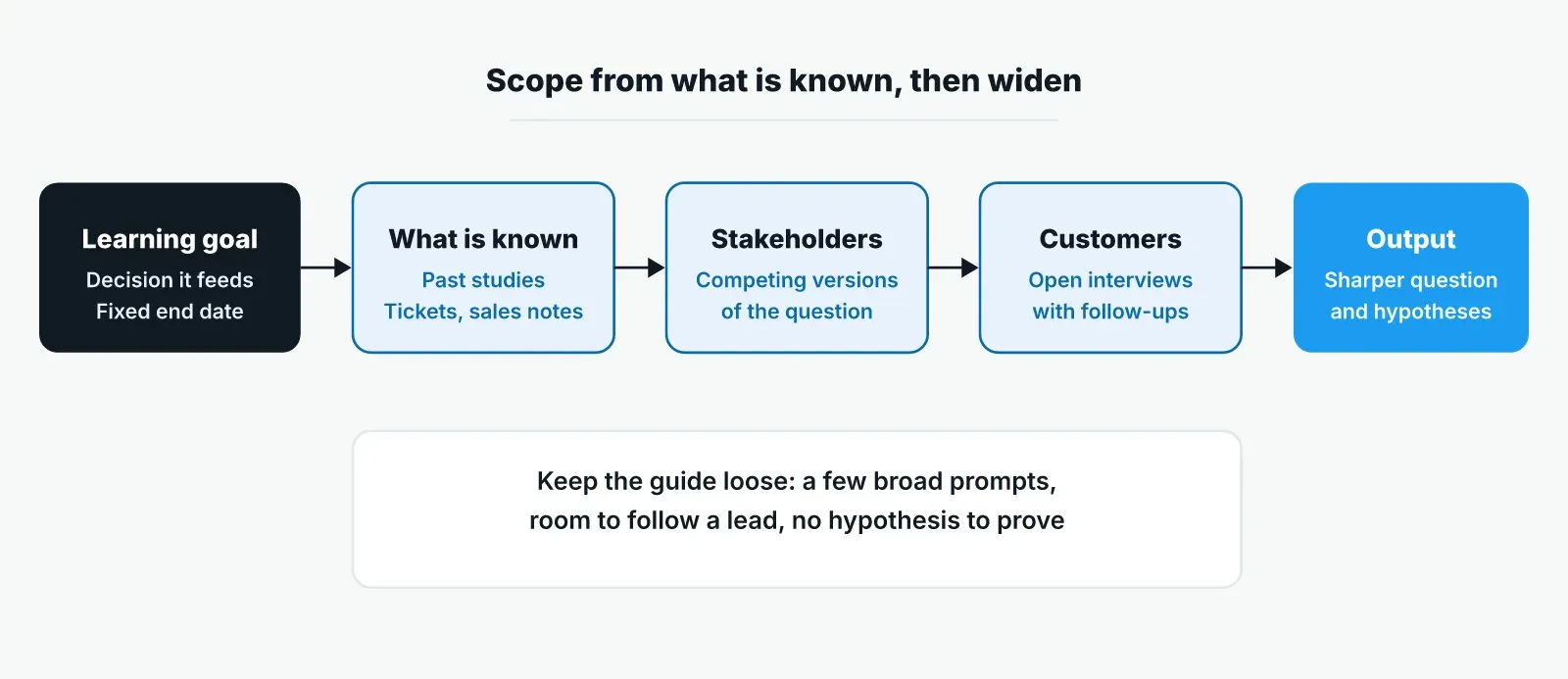
The core method is the open customer interview, with broad prompts and follow-up questions on every vague answer. Run a review of existing studies and secondary data first, because it costs least. Add observation, diaries or small group discussions when the behavior is something people do not describe well in an interview.
Past studies, analytics and support logs tell you what is already known and where the gaps are. This step often answers some of the questions the team planned to ask.
Open interviews let a participant describe the problem in their own words, and follow-up questions turn "it was confusing" into the specific screen and the specific moment. These open questions for customer interviews are a starting point for the broad prompts.
Observation and diary studies capture what people do across days or in context, which they often leave out when asked. This overview of qualitative research methods covers when each one fits.
Pulse supports the first two steps. It stores every study in a searchable insight repository, so a new brief can start from earlier findings, and its AI moderator asks a follow-up question when a reply is vague, with every theme traced to the transcript it came from.
This example is hypothetical. A large consumer lender sees loan applications drop off between the income step and the document upload step. Three teams offer three causes: the risk team blames verification friction, the product team blames the form's layout, and marketing blames the quality of paid traffic.
The insights team searches its repository and support tickets first. It finds two earlier studies on the same step, one from before a redesign, and a cluster of tickets about which documents count as proof of income.
The team interviews recent applicants who stopped, across channels and income types, with one broad prompt: "Walk me through the last time you started an application with us." Follow-up questions ask what happened next, what they expected and where they went instead.
The study ends with four candidate explanations, including one no team had proposed: self-employed applicants did not know which document to upload and left to find it. It also produces the closed answer options a descriptive survey can now use to size each explanation.
The team did not report which cause is largest. The interviews were chosen for range, and exploration cannot size a cause. The descriptive survey answers that.
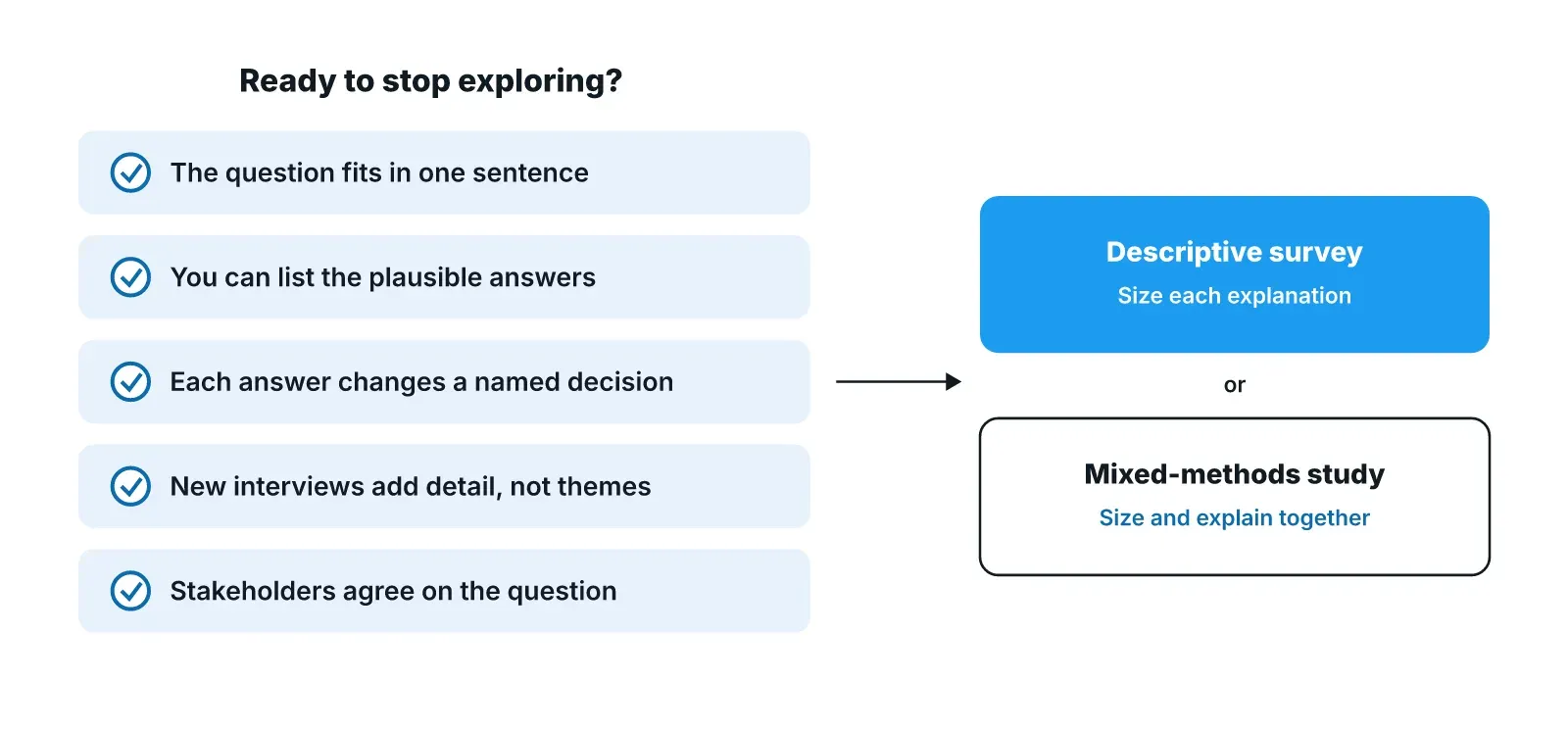
Stop exploring when you can state the research question in one sentence, list its plausible answers, and name the decision each answer would change. Two more checks help: new interviews add detail to known themes rather than new themes, and stakeholders agree which version of the question matters. Then hand off to a defined study.
"What share of self-employed applicants leave at the document step because they cannot tell which document qualifies?" is a defined question. "Why do people drop off?" is not.
When each new interview adds detail to the themes you have rather than new themes, the study is close to done. This point is often called data saturation. It depends on how varied the people are and how narrow the question is, so no fixed number of interviews proves it.
Bring the candidate explanations back to the stakeholders. If they agree which ones matter, the defined study can begin. The usual next step is a descriptive survey to size the explanations, or a mixed-methods study that sizes them and explains them in the same round.
The most damaging mistake is reporting exploratory themes as conclusions or percentages, when the sample was never designed to generalize. Others are hiding a favored hypothesis in the questions, exploring with no end date, and skipping what the organization already knows.
A slide line such as "seven of twelve applicants mentioned documents" describes twelve people chosen for range. It says nothing about the share of all applicants, and a slide that turns it into a percentage invites the wrong decision.
A question like "Was the document step frustrating?" plants the answer. This guide to avoiding bias in user research covers the common forms.
An exploratory study with no deadline keeps finding interesting threads and never hands a question to a decision.
Skipping the repository and past studies means paying to learn what a colleague learned last year.
Short answers to the questions people ask most about exploratory research.
Exploratory research finds out what is going on when the problem is poorly defined, and it produces hypotheses. Explanatory research tests why one thing affects another once the candidates are known, often through experiments or longitudinal data. Exploration usually comes first and supplies the hypotheses an explanatory study tests.
The four types most teams use are exploratory, descriptive, explanatory and confirmatory. Exploratory designs find the question, descriptive designs measure how common something is, explanatory designs look for causes, and confirmatory designs test a hypothesis fixed in advance. Many studies combine two of them, such as an exploratory phase followed by a descriptive survey.
Confirmatory research states its hypothesis and analysis before collecting data, then tests it. Exploratory research starts without a fixed hypothesis and changes direction as it learns. Findings from exploration are candidates; they become claims only after a confirmatory or descriptive study tests them.
Exploratory market research applies the same approach to a market question: a new segment, an unexplained shift in demand, or a category the company has not entered. It usually combines secondary data with open interviews of buyers and non-buyers. Pulse runs AI-moderated interviews with your customers for this kind of open study.
Exploratory research is mostly qualitative, because its job is to find the question and the possible answers before anything is counted. It can use quantitative material, such as analytics or an existing dataset examined for unexpected patterns, but the sample is not designed to generalize. Sizing what it finds is the job of a later quantitative study.
New product development needs a different research question at each stage. The question, the method and the evidence each gate review needs.
User personas earn trust when every attribute traces to interview evidence and a measured share of customers. Here is how to build them that way.
Transcription in qualitative research shapes what your analysis can prove. Pick a style, set a spec, check it against audio and keep quotes traceable.