Exploratory research when you do not yet know the question
Exploratory research turns a vague business problem into a precise question. Learn how to scope it, which methods fit and when to stop.
New product development needs a different research question at each stage. The question, the method and the evidence each gate review needs.
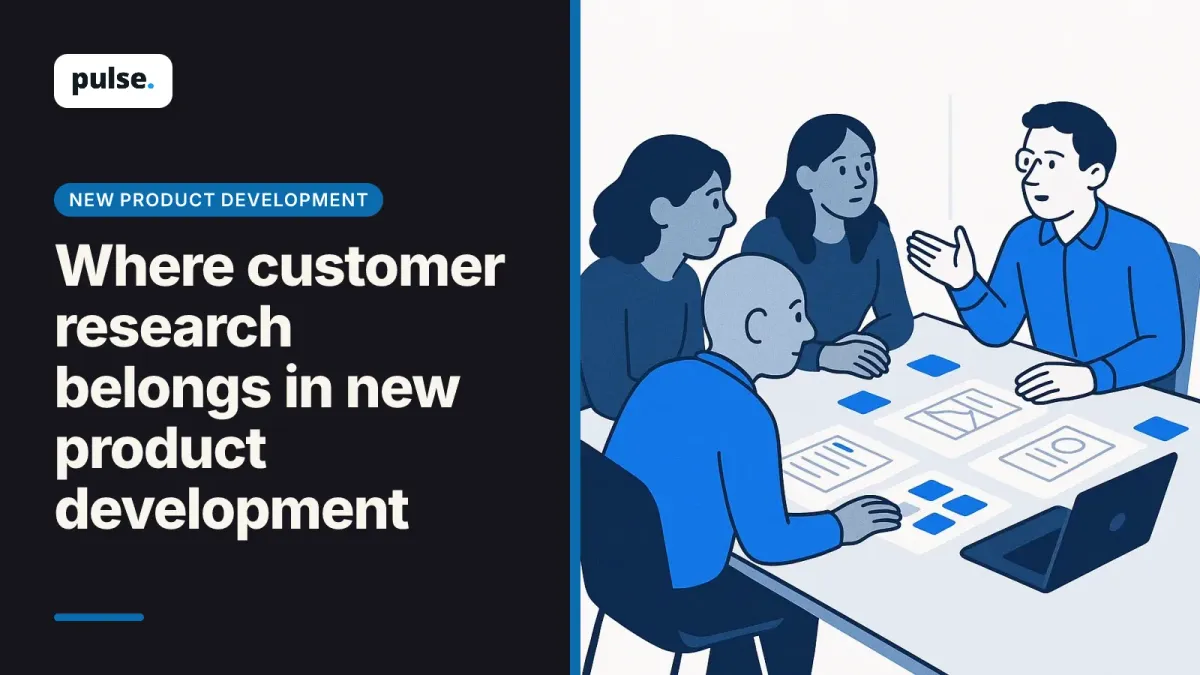
For illustration, picture a steering committee about to approve a new product's business case. The forecast looks great. No buyer has seen it. In new product development, customer research belongs at every gate, with a different question at each one. The gates that release the most money need it most.
Below you'll find the question to ask at each stage, and a simple way to make each gate ask for customer evidence before it spends.
Here's the short version:
New product development takes a product from a customer need to launch, and through its first months on sale. Each stage has one question customers can answer better than your team can. The gate after that stage should see the answer before it releases more budget.
Many large companies run these stages through gates. In a stage-gate process, a committee from product, finance, risk and marketing reviews the work after each stage. Then it decides to go on, rework or stop. Think of the gate as passport control: it only helps if someone actually checks the passport.
| Stage | The question research answers | Method that fits | Evidence the gate should see |
|---|---|---|---|
| Opportunity | Is this problem common and painful for a group we can reach? | Interviews with people who hit the problem recently, then a survey to size it | The problem in customers' words, and the size of the group |
| Idea generation | What do customers already do to work around the problem? | Discovery interviews about workarounds and past attempts | A short list of problems, each with quotes |
| Idea screening | Which ideas address a problem customers raised on their own? | Re-reading past interviews before running new ones | Each surviving idea matched to customer quotes |
| Concept development and testing | Do buyers understand it, believe it and see it replacing something they do now? | Concept interviews that ask the reason behind each reaction | Reasons for interest and doubt, by customer group |
| Business analysis | Would buyers pay and switch, and what would stop them? | Interviews on switching and the buying process, plus a pricing study | Each forecast assumption checked against interviews |
| Product development | Is the build still solving the problem customers described? | A mid-build interview round beside usability testing | Proof the problem has not drifted |
| Market testing | Why are pilot customers using it, or going quiet? | Interviews with active and inactive pilot customers | The reasons behind the pilot numbers |
| Launch and post-launch review | Why do early adopters stay or leave? | Interviews with early adopters and early cancellers | Themes carried into the next opportunity stage |
Research is easiest to act on before an idea has an owner. Nobody has staked a budget or a name on it yet. Discovery interviews are open conversations about the customer's problem, before any solution is on the table. Ask about the last time the problem happened, what it cost, and what the customer has already tried.
Keep ideas and sketches out of the room. Show a customer an idea and they start judging it. Then they say less about their own problem.
What you bring to the idea workshop is a short list of problems with quotes. Here's the difference:
The second one gives designers a problem to solve and leaves the solution open. The guide to customer research methods covers interview and survey formats for this stage.
At screening, score each idea against the discovery quotes. An idea no quote supports is an internal enthusiasm. That's allowed, but it should go into the gate review with that label on it.
At the concept stage, a positive reaction is where the interview starts. Ask what the concept would replace, what would have to be true for the buyer to switch, and who else would have a say. The mechanics of running a concept test are their own subject.
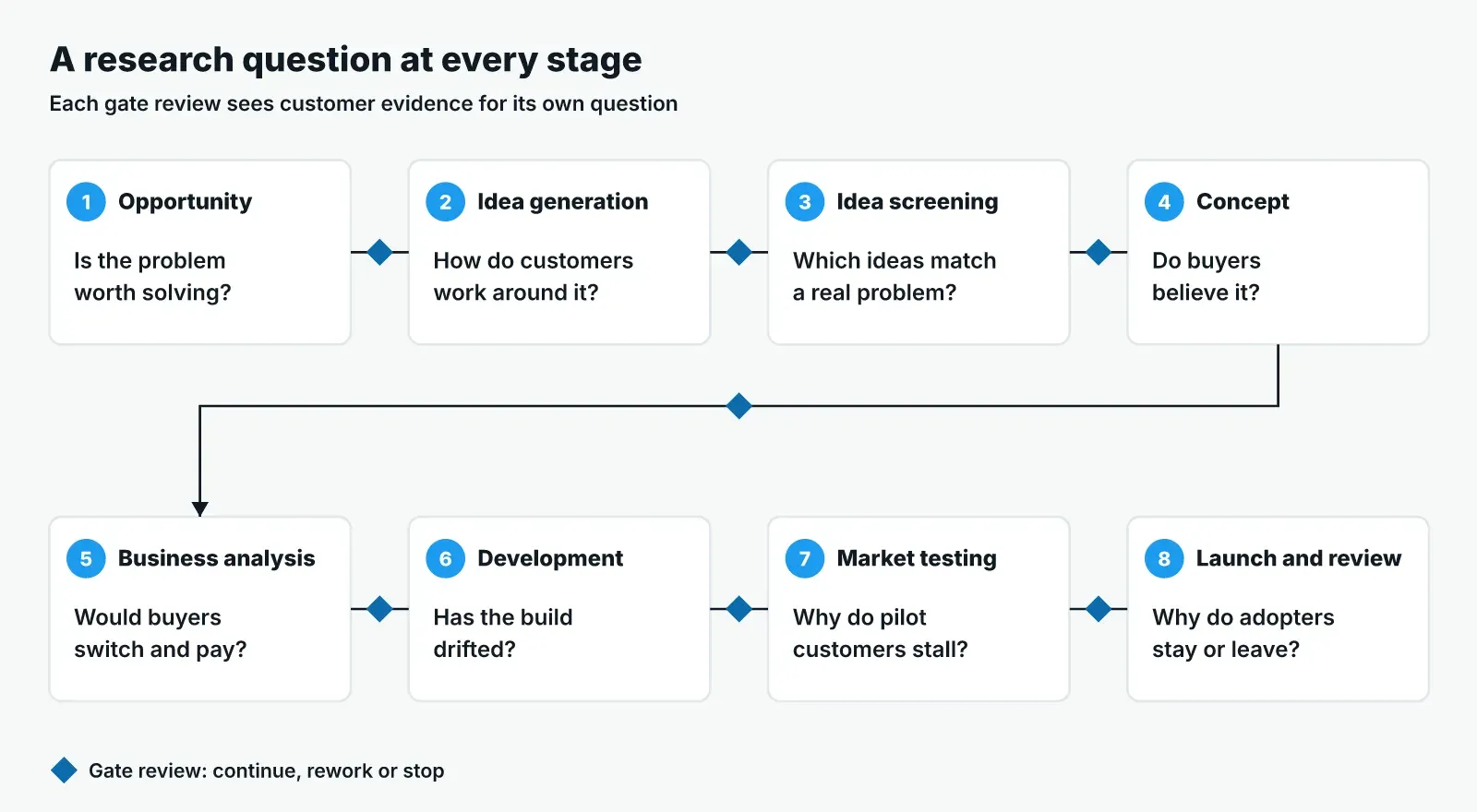
Business analysis, product development, market testing and the post-launch review are the stages most likely to run without customers. Each one rests on guesses about buyers. A short round of interviews tests those guesses before the next gate spends more. Without it, the committee approves on the slide deck alone.
The business case rests on a forecast. The forecast rests on guesses about who will buy, at what price, and who will switch. Interview target buyers about how they buy today, what switching would cost them in time and risk, and who signs off.
Leave price itself to a pricing study. Then hand the gate a list of the forecast's assumptions, each marked supported, contradicted or untested.
Usability testing checks whether people can use the product. It doesn't check whether the product still solves the problem discovery found. A round of interviews mid-build does that. It catches a build that has drifted toward the features the team enjoyed making.
A pilot is a small, early release to a limited group of customers. It produces numbers such as activation (how many start using it), usage and retention (how many stay). Interviews explain those numbers.
Talk to active users and to the ones who went quiet. The quiet group's reasons don't show up in usage data, and the launch plan needs them.
Interview early adopters and early cancellers in the first weeks after launch. They still remember why they signed up, and why they left. Their themes become the opening evidence for the next product's opportunity stage.
Customer evidence reaches a gate when the gate asks for it in writing. Add four lines to each gate's criteria: the research question, the minimum evidence, a reviewer who reads it first, and a place to store the study.
Take it from the table above and make it specific to your product. Here's the difference:
The first one is a poor gate question, because no answer to it changes the plan.
Write down what the committee needs to see. For example, interviews with owners in each target segment, with quotes on switching. Agree this in advance, so the bar doesn't move once the results are in.
The researcher presents what customers said and how confident the team can be. The committee decides. If the person arguing for the product also sums up the evidence, the summary tends to lean their way. So name a reviewer, such as the insights lead, who reads the themes against the transcripts before the gate.
A post-launch review should be able to read what discovery found two years earlier. That needs a shared research repository, one searchable place for studies across business units. In a multi-market program, run one study with one discussion guide across markets. Then the gate compares like with like.
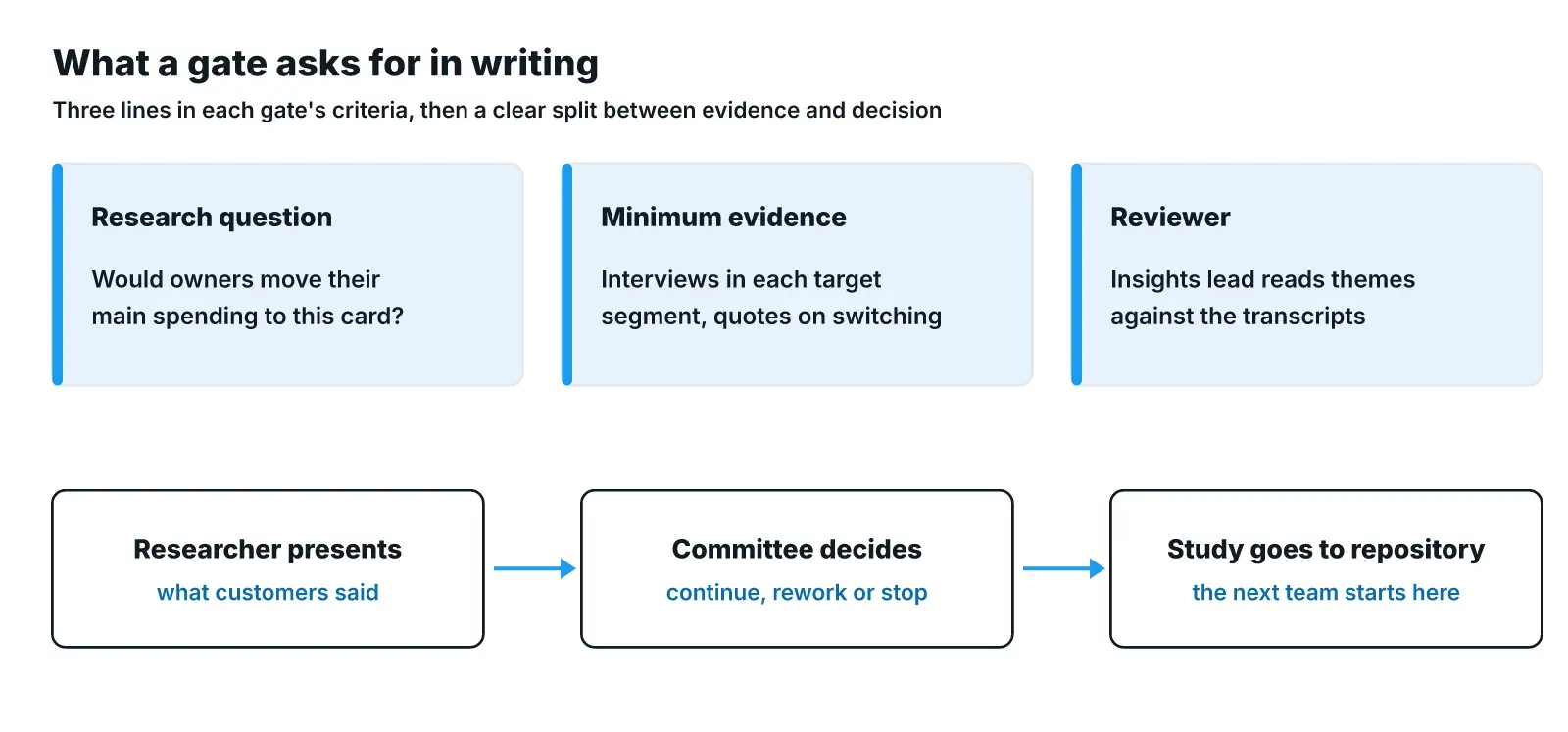
Illustrative example: a bank's cards division is developing a credit card for small-business owners. Discovery found that owners run business and personal spending on one personal card, and sort receipts by hand. Now the business analysis gate has to decide whether to fund the build.
The forecast assumes owners will move all their business spending to the new card. That assumption is the business question. If owners switch fully, the card is a main card and the revenue case holds. If they won't, the product needs a different shape before build starts.
The team has three ways to check it.
| Option | What it can establish | What it cannot establish |
|---|---|---|
| Forecast from internal account data | How much business spending runs through personal cards today | Whether owners would move it, or what stops them |
| Survey of business customers | How many say they would consider a new card | The reason behind a yes or a no |
| Switching interviews with owners in each segment | What switching would cost an owner, in their own words | How common each obstacle is across all customers |
The team runs the interviews, then sizes the main obstacle with a short survey. In this illustration, owners describe the same obstacle in different words. Their accounting software is linked to their current card, and moving means re-sorting months of transactions. The insights lead reads each theme against its transcripts before the gate.
The evidence changes the decision. The committee funds the build, but as a second card for business spending. It also adds an export to common accounting formats as a requirement. The forecast is rebuilt on that shape. After launch, interviews with early cancellers go into the repository as the starting evidence for the next cycle.
From then on, the committee follows one rule. If a gate is about to release budget on an assumption about customers, it asks for the interviews that test it. If none can run before the meeting, the assumption goes into the minutes as untested.
Timing is a common reason the later gates go without customers. The gate review is on the calendar, and a study that takes weeks arrives after the decision. Gate dates rarely move, so the study has to keep up. Pulse is built to close that gap for gates like the business analysis review above.
Pulse turns a business question into a study with an audience, a screener and a question set. It runs AI-moderated voice interviews with customers and asks a follow-up when an answer is vague. Then it groups the answers into themes, each traced to the quotes and interviews behind it.
Surveys run alongside the interviews in the same study, which covers the sizing step in the card example. A study that took weeks can run overnight, so the evidence reaches the gate in time.
Each gate study then sits in the insight repository, with its themes, quotes and transcripts beside earlier studies. It's all searchable, so the next gate starts from what customers already said. That includes the next product's opportunity stage.
Your researchers keep the parts that need judgment: the gate question, the minimum evidence and the call on what customers meant. To see a gate study run on one of your products, book a demo.
Five-stage models usually run from ideas and screening, through the concept and the business case, to build and testing, then launch. They cover the same work as eight-stage models, with neighboring stages merged. So the research questions in the table still apply. Each one simply moves to whichever stage now holds that work.
Companies draw ideas from inside, such as R&D, sales feedback, strategy reviews and rival products. They also draw them from customers. Discovery interviews add ideas grounded in problems customers already live with. A strong idea list mixes both, and ties each candidate to evidence that real customers have the problem.
A product can fail for reasons outside research, such as cost, timing or distribution. Research can prevent three kinds of failure. Gates approve on weak evidence. Products solve a problem few customers have. Launches have no plan to learn from early adopters and cancellers.
A repeatable process puts every product through the same gates, so committees compare products on the same terms. But the gates are only as consistent as the evidence they review. Give each gate a standing research question and minimum evidence, and each study also adds to what the next product starts from.
Exploratory research turns a vague business problem into a precise question. Learn how to scope it, which methods fit and when to stop.
User personas earn trust when every attribute traces to interview evidence and a measured share of customers. Here is how to build them that way.
Transcription in qualitative research shapes what your analysis can prove. Pick a style, set a spec, check it against audio and keep quotes traceable.