How to choose an AI assistant for research
Choosing an AI assistant for research? Match it to the evidence your question needs, then test whether every finding opens to the source behind it.
Test marketing sells a product in a small real market first. See which kind fits your launch, what to measure, and how to learn why it won or lost.
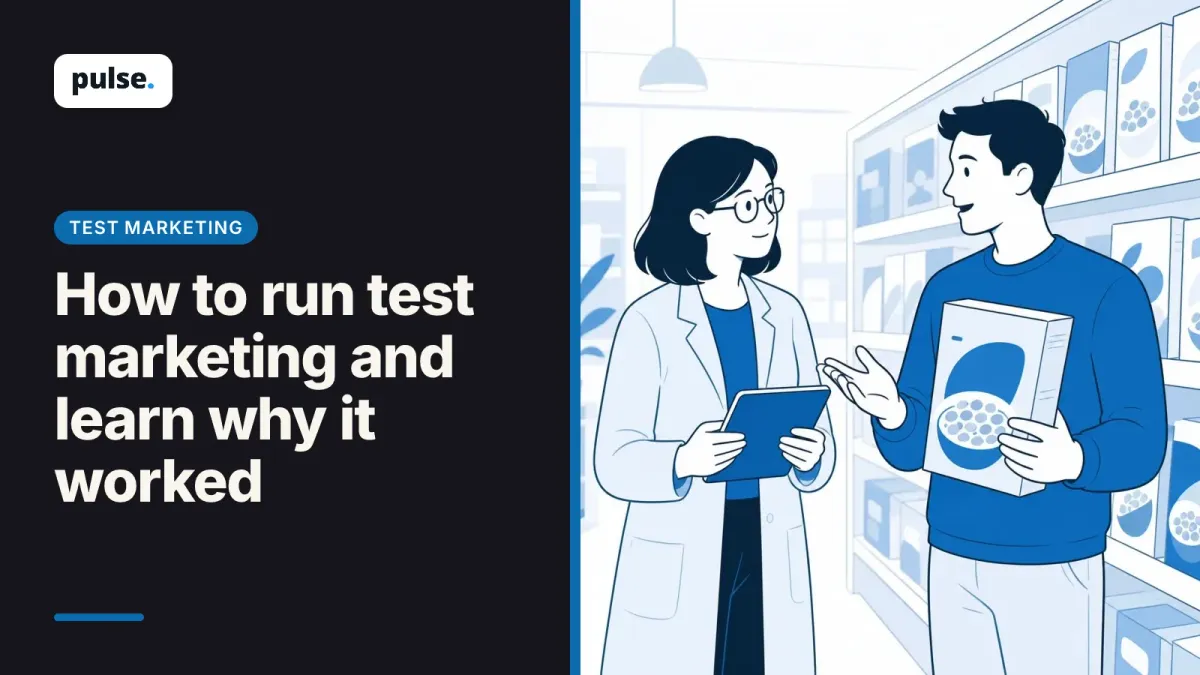
Your team at a breakfast cereal company has a new range of oat cereals ready. The plan is to sell it in a few cities first, and your manager will then ask one thing: should we launch everywhere?
Selling in a small, real market before a full launch is called test marketing, and it shows what people do with their own money.
If you want to know whether people buy the cereal and buy it again, the sales from the test cities tell you. If you want to know why some shoppers never came back, you have to ask them.
Three choices make a test market worth its cost: the kind of test, the result that means go, and who you talk to after.
By the time the oat cereal reaches a test city, it has passed earlier checks, and people said they liked the idea and the taste. A test market is the first time shoppers pay their own money, next to rival cereals on a real shelf. So it shows whether they buy once, and whether they come back.
Buying once is called trial, and buying again is called repeat. A test market also shows where the cereal sells, how it sits beside rival brands, and whether stores, stock and delivery cope with real demand.
Earlier steps answer smaller questions. A concept test checks the idea before anything is made. A product test puts the cereal in people's kitchens before launch. A test market puts it on sale.
That realism has a price. The company needs real stock, store space and months of time. Rival brands also see the cereal on the shelf long before the full launch.
Each kind of test market answers a different launch question, and each costs you something different.
| Kind of test | How it works | The question it answers | What it costs you |
|---|---|---|---|
| Standard test market | Sold through normal stores in a few chosen cities | Will it sell in real conditions? | The most time and stock, and rivals see it early |
| Controlled test market | A research firm or retail partner places it in agreed stores | Does it sell when shelf space and price are held steady? | Fees to the partner, and fewer stores than the real launch |
| Simulated test market | Shoppers choose from a mock store, in person or online | How might it sell before stock is made? | Shoppers don't spend real money in a real store |
| Online test | A limited online release, targeted ads or a landing page in one region | Will people click and order through this channel? | It shows online buyers only |
| Soft launch | The full product released quietly in one market | Does the whole operation work, from factory to shelf? | It is close to a real launch, so harder to undo |
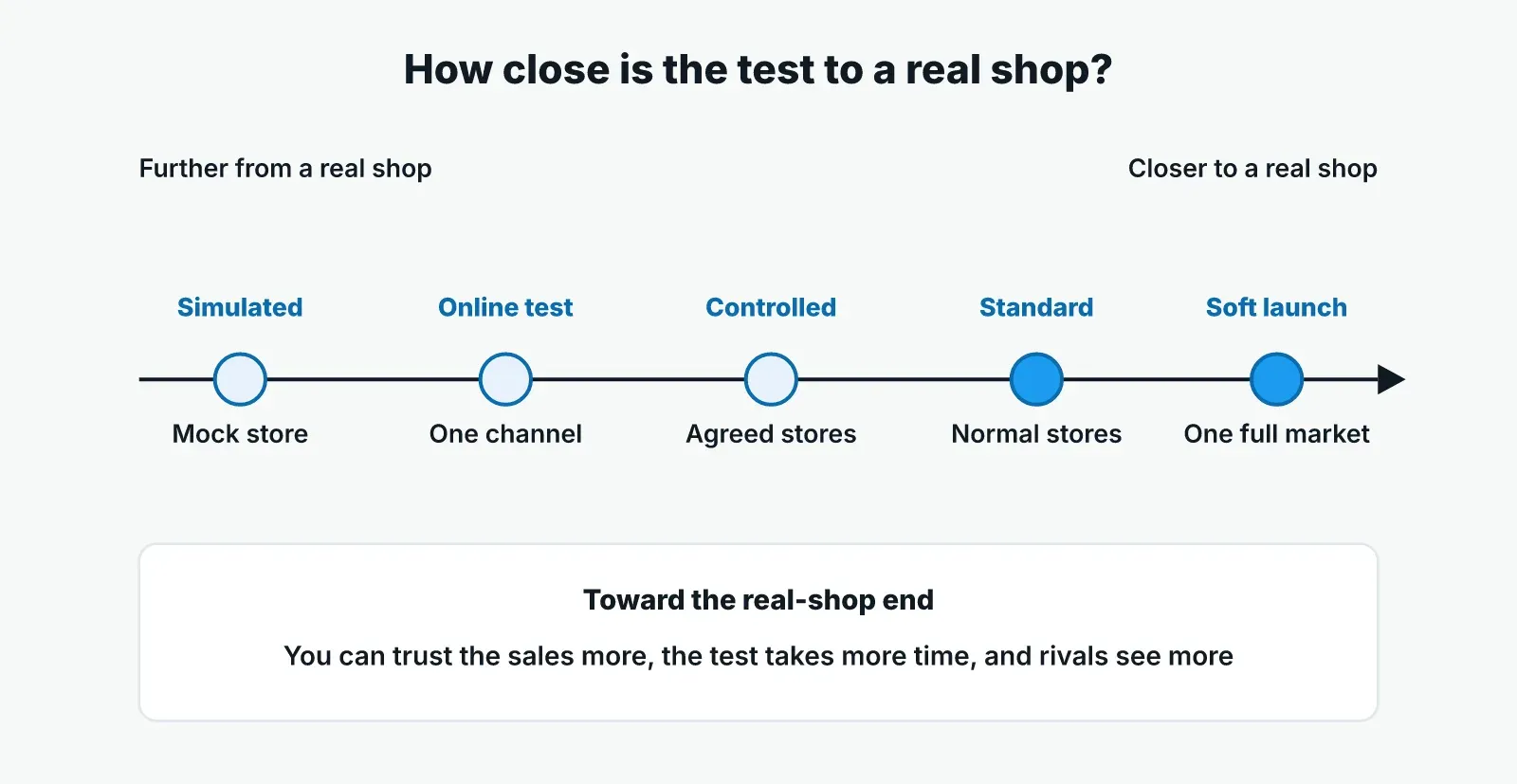
The closer the test is to a real shop, the more you can trust the sales. But it also takes more time, and your rivals see more.
Say the test has run for a few months and sales look fine. Without a rule written down in advance, "fine" can turn into a yes, because the launch is already planned. So before the test starts, agree with your manager what result means go, what means wait and what means stop.
Agree what trial and repeat would mean go, wait or stop, and which store types matter most. Without a target, write the rule in words: "go if shoppers who try it keep coming back in every test city".
Choose cities whose shoppers, stores and prices look like the places the full launch will reach. A city full of health food shops tells you little about how the cereal will do in supermarkets.
Keep one similar city where the cereal is not on sale. That city is called a control market. It shows what changed in the cereal aisle anyway, so you don't credit the new range with a change that happened everywhere.
Note every rival discount, one-off promotion and week when stock ran out in a test city. Each one can lift or sink sales for reasons unrelated to the cereal. The record lets you read the result fairly.
Say the sales report shows plenty of shoppers tried the cereal, but few bought it again. The number tells you something went wrong after the first box. It can't tell you what, so the next step is to ask the people behind the number while the test is still running.
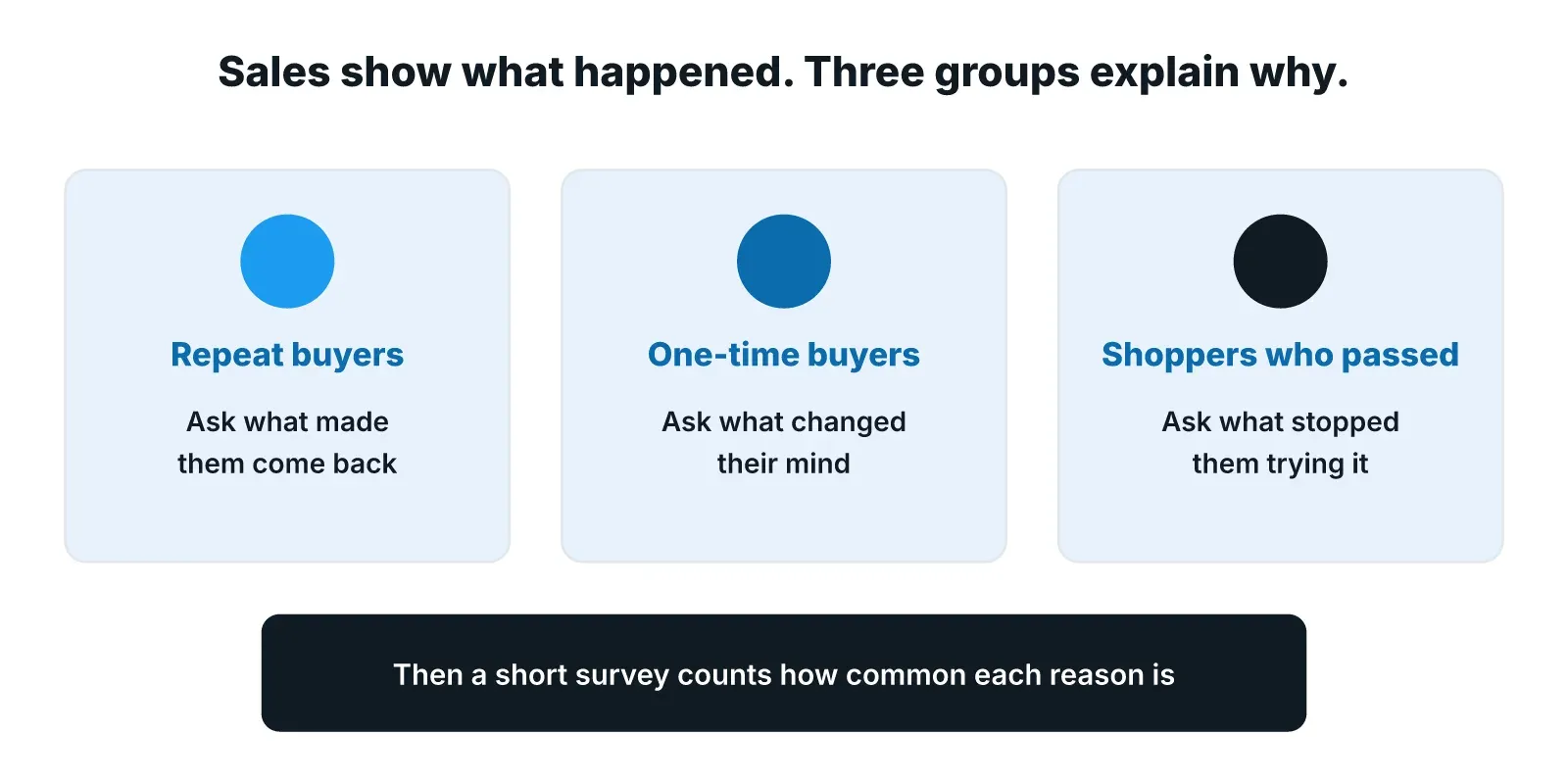
Three groups hold different answers. Repeat buyers can tell you what made them come back. One-time buyers can tell you what changed their mind. Shoppers who saw the cereal and passed can tell you what stopped them before they tried it.
Each group needs its own questions, and how to run the interviews matters as much as who you ask. Ask about the last time they stood in the cereal aisle, because a real moment is easier to recall than a guess about next month.
Say a one-time buyer says the cereal was "not worth it". When you ask "not worth it compared with what?" the answer shows the problem was the box, which was empty within a few days. The taste was fine. That points to a bigger box or a better price for the box, and the recipe can stay.
A leading question can plant the answer you hoped for, so judge whether a follow-up question was fair before you trust a quote.
If your manager needs to know how common each reason is, follow up with a short survey of shoppers in the test cities. The interviews find the reasons, and the survey counts them.
Say the launch date is close and a rival brand is working on something similar. A long test in real stores would show that rival the cereal months early. In that case a lighter step, such as a simulated test, an online test or a soft launch, may answer your question faster.
A lighter step fits when the risk sits in the message or the price more than in the product. A simulated or online test, followed by interviews, can show whether the message works for shoppers. It also fits when the product is cheap to change after launch, because a soft launch lets you fix problems as you go.
A full test market earns its cost when a wrong launch would be hard to undo. Think of a national rollout, new production lines, or a new kind of store. If the open question is about people more than sales, other customer research methods may answer it before any stock is made.
Run a full test market when a failed launch would cost more than the months it takes and the early look it gives rivals. If the main risk is the message, the price or the box, test those first with a lighter step and interviews.
The reason behind a weak repeat rate is easiest to find while the test is running and shoppers still remember the aisle. Pulse runs AI-moderated voice interviews that people open by link on a phone or laptop. So buyers and non-buyers in the test cities can take part without a scheduled call.
The AI moderator asks every participant the same well-formed questions from one interview guide. Its follow-ups build on what the person said earlier, and a vague reply such as "not worth it" gets a second question. You can invite your own customers from a list or have shoppers recruited. Each group, from repeat buyers to shoppers who passed, gets its own profile and screener.
Surveys run alongside the interviews in the same study, so the count and the reason arrive together. One study can also run across several markets from one brief. Pulse groups the answers into themes, each with the quotes behind it, and every quote links to its transcript. What the company changes is a decision for you and your manager. To see how this would work for your next launch, book a demo.
Test marketing means selling a new product in a small, real market, such as a few cities or one online channel, before the full launch. It shows whether shoppers buy it and buy it again with their own money, and whether stores, stock and delivery can handle real demand.
The main advantage is real buying. Shoppers spend their own money next to rival products, which is closer to the full launch than a survey or mock store. The disadvantages are cost, time and rivals seeing the product early. A test market also shows only what happened, so you still need interviews to learn why.
There is no fixed length. A test market needs to run long enough for shoppers to buy a second time. So it depends on how often people buy in that category. A cereal that people buy every week gives a repeat reading sooner than a product people buy once a year.
Choosing an AI assistant for research? Match it to the evidence your question needs, then test whether every finding opens to the source behind it.
Jobs to be done interviews at scale: how to keep hundreds of interviews on track, sort what buyers say and check each reason across groups.
How to write a screener survey that lets the right B2B buyers into your interviews: role checks, hidden criteria, quotas and a test run.