Participant recruitment methods: 5 ways to find people
Participant recruitment methods compared by who you need: your own list, panels, referrals, networks and recruiters, plus a check before you set a date.
How to scale customer interviews without adding researchers: your team keeps the study design and the judgment, and AI moderation runs the interviews.
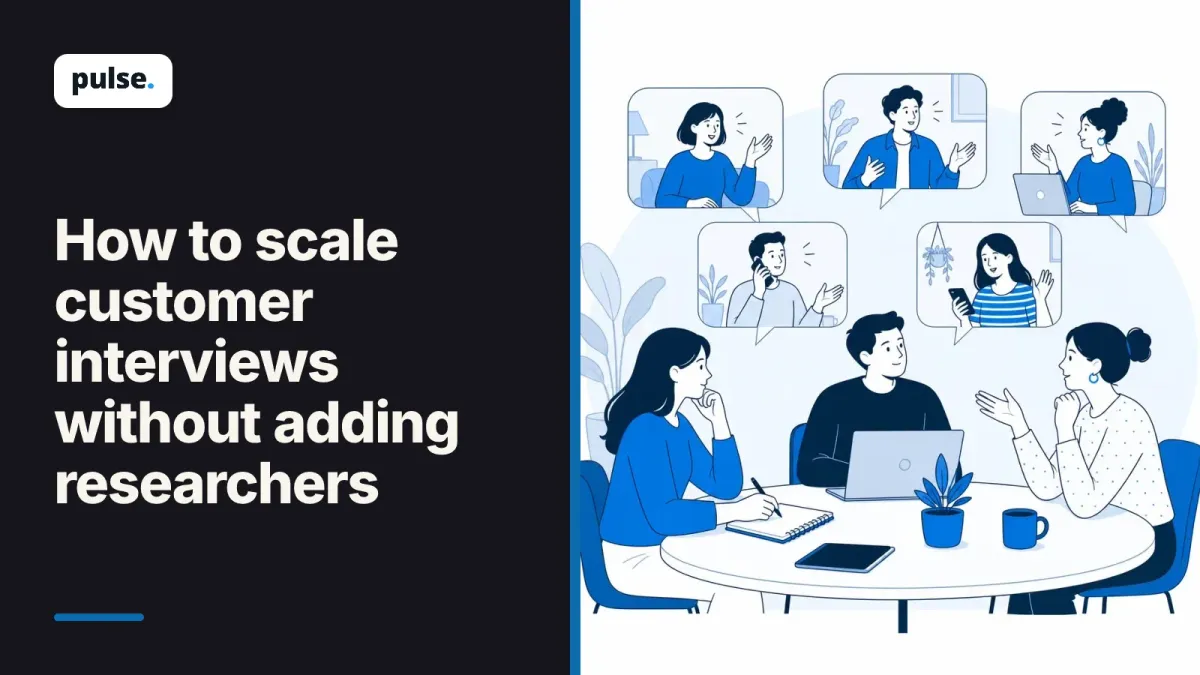
Your team just got a request for customer interviews from the product team, the sales team and the support team at once. You're on the research team at an accounting software company, and your team can run one study at a time. So how do you say yes to all of them?
You can scale customer interviews without hiring more researchers if you split the work. Your researchers keep the parts that need judgment, such as the question and what the answers mean. AI moderation takes the parts that repeat, such as booking times, asking the questions and writing up each conversation. Every finding goes into one shared record, so the next study starts from it.
Each of the three requests needs interviews, and every interview needs a researcher for an hour and a free time in two calendars. So customer interviews stop scaling as soon as your researchers' hours run out. A second country or group of customers adds more hours.
Most teams then run fewer interviews, ask a narrower question or wait for an agency, which is an outside research firm. But with fewer interviews, you can't trust a theme across groups of customers. A narrower question can miss the reason you wanted. And an agency's results can arrive after the decision.
So the answer is to change who does which part of the work.
Your researchers feel busy with every part of a study, but most of the hours go into steps that repeat.
The interview guide is the list of questions every interview follows. A theme is a pattern that shows up across many interviews.
Framing the question, writing the guide and deciding what people meant need a researcher's judgment. Hand the rest to software.
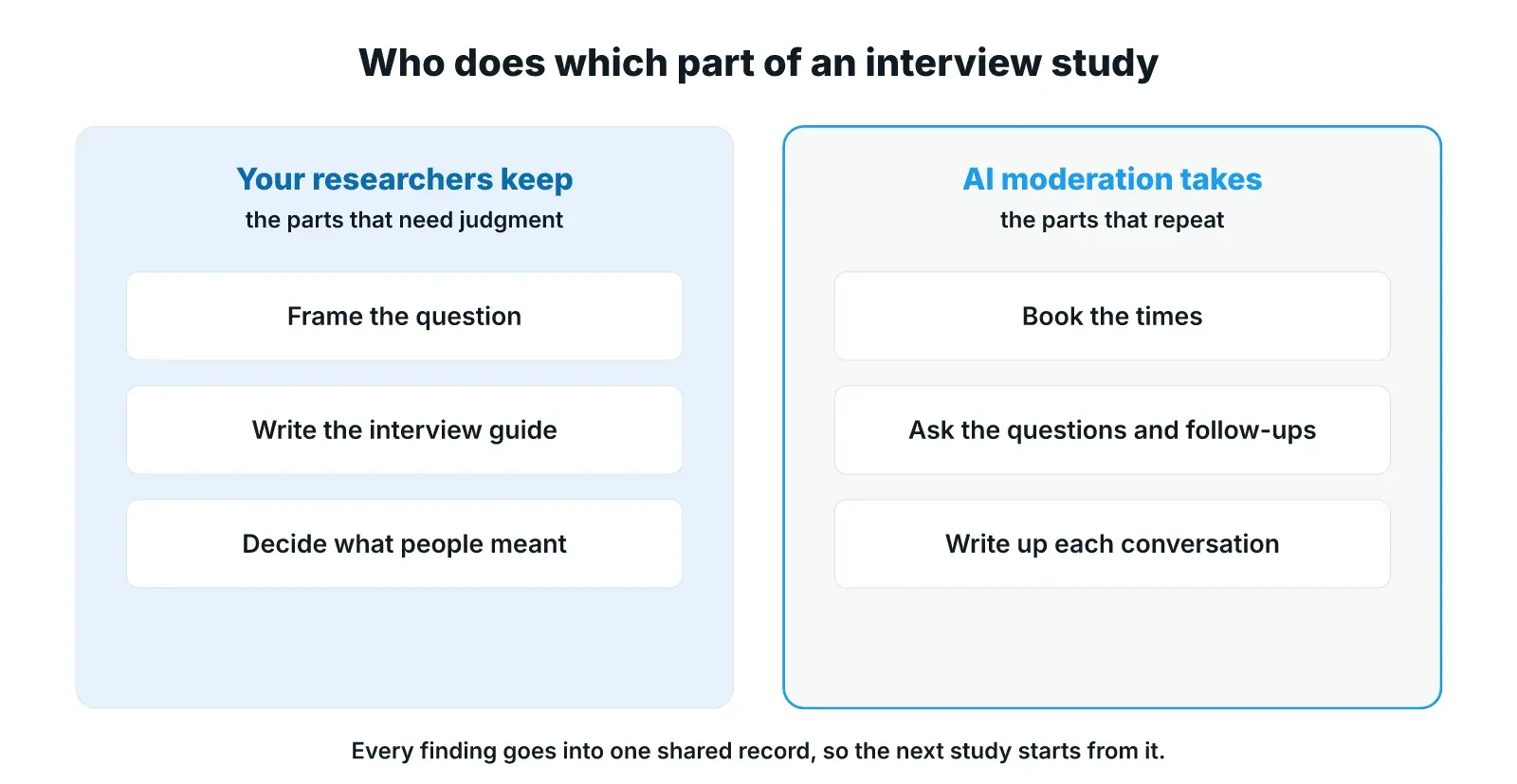
AI moderation means an AI runs the interview. It asks the questions and the follow-ups, the way a human interviewer would. Customers take the interview by opening a link on a phone or a laptop, so interviews run at the same time instead of one after another.
Every customer hears the same well-formed questions from one guide. The follow-up questions build on what the customer said earlier in the conversation, and a vague reply gets a second question. On Pulse, results arrive within minutes of the last interview.
Your manager may worry that an AI won't dig as deep as a person. A pre-registered study by Deng, Liu, Toubia and Jain (arXiv, September 2026) compared AI-moderated (139 people), human-moderated (24 people) and static interviews with fixed questions (154 people), 317 people in all, with three industry partners. Pre-registered means the researchers published their plan first.
AI moderation matched human moderation in depth and covered more themes. With the budget held the same, it also found significantly more customer needs than human moderation or static interviews. So in that study, more interviews didn't cost depth.
On Pulse, you set the research question, the areas to cover, the audience and the screener, and Pulse builds the interview from that brief. A screener is the short set of questions that checks each person fits the study. Your team can edit the questions before launch. Read more about AI-moderated interviews with your customers.
Say the sales team wants to know why people who try the app for free don't buy it. They'll ask how many interviews you need.
Enough customer interviews is the point where new interviews in each group stop adding new themes. So size the study by the groups of customers and the countries you need to compare. When a group's themes stop changing, stop adding interviews there. Researchers call this saturation.
If the sales team wants to know how many customers feel a certain way, pair the interviews with a survey. Interviews explain why, and a survey counts how many customers give each reason. There's more in interviews versus surveys for finding why customers leave.
Say the support team wants to compare customers in the two countries where the company sells. If each country runs its own study, you can't tell whether a difference comes from the customers or from the study.
On Pulse, one study runs in several countries at once from one brief and one interview guide. So a difference in the findings comes from the customers. That's hard to be sure of when several agencies each run their own version.
Pulse runs interviews in 240+ languages, enabled on request, including every Indian language. One study can run in several languages at once, so the support team writes the guide once.
Your manager will want the last interview to be as good as the first. That comes from checking any finding. On Pulse, every theme carries its quotes, and every quote links to its transcript, the written record of one interview.
A randomized experiment by Guven and colleagues (arXiv, October 2026) compared answers in AI-led and human-led interviews with 41 people. The authors describe it as the first direct comparison of its kind. Answers were overwhelmingly on-topic in both, with no detectable difference in how specific they were.
Still, read a sample of transcripts in every study and check the follow-ups. Learn to judge interview quality in one transcript, so you catch a weak question before it repeats across hundreds of conversations.
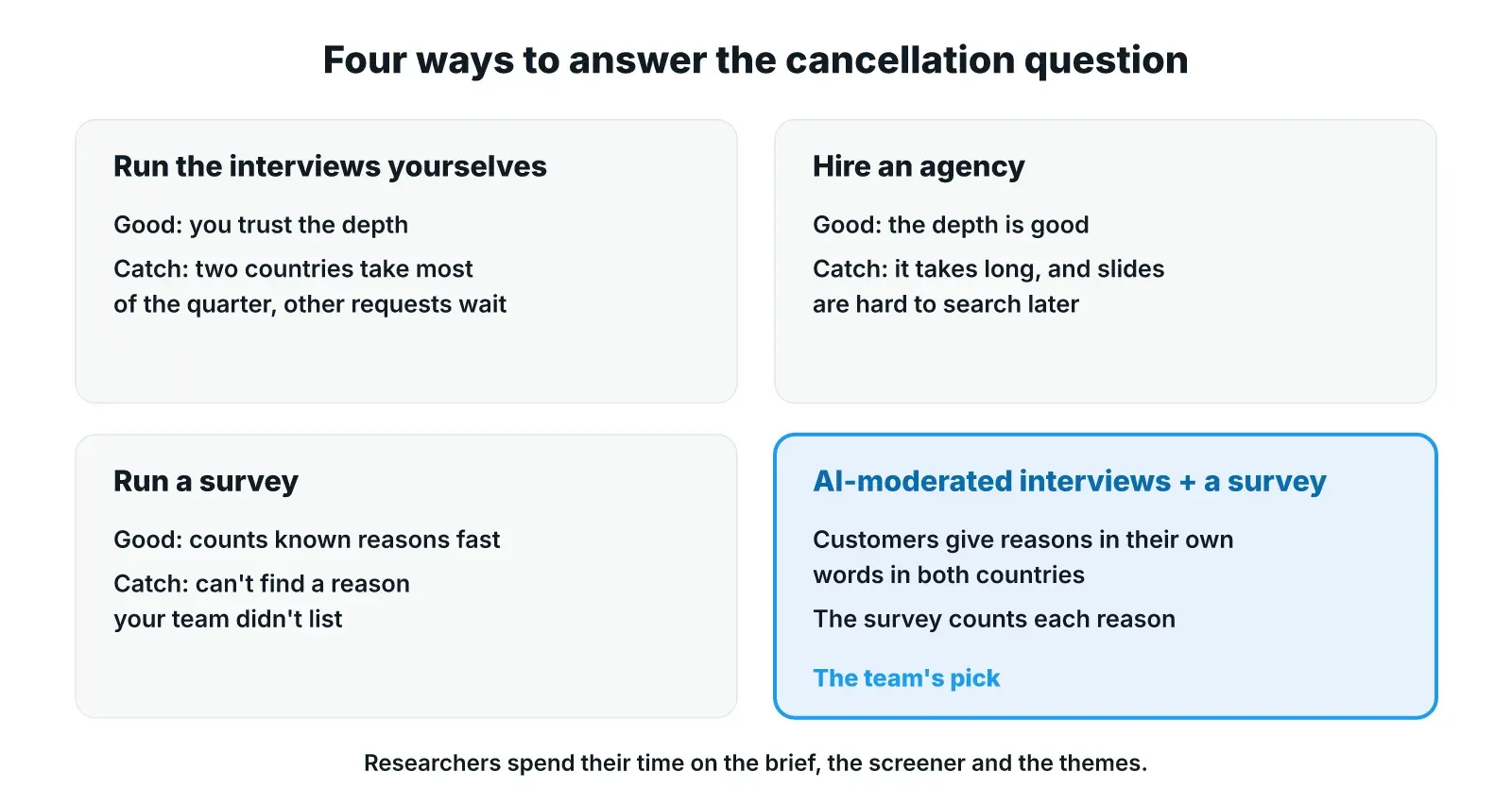
Say your team has three researchers. The product team needs to know why small businesses canceled last quarter, in both countries. Your team weighs four options.
Your team picks the last option. The researchers spend their time on the brief, the screener and the themes, and check the top themes against transcripts. The study then goes into the shared record, where the sales and support studies start from it.
These five steps help when more teams ask for interviews than your researchers can run.
Set the question, the areas to cover, the audience and the screener in one place, and review the interview before launch.
Let customers take the interview by link, so nobody books a time.
Add interviews only where themes are still changing.
Open the quotes behind every theme before you share it.
On Pulse, the Insights library keeps every study's findings in one place, queryable across projects, so the next team starts from what customers already said.
For a hands-on version, see a step-by-step playbook for running interviews. Pulse offers a free trial and a free study, so you can try the steps on a real question. Book a demo of Pulse to start.
They overlap. User interviews focus on people using a product, often on how easy it is to use. Customer interviews cover anyone who buys or uses it, including people who left and people who pay but never log in.
For example, at the accounting software company, a user interview might be with a bookkeeper who sends invoices daily. A customer interview could also be with the business owner who pays for the plan.
Check five things. The software should build the interview from your brief and reach both your own customers and recruited people. It should follow up on vague answers, trace every theme to a transcript and keep studies searchable. Ask each vendor to show all five in a live study.
Data shows what customers do, and interviews show why. A dashboard can show cancellations going up, but only customers can tell you what changed for them. A product or pricing decision turns on those reasons.
It's a simple rule for interviewers. The person being interviewed should do most of the talking. Open questions and patient follow-ups keep that balance at any number of interviews.
Participant recruitment methods compared by who you need: your own list, panels, referrals, networks and recruiters, plus a check before you set a date.
Semantic vs latent themes, from Braun and Clarke's paper "Using thematic analysis in psychology", shown on real-life quotes, with when to use each.
How to choose a transcription service for research interviews: test each option on your own audio with five simple checks, from accuracy to data safety.