
Participant recruitment methods: 5 ways to find people
Participant recruitment methods compared by who you need: your own list, panels, referrals, networks and recruiters, plus a check before you set a date.
How to set up a remote diary study people finish: how long to run it, how often to prompt, what to pay and what the app needs to do.

Imagine you work on the product team at a recipe app. Your manager wants to see how people really cook on busy weeknights. A survey only shows what people say they do. So you plan to have people log their dinners from home, as they cook. How long should it run, how often should you ask, and what should you pay?
That plan is a remote diary study: a study where people log short entries on their phone about one part of their day, over days or weeks, using the diary method.
Run it long enough to see each person cook from the app several times. Ask for one entry each time they cook, rather than many check-ins a day. Pay for all the time you ask of people, and end with a short interview.
Those three choices also tell you what the app has to do. So start with the length and work down.
A diary study should last long enough to catch the behavior several times for each person, and no longer. People get tired of logging, so every extra week can cost you entries. Nielsen Norman Group, a UX research firm, advises basing the length on how often the behavior happens.
So start there. A daily habit shows up often, so a short study can be enough. Something people do once or twice a week needs more weeks to show up several times.
Say people cook from the recipe app two or three nights a week. Then three weeks gives each person several dinners to log. One week might catch only one or two, which isn't enough to see a pattern.
Longer studies need more reminders and more pay. If you can't afford both, make the study shorter.
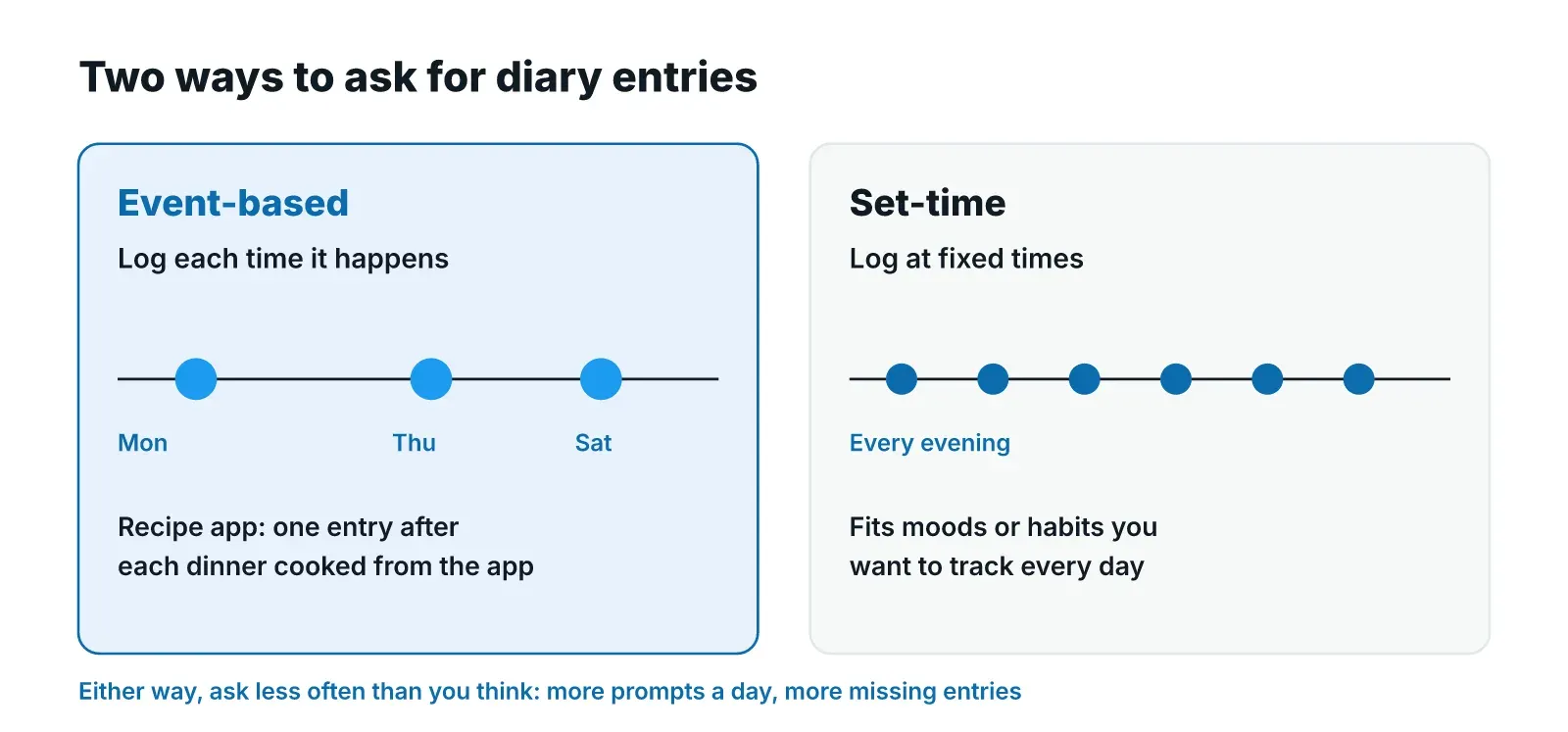
There are two common ways to ask for entries. In an event-based diary, people log each time the thing happens, such as cooking a dinner. In a set-time diary, people log at fixed times, such as every evening. Event-based fits behavior that comes and goes. Set times fit moods or habits you want to track every day.
Whichever you choose, ask less often than you think. A 2023 study from the University of Alabama at Birmingham looked at three daily diary studies with family caregivers of people with dementia. It measured compliance, which means the share of asked-for entries people actually sent. The lowest compliance, 78%, came from an 8-day study that asked for four diaries a day. The authors say this suggests that several surveys in one day lower compliance.
In plain words, when you ask more often, more entries go missing.
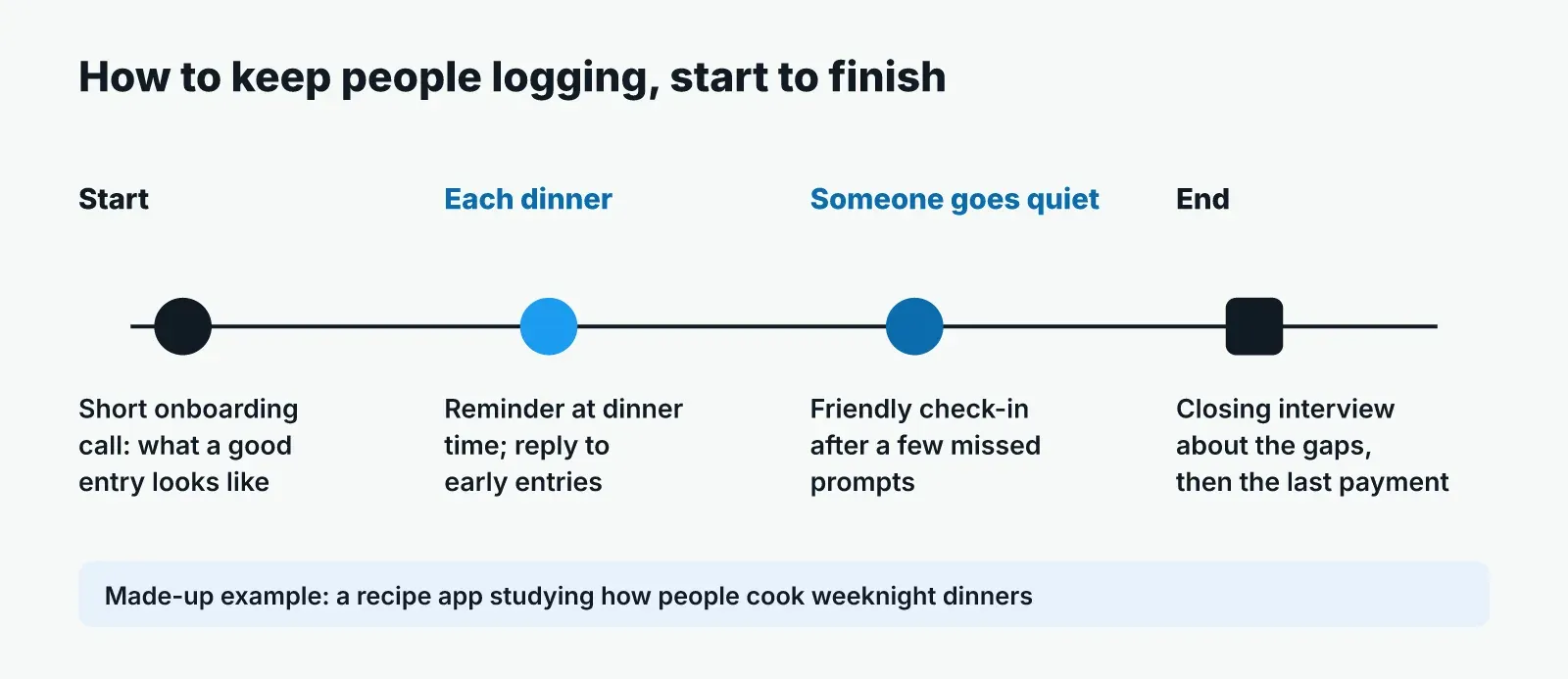
For the recipe app, ask for one entry after each dinner cooked from the app. A quick photo of the meal and two lines on how it went is enough. Skip the extra morning and lunch check-ins.
Pay for the total time the study asks of people. That includes setup, every entry and any closing interview. Nielsen Norman Group's 2024 guide suggests about $40 per hour of total expected time, as a broad guideline for a general sample of US-based participants. It says to adjust that for very specialized audiences. Rates also differ by country, so check what's normal where your people live.
Pay alone may not keep people logging, though. The same Alabama study found that compliance did not change with incentives, reminder method or study length. It also found that once-a-day surveys with total incentives of $82 to $91 were enough to keep compliance high. That's one group of family caregivers, so treat it as a hint, not a rule.
So pay fairly for the time, but don't expect pay to rescue a study that asks too much.
It also helps to pay in stages, such as part after the first week and the rest after the final interview. That gives people a reason to keep going. For the recipe app, add up the minutes for setup, each dinner entry and the final interview, then pay for that total.
People drift away from a diary study when logging feels like a chore, or when nobody seems to read their entries. The right app and a few simple habits keep them going. Start with the app, because people meet it every day. Then look at how you run the study.
People should be able to log in seconds, on the phone they already carry, with no long sign-up.
A photo of the pan or a short voice note is easier than typing after a long day. The more ways people can log, the more moments you catch.
For the recipe app, a reminder at dinner time works better than one at noon. The app should also show you who has gone quiet.
You'll want to ask a question about a single entry, take everything out at the end, and keep people's personal details safe. These checks work for any tool you look at.
Show what a good entry looks like. One clear example at the start saves a week of thin entries.
A quick note such as "Thanks, what did you swap in for the garlic?" shows someone is reading.
If a person misses two or three prompts in a row, send a friendly message. Ask if something changed.
Entries show what happened. The interview asks about the gaps, such as the nights people ordered takeaway instead, and why.
If you can only fix one thing, ask for fewer entries. Then pay for the time and close with an interview.
The closing interview is where the gaps in a diary get explained. Pulse runs AI-moderated interviews by voice, video, text chat, phone call or WhatsApp, so you can talk with the same people who kept the diary. You can invite them from an uploaded list, a public link, a QR code or WhatsApp.
The AI moderator asks a second question when an answer is vague, and builds on what the person said earlier. Pulse then groups the answers into themes, with the quotes behind each one traced to its transcript. Everything sits in the insight repository beside your earlier studies.
Your team still sets the length, the prompts and the pay. To see how the closing interviews would run, book a demo, start on the $0 Explorer plan, or ask for a free study.
No single number fits every diary study. Each person gives you many entries, so you need fewer people than a survey does. Choose enough people to cover the groups whose habits might differ, such as people who cook every night and people who cook once a week. Then add a few extra, because some people will drop out.
Yes. Many people already use chat apps every day, so logging there takes little effort. People can send a photo, a voice note or a few lines in the moment. Before you start, check that you can export the messages and keep personal details safe, and agree how people will get reminders.
Journaling is private writing for yourself, on any topic, that nobody else reads. A diary study is research. A team asks a group of people to log one part of their life with the same prompts, so the team can compare entries and learn from them. Everyone taking part knows their entries will be read.
Reach out once, kindly, and ask if anything changed. Sometimes life got busy for a week, and sometimes the prompts were confusing. If they come back, carry on. If they don't, keep the entries they sent, pay for the time they gave, and note the gap when you report.
Participant recruitment methods compared by who you need: your own list, panels, referrals, networks and recruiters, plus a check before you set a date.
Semantic vs latent themes, from Braun and Clarke's paper "Using thematic analysis in psychology", shown on real-life quotes, with when to use each.
How to choose a transcription service for research interviews: test each option on your own audio with five simple checks, from accuracy to data safety.