When a concept test says yes and the launch still fails
Concept test results overstate demand when a yes costs the respondent nothing. How to read them, what to check before launch, and what to ask after.
Price increase research tells you which customers a rise will lose and which value story holds. Here is how to run it before the announcement.
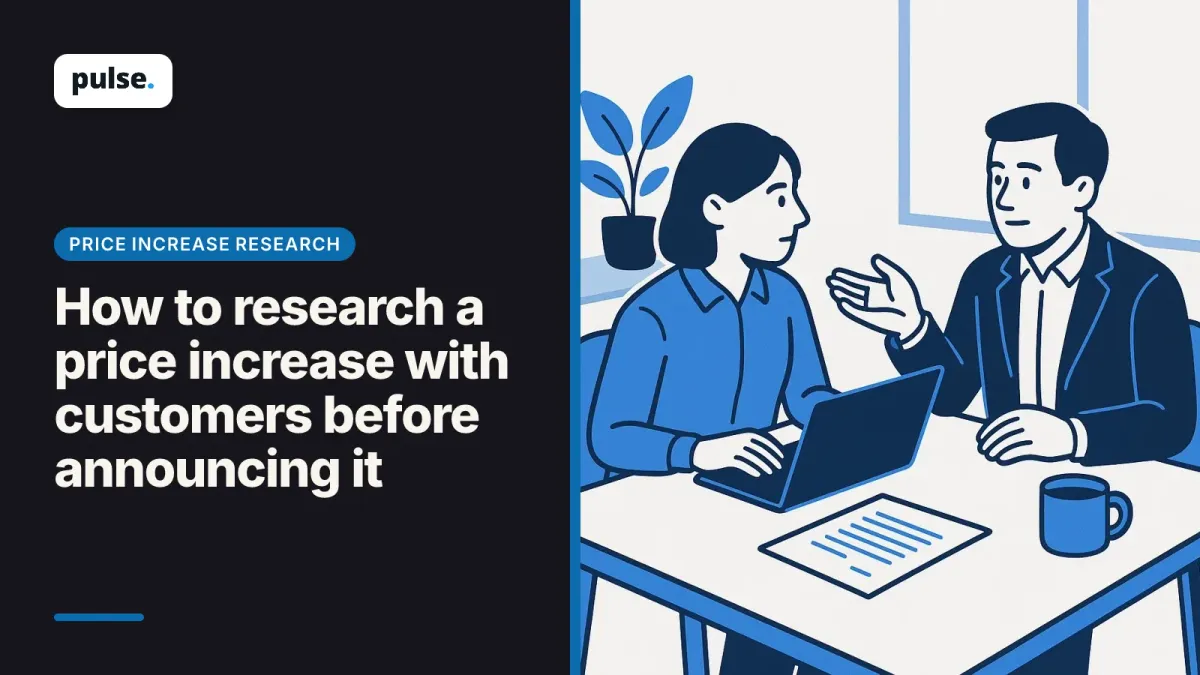
Illustrative example: the new price list goes to every account on Monday. By Friday, your biggest customer in one market wants a call about "other options". Price increase research moves that warning to before the announcement. It shows which segments the rise could lose, which explanation they'll accept and what sales will hear on renewal calls.
Below, you'll get six steps, from mapping who's exposed to a rollout plan, plus a worked example.
A segment is a group of customers who share something that matters here, such as size, market or plan. In a large company, one rise hits many of them, each with its own contracts and options. So treat it as a set of segment decisions, each with its own evidence.
Price increase research answers five questions, and each has its own best source.
| Question | Where the answer comes from |
|---|---|
| Who does the rise touch, and when do they renew? | Billing and CRM data |
| Who is likely to switch, and to what? | Interviews, then a survey to count |
| What do customers value enough to stay? | Interviews |
| Which explanation of the change reads as fair? | A framing test with separate groups |
| What objections will sales and customer success hear? | Interviews, in the customer's words |
Perceived value sits under every one of these questions. In BCG's survey of more than 13,000 consumers in 12 markets, published in August 2026, 67% said they would not buy a product they could afford if they did not perceive strong value. That's a consumer finding. In B2B, the same test is simple. Can your buyer defend the new price in their own budget review?
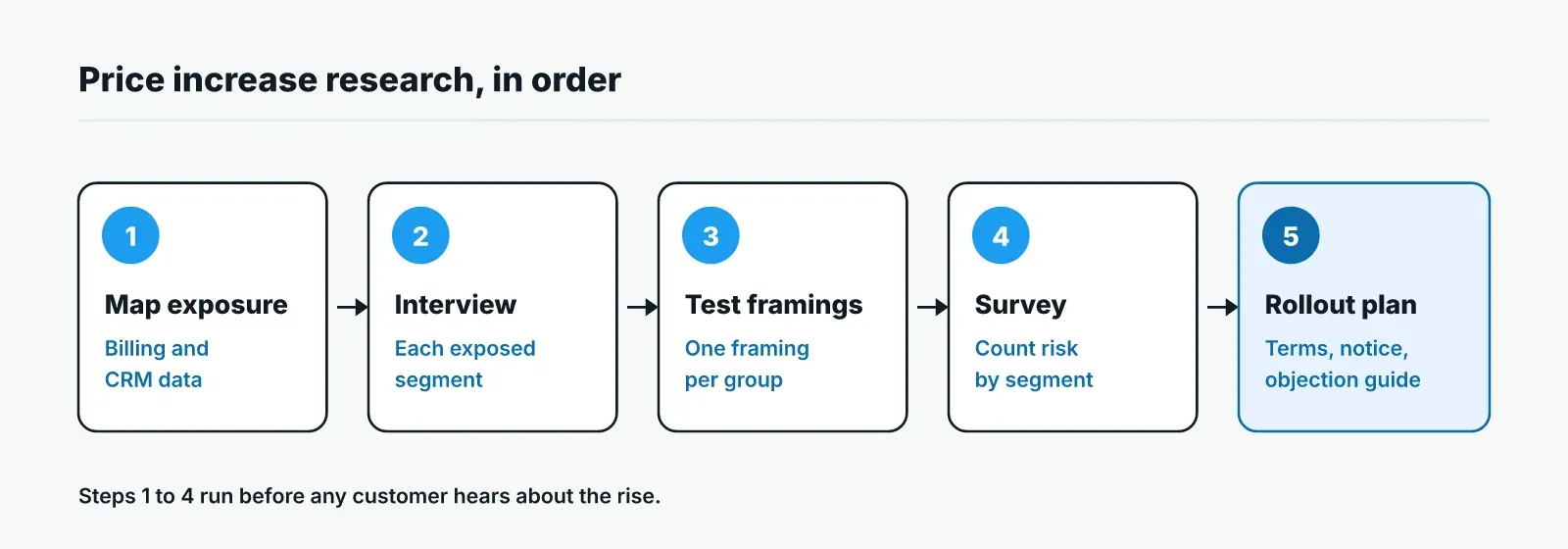
Start with your own data, then talk to customers without naming the new price. The data shows who the rise touches. The interviews show how they'd react, and why. Do both while the plan can still change.
Pull every account the rise touches. Sort them by segment, contract value, market and renewal date. Then flag two kinds of account.
Use the map to set how many interviews each segment gets, based on revenue at risk. A few large accounts can matter more than many small ones.
Frame the study as value and renewal research. Ask about the last budget review, the option they'd turn to and what they'd cut first. Late in the interview, raise a possible cost change. Ask what would happen inside their team. Here's a before and after:
| Weak question | Stronger question |
|---|---|
| Would you accept a 10% increase? | If the cost of this plan went up next year, what would happen inside your team? |
| Is our product good value? | When you last reviewed this budget line, what did you compare it with? |
| Would you leave over a price rise? | Who would need to approve a higher cost, and what would they want to see? |
The moderator is the person who asks the questions. A customer talking to their account manager is also talking to the person they'll haggle with next. They answer with that in mind. So use a researcher or another neutral moderator. The post on how moderator bias shapes answers covers what to watch for.
Have legal and communications review the discussion guide before you start. Anything said in an interview can reach the market.
Once you know why each segment would push back, test how to explain the change. Then count how many accounts are at risk. The interviews give you the words for both.
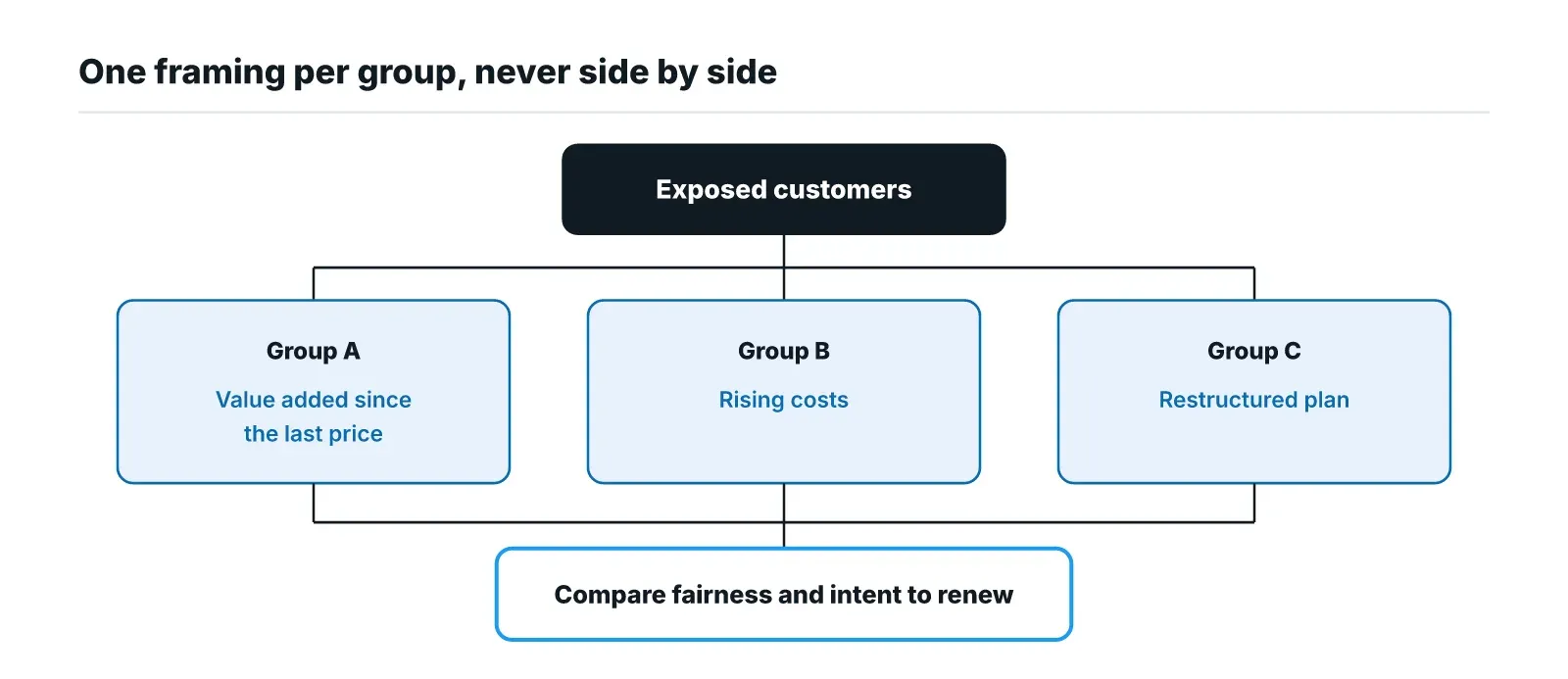
A framing is the way you explain the change. Write two or three framings of the same rise. Common ones are the value added since the last price change, rising costs and a restructured plan.
Show each framing to a separate group, so nobody compares them side by side. Ask whether the change seems fair and whether they'd renew. Build the framings from words customers used in the interviews. A sentence no customer would say out loud tends to read as spin.
Survey the exposed customers after the interviews. Build the answer options from the reasons and options customers gave. Options written from inside guesses just hand back what the team already expected. That's where a fixed questionnaire stops.
Read the results by segment and contract size. An average is like the temperature of a whole house. It can read fine while one room is freezing, and that room might hold your largest accounts in one market. Treat what people say about renewing as a direction, never as a churn forecast.
Set the size and timing of the rise for each segment. High-risk accounts get earlier notice or a longer transition. Low-risk segments move on standard terms.
Then build the objection guide for sales and customer success. List each objection in the customer's words. Add the answer that held up in the framing test, and the evidence behind it.
For illustration, a lending platform plans to raise its platform fee for business customers in two markets. The exposure map shows the new fee crosses an approval limit for mid-sized accounts in both. The steering committee has to decide whether both markets get the same terms.
The team has four sources, and each has limits.
| Source | What it shows | What it can't show |
|---|---|---|
| Exposure map | Revenue at risk and renewal dates | Intent |
| Interviews | What each market's buyers would compare the fee with | How many share that view |
| Framing test | Which explanation reads as fair | How many accounts are at risk |
| Survey | Accounts at risk by segment, using answer options from the interviews | The reasons behind the numbers |
The team weighs them in order. Interviews set the reasons. The survey checks how far each one spreads. The map turns that into revenue at risk, so the committee sees each market in money as well as quotes.
Then the evidence sets the terms. Say buyers in one market call the platform part of daily loan work, with no real option soon. That market moves on standard terms. Now say buyers in the other keep naming an in-house build their engineers could deliver. That market gets a longer transition, a value framing and an objection guide that answers the in-house option.
The hard part is hearing from exposed accounts in confidence, then handing sales the exact words customers used. Pulse runs AI-moderated voice interviews that ask every participant the same well-formed questions. It follows up when an answer is thin.
You can start straight from the exposure map. Invite those customers from a list you upload, and they take the interview by opening a link. There are no calls to schedule, and no account manager needs to be in the room.
Every interview arrives as a full transcript alongside its recording. Each theme traces back to the quotes behind it, so the objection guide quotes real customers. Pulse runs surveys too, which keeps the reasons and the counts in one study. The pricing lead still sets the number, the timing and the trade-offs.
Here's one rule for the rollout. If a segment crosses a budget limit or has a named alternative in play, give it its own terms, notice period and framing. Every other segment moves on standard terms. To see how a confidential pricing study would run with your customers, book a demo.
Start early enough that the findings can still change the plan. That means before renewal notices are drafted, and before any notice period begins for your key accounts. If the study can't change the size, timing or framing of the rise, it's only measuring a decision already made.
Frame it as value and renewal research, which it is. Bring in a possible cost change late in the interview, without naming the planned number. Agree with legal and communications what the moderator says if someone asks directly. That way nobody makes up an answer that turns into the announcement.
You can, but treat the answer as a direction only. A customer saying yes in an interview hasn't yet faced the budget review where the real decision happens. So ask what would happen inside their team and who would need to approve a higher cost. Those answers show you where the decision will be made.
Start with accounts where the new price crosses a budget or approval limit. Then add the ones where a named alternative is already in play. Their answers are the most likely to change the plan. Happy, low-risk accounts can come later, as a check that the framing works for them too.
Concept test results overstate demand when a yes costs the respondent nothing. How to read them, what to check before launch, and what to ask after.
How do AI interviews work in customer research? Follow one session from screener to follow-up question to a theme traced to its transcript.
Jobs to be done research gets harder when one account has many roles and business units. How to recruit, interview and merge jobs across them.