When a concept test says yes and the launch still fails
Concept test results overstate demand when a yes costs the respondent nothing. How to read them, what to check before launch, and what to ask after.
Creative pretesting for B2B ads works when the respondents are the buyers the media targets. Who to recruit, what to ask and how to read it by role.
Creative pretesting for B2B ads shows draft ads to people who match the campaign's target roles and accounts, before any media money is spent, and asks whether they understand the message, believe it and know what to do next. Recruit fewer, better-matched respondents than a consumer test would use, and ask open questions before any rating.
A B2B creative pretest is only as good as its respondents, because the questions that matter are about a buyer's judgment. A general panel can say whether it likes an ad. It cannot say whether a claim is credible to a chief financial officer or relevant to an IT lead, because its members are not the people who have to defend that purchase.
Pretesting sits before launch. In-market tests compare live versions on real behavior, and post-launch measurement tracks what the campaign changed. Each answers a different question. The pretest is the last point where the claim, the proof point or the call to action can change before the media plan locks and money is committed.
Recruit the roles the media plan will target, at the kinds of company it will target, and screen on the same criteria the media buyer uses: role, company size, industry and buying stage. If the test audience differs from the served audience, the result describes someone who will never see the ad.
| Segment | Why include them | Screener criterion |
|---|---|---|
| Target role at target-fit accounts | The core audience the media will reach | Job function, seniority, company size and industry matching the media targeting |
| In-market buyers | They read the ad against live alternatives | Evaluating the category now or in the next two quarters |
| Current customers | They can say whether the claim matches their experience | Active account, recruited from your own list |
| Non-customers using another approach | They show whether the claim moves people who chose differently | Uses a competing product or an in-house process |
| Adjacent roles who influence the decision | Budget owners and users judge different things | Named role in the buying committee |
Keep internal stakeholders, sales teams and agency staff out of the respondent pool. They share the brief's assumptions, so their reactions carry the confirmation bias the test exists to remove. Recruit current customers from your own list and non-customers from a panel recruited to the profile.
B2B creative has five jobs: get noticed and credited to the right brand, say plainly what is offered and to whom, make a claim the buyer believes, use the buyer's own vocabulary, and make the next step obvious. Test each job separately, because an ad can pass four and fail on one.
| Job | What to ask | Sign it failed |
|---|---|---|
| Noticed and credited to the brand | Who was that ad from? | Respondents name a competitor or cannot say |
| Says what it is and who it is for | What is being offered, and to whom? | Playback describes a different product or audience |
| Makes a believable claim | What would you need to see to believe that? | Respondents ask for proof the ad does not give |
| Uses the buyer's vocabulary | Which words would you not use yourself? | Respondents flag terms as vendor jargon |
| Makes the next step obvious | What would you do now, if anything? | No clear action, or an action the campaign cannot support |
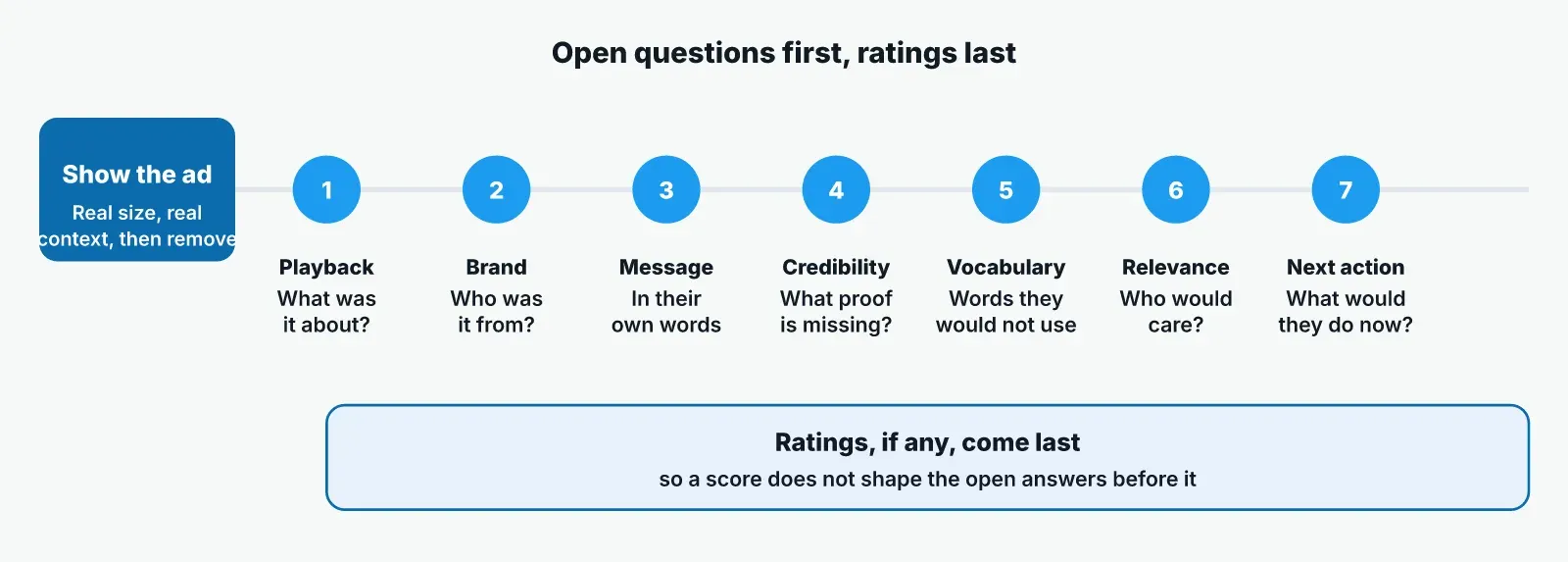
Show the ad as it will appear in market, at its real size and in its real context, then remove it and ask open questions before any rating. The order matters because each question shapes the answers after it. A respondent who has already scored the ad's clarity will then describe it in the terms of the score.
Use this sequence:
Ratings come last, if at all. Spoken answers tend to carry more of a respondent's reasoning than typed ones; the post on how spoken answers surface reasons a typed reply hides covers why, and the post on why completed surveys can still give thin answers covers the survey side.
Read results by role before you read the total. A version that wins with users can lose with the budget owner, and an average across roles hides the split the media plan needs to know about.
A respondent who misread the claim and a respondent who read it correctly and doubted it need different fixes. Fix comprehension first and retest. Judge credibility only once the claim is understood.
Give each respondent one version (a monadic design), or show several versions in rotated order (a sequential design). Without rotation, the first ad seen sets the bar for every ad after it.
Set a planned number of interviews for each role before fieldwork, and keep going while new objections are still appearing. The post on how many interviews you need covers the judgment involved.
In a large company, the pretest has to fit between legal clearance of the stimulus and the media plan locking. This example is hypothetical. The B2B payments unit of a large bank has two ad routes for a paid social campaign aimed at finance controllers and treasury heads. Brand, legal and an agency all sign off.
The team plans the pretest for the week after legal clears both routes and screens to the campaign's targeting: controllers and treasury heads at companies in the size bands the media plan will reach, split between current customers and non-customers.
Pulse recruits participants to that screener or invites existing customers, and runs AI-moderated voice interviews that participants take by link without a scheduled call. Each theme is traced to the quotes behind it, so brand, legal and the agency each get evidence for their own question.
In this hypothetical, one route wins on clarity with controllers, while treasury heads doubt its main claim and ask what it is based on. The team rewrites the proof point, retests it with treasury heads only, and the revised route goes into the media plan on schedule.
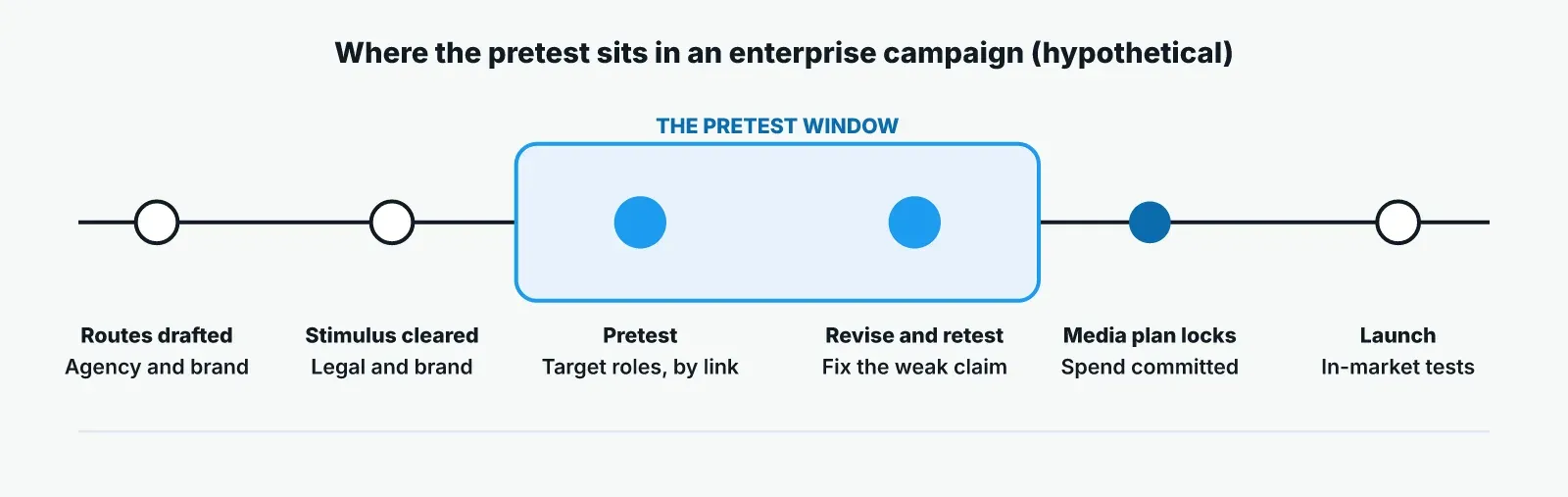
Run it after the ad routes are drafted and the stimulus has cleared legal and brand review, and before the media plan is locked. That window is when the claim, proof point and call to action can still change without reworking the whole campaign.
Mostly as long as it takes to reach the right roles. Senior and specialist buyers are the hardest respondents to reach, so they set the pace. Start recruiting as soon as the targeting is agreed, and do not wait for final artwork to begin screening.
Measure brand attribution, accuracy of the unprompted playback, credibility of the main claim, fit with the buyer's vocabulary and the next action the respondent would take. Read each measure by role, because budget owners and users judge different parts of the same ad.
A pretest explores reactions and reasons before launch, with recruited respondents who match the target. An A/B test measures behavior in market, on live variants served to real audiences. A pretest tells you why a version works; an A/B test tells you which one performs once it is running.
Yes, when the claim itself is uncertain. Test the claim in plain words first, then test the executions that carry it, so a weak message is not blamed on the design. To run both stages with your own buyers, book a Pulse demo.
Concept test results overstate demand when a yes costs the respondent nothing. How to read them, what to check before launch, and what to ask after.
How do AI interviews work in customer research? Follow one session from screener to follow-up question to a theme traced to its transcript.
Jobs to be done research gets harder when one account has many roles and business units. How to recruit, interview and merge jobs across them.