When a concept test says yes and the launch still fails
Concept test results overstate demand when a yes costs the respondent nothing. How to read them, what to check before launch, and what to ask after.
Build a competitive landscape analysis from your buyers first. Learn which alternatives they weighed and why, then fill in the facts with desk research.
Your sales team keeps losing deals to an option that is not on your competitor list. A competitive landscape analysis maps the alternatives a buyer could choose and how you compare. Build it from buyers first. Ask recent buyers, lost prospects and customers who left what they weighed and why, then fill in the facts with desk research.
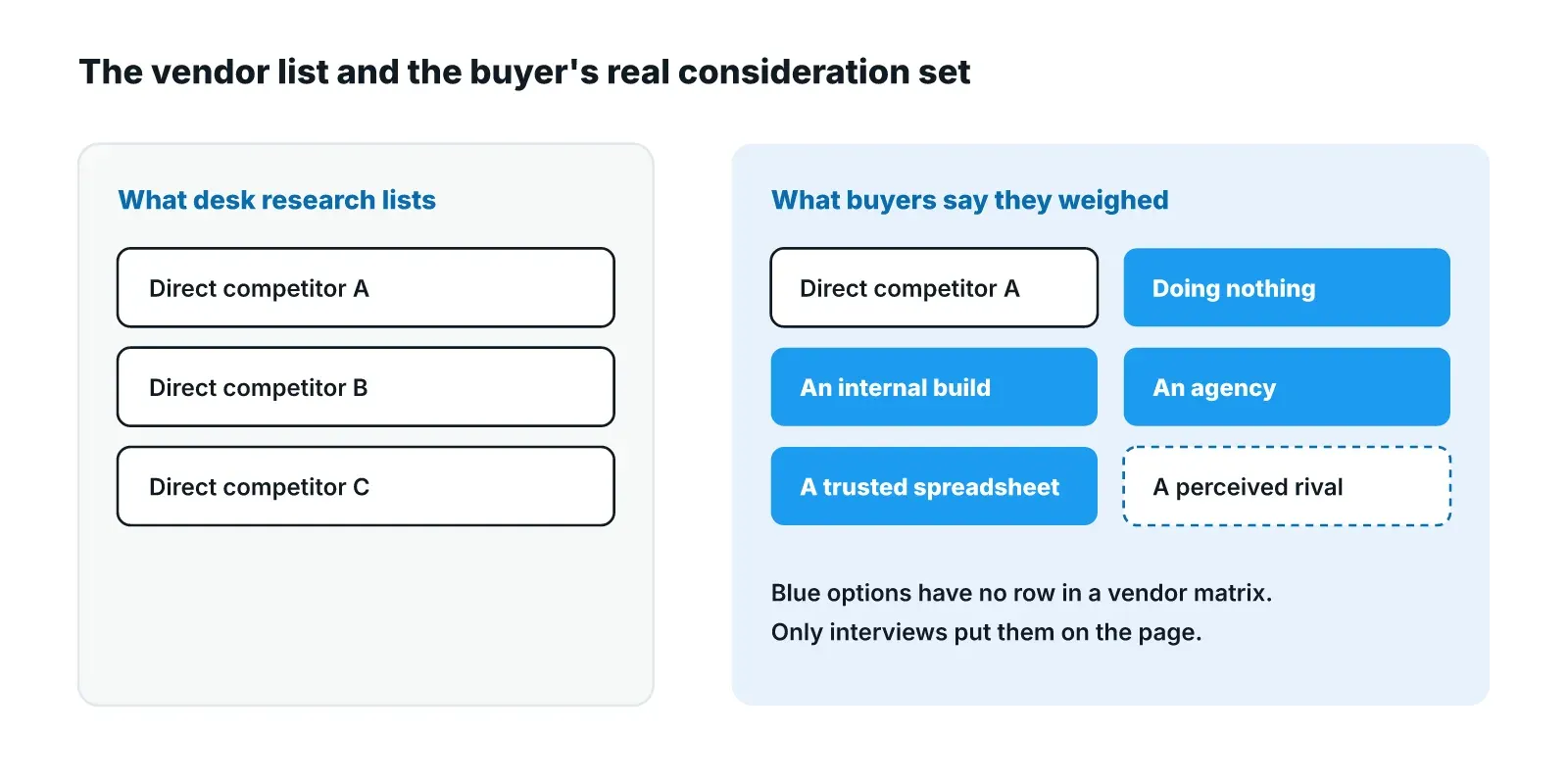
Desk research shows what rivals claim and charge. It cannot show which options a buyer took seriously. It also misses alternatives with no pricing page: doing nothing, an internal build, an agency. When that list is wrong, product, marketing and sales plan a year of work against a rival the buyer never considered.
The steps below show which buyers to interview, what to ask them, and which parts of your current analysis to keep.
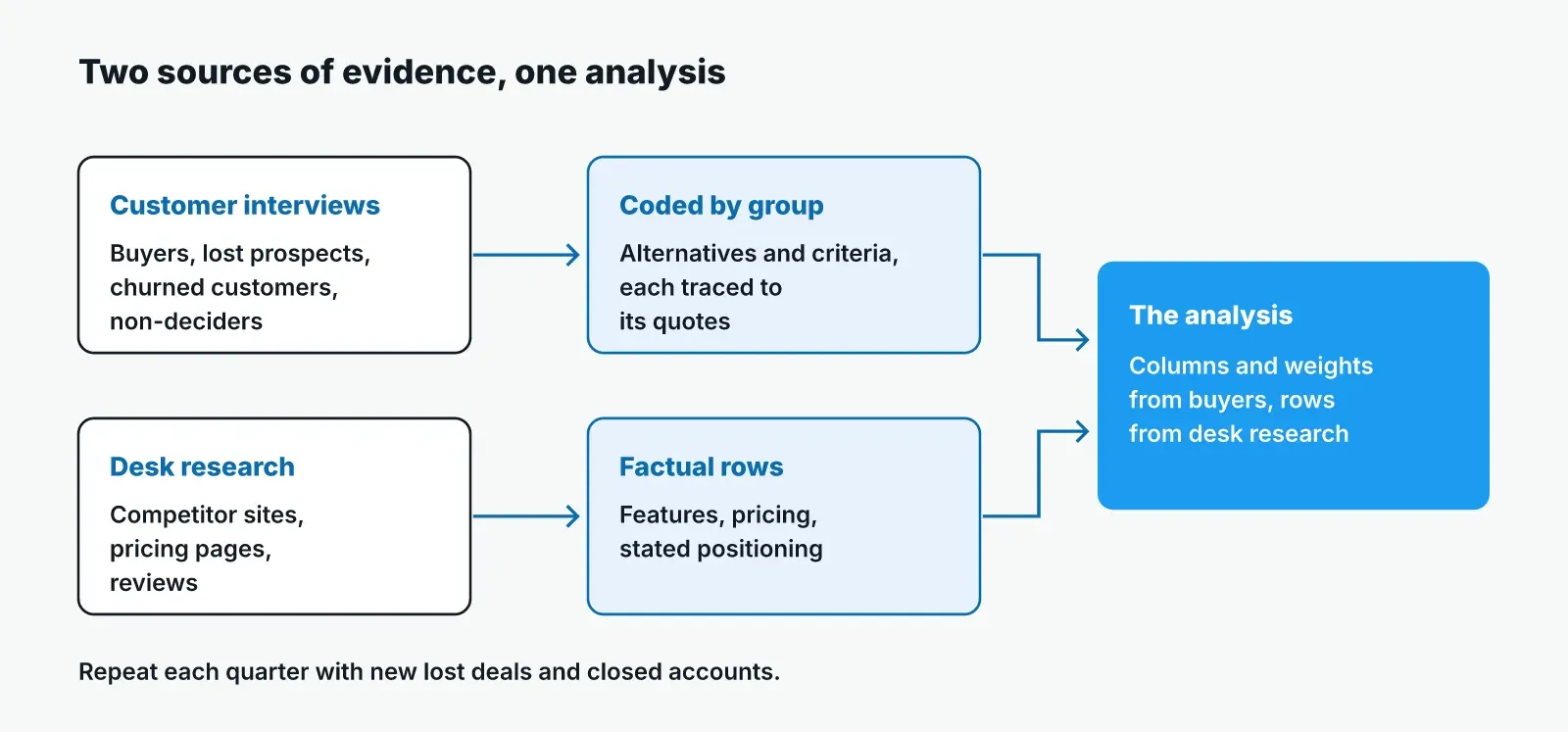
Buyers are the only first-hand source for two things: the alternatives they weighed, and the reasons one of them won. Desk research is better for facts such as price, features and contract terms. So start with buyer interviews to decide what to compare and how much each point counts. Then use desk research to fill in the facts.
If your team already keeps a comparison matrix (a grid of rivals against the points you compare them on) and a SWOT (strengths, weaknesses, opportunities and threats), keep both. Interviews change what goes into them.
| Question | Better source |
|---|---|
| Which alternatives did buyers consider? | Buyer interviews |
| Which points decided the choice, and in what order? | Buyer interviews |
| When did each option drop out, and why? | Buyer interviews |
| What does each rival charge and include? | Desk research |
| How does each rival describe itself? | Desk research |
Direct competitors sell the same kind of product to the same buyer. Indirect competitors solve the same problem another way: an agency, an internal build, or a spreadsheet the team already trusts. Then there is doing nothing. Perceived competitors are options buyers compared you with that your team never saw as rivals.
For illustration, a company selling expense software to large firms tracks four direct rivals. Lost prospects say they kept the finance team's spreadsheet. That alternative has no pricing page, so desk research never found it.
Buyers name the points they compared on, in the order they mattered, and the moment each option dropped out: a reference call, a security review, a demo that missed their use case. For illustration, a procurement lead recalls that two rivals were cut at the IT security review, before anyone compared features. The matrix should weigh security first, and sales learns where deals are lost.
Four groups know your alternatives first-hand: recent buyers who chose you, prospects who chose something else, customers who left for an alternative, and evaluators who decided to change nothing. Each group sees a different part of the decision and carries a different bias, so interview all four and report each one separately.
| Group | What they can tell you | Bias to watch for | When to reach them |
|---|---|---|---|
| Recent buyers who chose you | The shortlist and what tipped it your way | Justifying a choice they already made | Soon after the contract is signed |
| Prospects who chose another option | Where you fell behind the option they picked | Politeness to the vendor who lost | Soon after the deal is marked lost |
| Customers who left | What the alternative did for them in practice | Grievance about how the relationship ended | Once the switch has settled |
| Evaluators who changed nothing | Why staying put beat every vendor | Playing down the problem | When the evaluation closes with no decision |
Recruit them from your own CRM and account records.
In a large company, one decision rarely belongs to one person. For illustration, when a global retailer buys a payroll system, finance compares options on cost, HR on ease of use and procurement on contract terms. Interview more than one role per account, and record which role said what.
Illustrative example: a steering committee asks the insights team for a large bank's cards unit why card applications are going elsewhere. Its matrix compares rival cards on fees, rewards and app ratings, and does not explain the drop. Its best first move is to interview applicants and cardholders, then refresh the desk research.
The team has three options.
| Option | What it can establish | What it cannot establish |
|---|---|---|
| Refresh the desk-research matrix | Fees, rewards and rates of the listed rival cards | Which cards applicants weighed |
| Survey recent applicants | How many rate each listed factor as important | Factors and alternatives not on the list |
| Interview applicants and cardholders | Which alternatives people weighed, and when each dropped out | How common each reason is |
The team invites four groups from its own records: approved applicants, applicants who abandoned and took another card, applicants who abandoned and took no card, and cardholders who closed accounts last quarter. A reason raised by more than one group carries more weight, and every claim links to its quotes.
The analysis gains an alternative nobody had listed: a card offered inside the app of the bank where applicants already hold their salary account. Approval speed and the handling of document requests move ahead of rewards. Fees and rates stay, because desk research is the right source for them.
The next decision changes. The product team reviews the approval flow before it touches the rewards rate. A survey can then measure how common each reason is, and the guide to customer research methods covers when each method fits.
Run the interviews so the buyer leads, then code what they say so every finding keeps its source. Each step below guards against a common way these studies go wrong: leading the participant, accepting a vague reason, or mixing groups until nobody can check a claim.
Start with what made them look and the problem they needed solved. If you name a competitor first, you plant it in their memory of the choice, and the analysis records your list instead of theirs. Three open probes to start:
The guide to running a customer interview without leading covers the wider technique.
Ask what they looked at first, what they dropped and when, and what was left at the end. The order shows which points cut the shortlist and which only broke a tie.
"It was simpler" or "a better fit" is a summary, and the reason sits underneath it. Ask what was simpler, for whom, and when they noticed. Keep going until you hear a moment or an example.
Code each alternative a participant names into a category: a direct rival, another kind of product, an agency, an internal build, or doing nothing. In the readout, describe alternatives by category and keep vendor names in the coded data. Categories stay comparable from quarter to quarter as vendors come and go. Coding the transcripts this way shows how often each category comes up per group.
Keep each theme tied to the quotes and transcripts it came from, and show which group said it. Mixing groups hides their bias: a theme raised only by customers who left reads differently from one every group raises. Leaders in product, marketing and sales will test each claim, and a claim they can trace to a buyer's words holds up.
Then feed the findings into the matrix and the SWOT you already keep.
Run a new round each quarter with that quarter's lost deals and closed accounts, and store each round so the next starts from what the last one found. Last year's list can miss this year's rival.
If nobody has interviewed a lost prospect since your matrix was last updated, treat its list of rivals as a guess and interview before the next review. If interviews name an alternative the matrix lacks, add it, then send desk research to fill in its facts.
The hardest groups to reach are lost prospects and customers who left, because they owe you nothing and often will not book a call. Pulse runs AI-moderated voice interviews by link, so they can answer on a phone or laptop when it suits them, with no call to schedule.
The AI moderator asks every participant the same opening questions and follows up when a reply is vague, which is step 3 done every time. It groups the answers into themes that keep their quotes, each traced to its transcript, and stores every study in a searchable repository, so next quarter's round starts from this one.
Desk research and surveys keep their jobs. Your team's time goes to the parts that need judgment: framing the question, reading the surprises, and deciding what the business should change. To see a buyer study like this run end to end, book a Pulse demo.
Sales can help recruit, but someone outside the account team should ask the questions. A lost prospect tends to be most polite with the person who pitched them, and a seller has a stake in the reason for the loss. A researcher or an AI moderator working from one guide asks every participant the same questions.
Add it to the analysis as its own entry, then send desk research to find its facts. Check whether more than one group mentions it. A name that comes up once may be one buyer's quirk. One that appears among lost prospects and customers who left is a rival you are already losing deals to.
A SWOT looks inward: your own strengths and weaknesses, plus the opportunities and threats around you. A competitive landscape analysis looks outward, at the alternatives a buyer could choose and how you compare with each. In a SWOT, an alternative that buyers named and your team had missed belongs under threats.
Concept test results overstate demand when a yes costs the respondent nothing. How to read them, what to check before launch, and what to ask after.
How do AI interviews work in customer research? Follow one session from screener to follow-up question to a theme traced to its transcript.
Jobs to be done research gets harder when one account has many roles and business units. How to recruit, interview and merge jobs across them.