How to choose an AI assistant for research
Choosing an AI assistant for research? Match it to the evidence your question needs, then test whether every finding opens to the source behind it.
Brand sentiment scores average away who is upset and why. Learn to read the score, then use customer conversations to bring the reasons back.
You work on the marketing team at a furniture retailer. Your manager stops by your desk with the dashboard open. Brand sentiment fell this month, she says. Why did it fall, and does it matter?
That number is brand sentiment, the overall mood of what people say about a company, sorted into positive, negative and neutral.
To learn why it fell, read the negative mentions by topic, then talk to the customers behind them. To learn whether it matters, find out who is talking and whether quiet buyers feel the same.
The score is a good alarm, and the reasons come from talking to customers.
Before you can explain the drop, you need to know where the number comes from. Brand sentiment is built from mentions, which are the things people write or say about the company. A tool reads each mention, gives it a label and adds the labels up into one score.
The mentions come from many places. Social posts and comments, product reviews, news stories, support chats and survey comments all count. Some teams now add one more source, which is how AI assistants describe the company when someone asks about it.
Each mention gets a label through sentiment analysis, which reads text and decides whether it sounds positive, negative or neutral. The dashboard then shows the share of each, or a net figure. A net figure is the share of positive mentions minus the share of negative ones, so it falls when complaints grow or praise shrinks. The glossary entry on the sentiment score shows how one is put together.
So when people ask how to measure brand sentiment, the honest answer has two parts. Brand sentiment analysis counts the mood across many mentions. Something else has to explain it.
Automated labels also slip. A post that says "Great, my sofa arrived a month late" contains a happy word, and a tool can read it as praise.
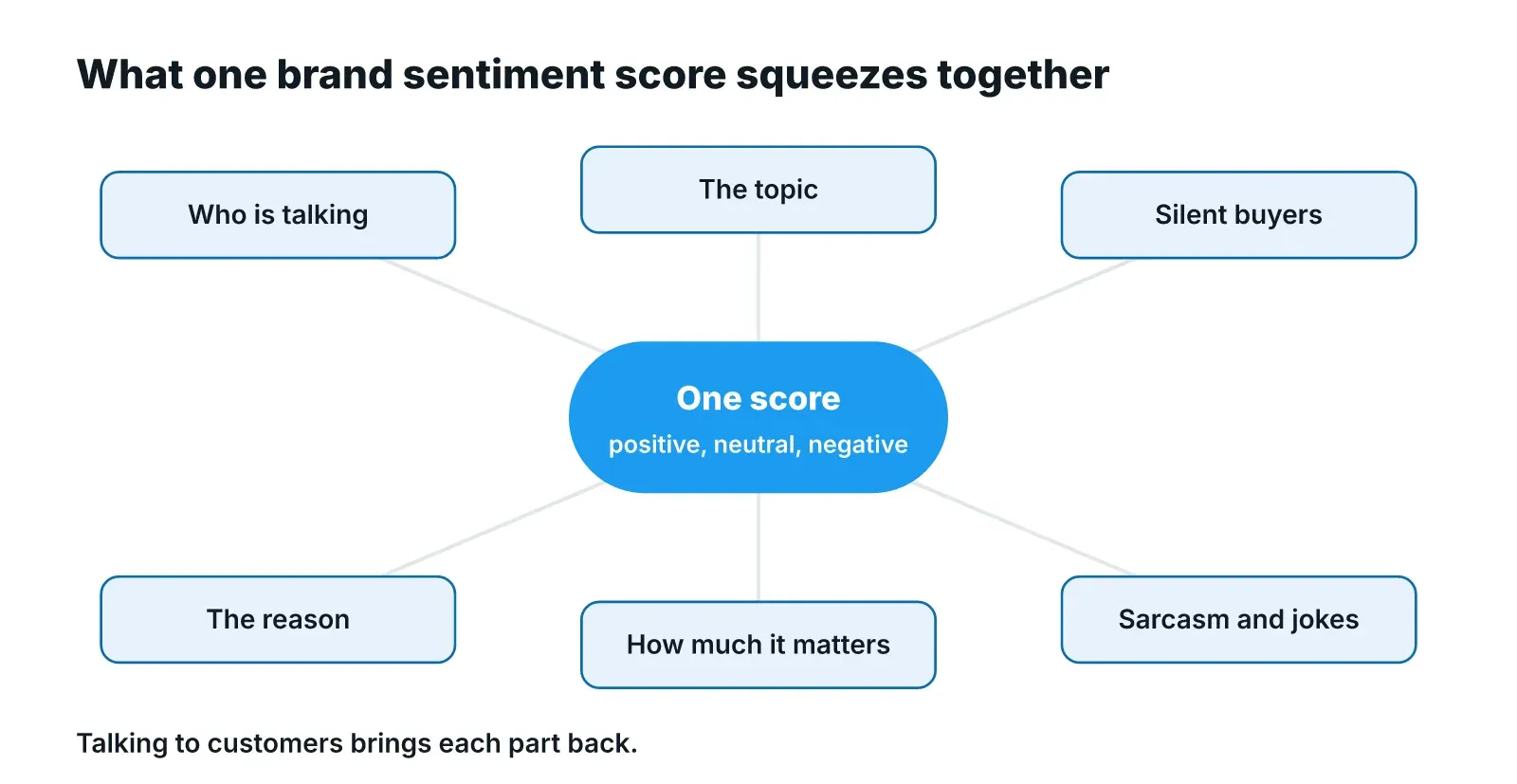
You want the score to tell you what went wrong at the retailer. It can't, because one number squeezes many mentions together, and the details that point to a fix get averaged away. Each row is a different reason the score could fall, and each needs a different fix.
| What the score hides | How it shows up at the retailer | What a conversation adds |
|---|---|---|
| Who is talking | A few loud posters, not most buyers | Talk to recent buyers, posters or not |
| The topic | People love the sofas and are angry about late delivery, so the two cancel out | Ask about each part of the purchase on its own |
| The silent buyers | Many customers never post at all | Invite them from the customer list |
| The reason | A post says "never again" but not what went wrong | Ask what happened, step by step |
| How much it matters | One city's delivery problem moves the national score | Ask where they live and which store or warehouse served them |
| Sarcasm and jokes | "Great service, as always" gets counted as praise | Hear the tone and the full story |
A score tells you the mood changed, but never what to change.
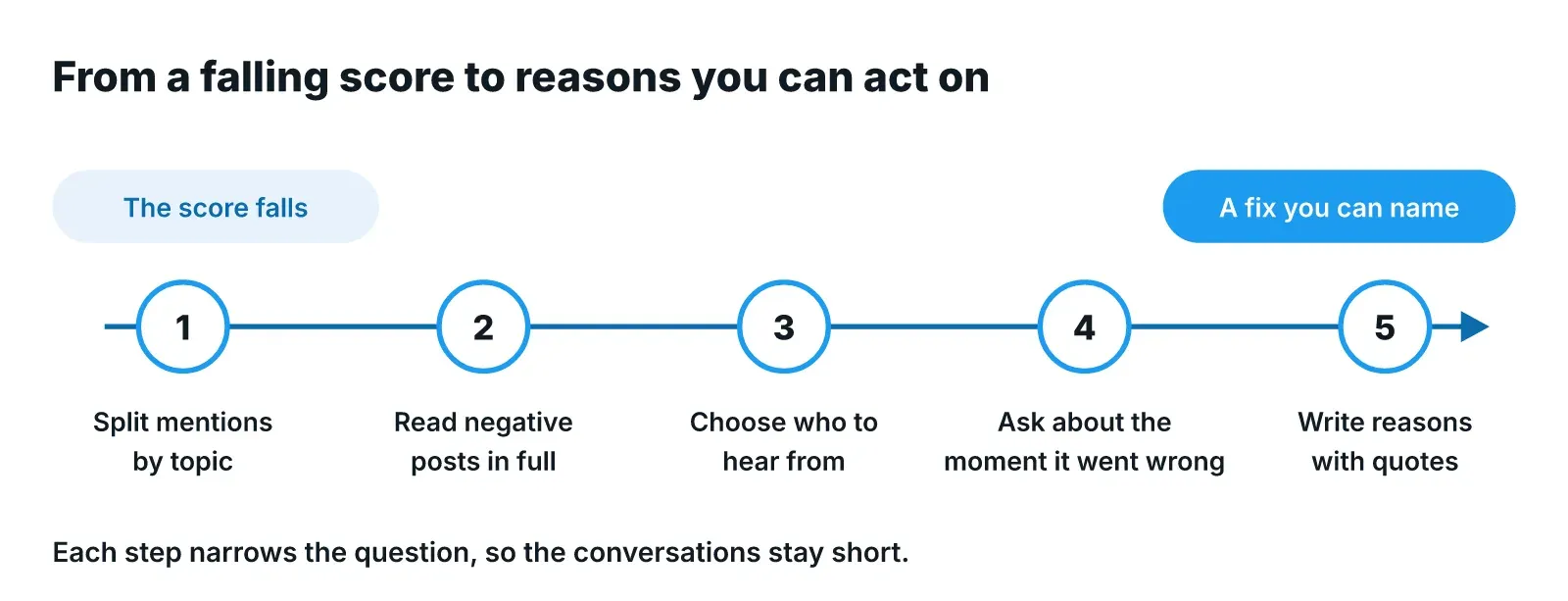
Your manager wants a reason she can act on, so the job is to get from a falling number to a few clear causes. Each of these five steps narrows the question, so the conversations at the end are short and focused.
Sort the negative mentions into topics such as delivery, price, quality and staff. If most of the drop sits in one topic, you know where to look. If it is spread evenly, the problem may be wider, such as a price change everyone noticed.
Labels are short, but the posts behind them carry clues. Read a few dozen in full and note what each person mentions, such as a store, a product or a delivery date.
Pick recent buyers from the topic that moved. Include people who never posted, because the score never heard them. If the problem looks local, include buyers from that area and from somewhere else, so you can compare.
A direct question such as "How do you feel about our brand?" gets polite, thin answers, because people tidy up their feelings for a stranger. Questions about a real moment work better. Ask about the last delivery, not the brand in general. Ask what they told a friend about it, and what almost made them buy somewhere else. Ask what would bring them back. After each answer, ask "What happened next?" Spoken answers help here, and the post on why spoken answers surface reasons a typed reply hides shows how.
For each reason, write one plain sentence, the number of people who gave it and two or three quotes. "Several buyers near the new warehouse said the van came on the wrong day" is a reason your manager can act on.
Say several of the customers you talk to describe the same thing. The delivery van came on a different day from the one they booked, and nobody called. When you check their addresses, they all got their furniture from the new warehouse. The score fell across the country, but the cause sits in one building, and only the conversations could show that.
Your manager will ask again next month, so you need a habit and not a one-off. Keep the score as the alarm. Agree with your team on how big a move counts. When the score crosses that line, talk to a small group of customers about the topic that moved. Then report the score, the top reasons and one quote for each. That is brand sentiment tracking with the reasons attached.
Sometimes you need to know how many customers share a reason before you spend money on a fix. Then add a short survey that asks about that reason directly. Surveys and conversations do different jobs, which the post on how surveys tell you what, interviews tell you why sets out. For how often to repeat the whole check, see the post on how often to run a brand tracker.
When the score moves, the slow part is reaching the customers behind it. Pulse can invite the company's own customers from an uploaded list, and they take an AI-moderated interview by link, with no calls to schedule. The moderator's follow-up questions build on what each customer said earlier, and a vague answer gets a second question.
Pulse groups what people said into themes, each with the quotes behind it, and every quote links to its transcript. Surveys can run alongside the interviews in the same study. Trackers that repeat a study wave after wave show a change against the baseline, and interviews can explore it.
The dashboard raises the alarm, the conversations give the reasons, and your team decides the fix. If the score moves and you can name the topic, talk to customers about that topic. If you can't name the topic yet, read the mentions first.
To see how a study like this runs, book a demo.
Yes. A chat model can label a batch of mentions as positive, negative or neutral, and it often reads context better than a simple word list. Check a sample of its labels by hand, especially jokes and complaints that use happy words. Then read the reasons yourself, because a label is not a reason.
Yes, as an alarm. Sentiment analysis is a fast way to watch the mood across many mentions and spot when it changes. It works best when you treat a change as a question. Then talk to customers to find the cause before anyone acts on it.
Brand sentiment is the mood of what people say about a company right now, positive, negative or neutral. Brand perception is what people believe the company stands for, such as good value or careful service. One bad delivery week can pull sentiment down while that belief stays the same.
Choosing an AI assistant for research? Match it to the evidence your question needs, then test whether every finding opens to the source behind it.
Jobs to be done interviews at scale: how to keep hundreds of interviews on track, sort what buyers say and check each reason across groups.
How to write a screener survey that lets the right B2B buyers into your interviews: role checks, hidden criteria, quotas and a test run.