When a concept test says yes and the launch still fails
Concept test results overstate demand when a yes costs the respondent nothing. How to read them, what to check before launch, and what to ask after.
Willingness to pay research for a new tier: who to interview, what to show, which survey method fits, and how to check stated answers against behavior.
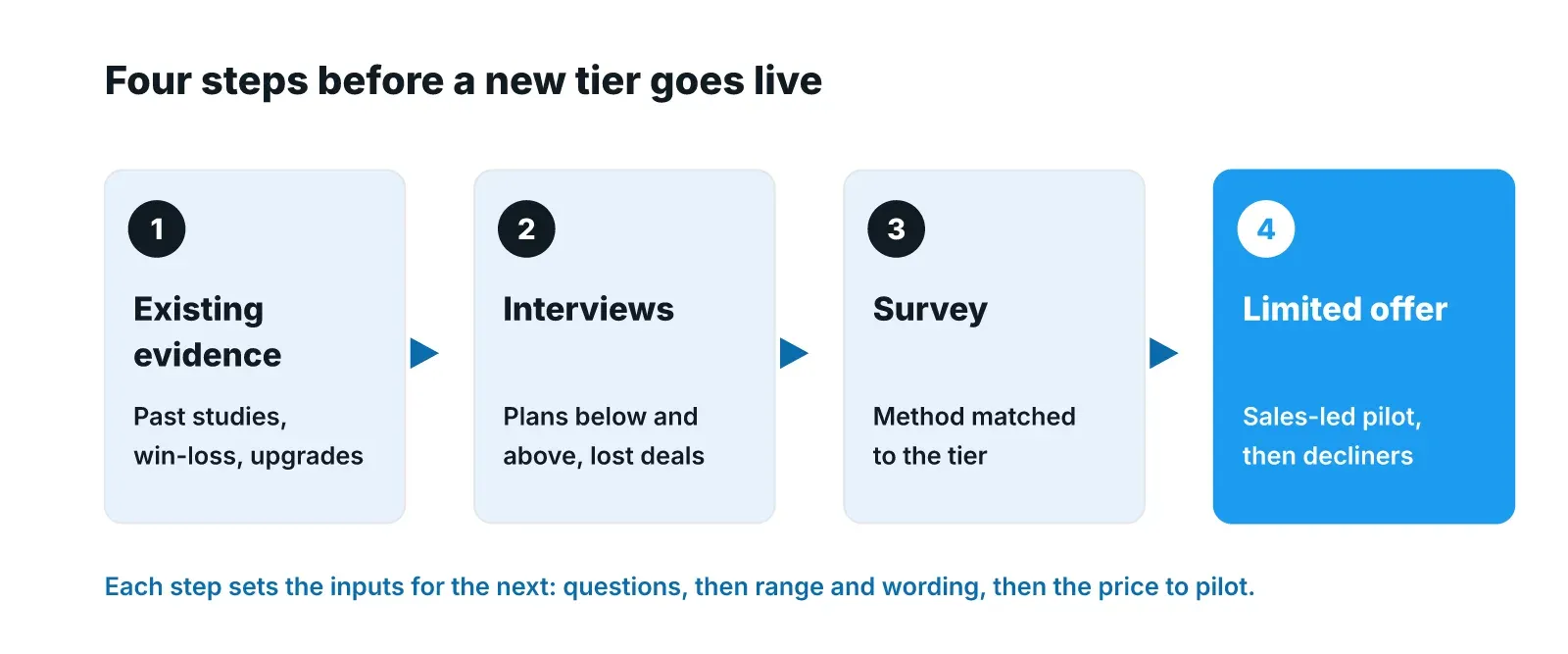
Willingness to pay research for a new pricing tier runs in four steps. Start from the evidence you already hold, interview current customers, recent upgraders and prospects lost on price, measure with a survey method matched to the tier decision, and then check stated answers against a limited, sales-led offer before general launch.
Test willingness to pay for a new tier by fixing one study question, then running interviews, a survey and a limited offer in that order. Willingness to pay is the highest price a buyer would pay for an offer. For a tier the question is narrower: at what price does the tier win upgrades without pulling accounts down from the plan above?
The sequence is a mixed methods design, and each step feeds the next:
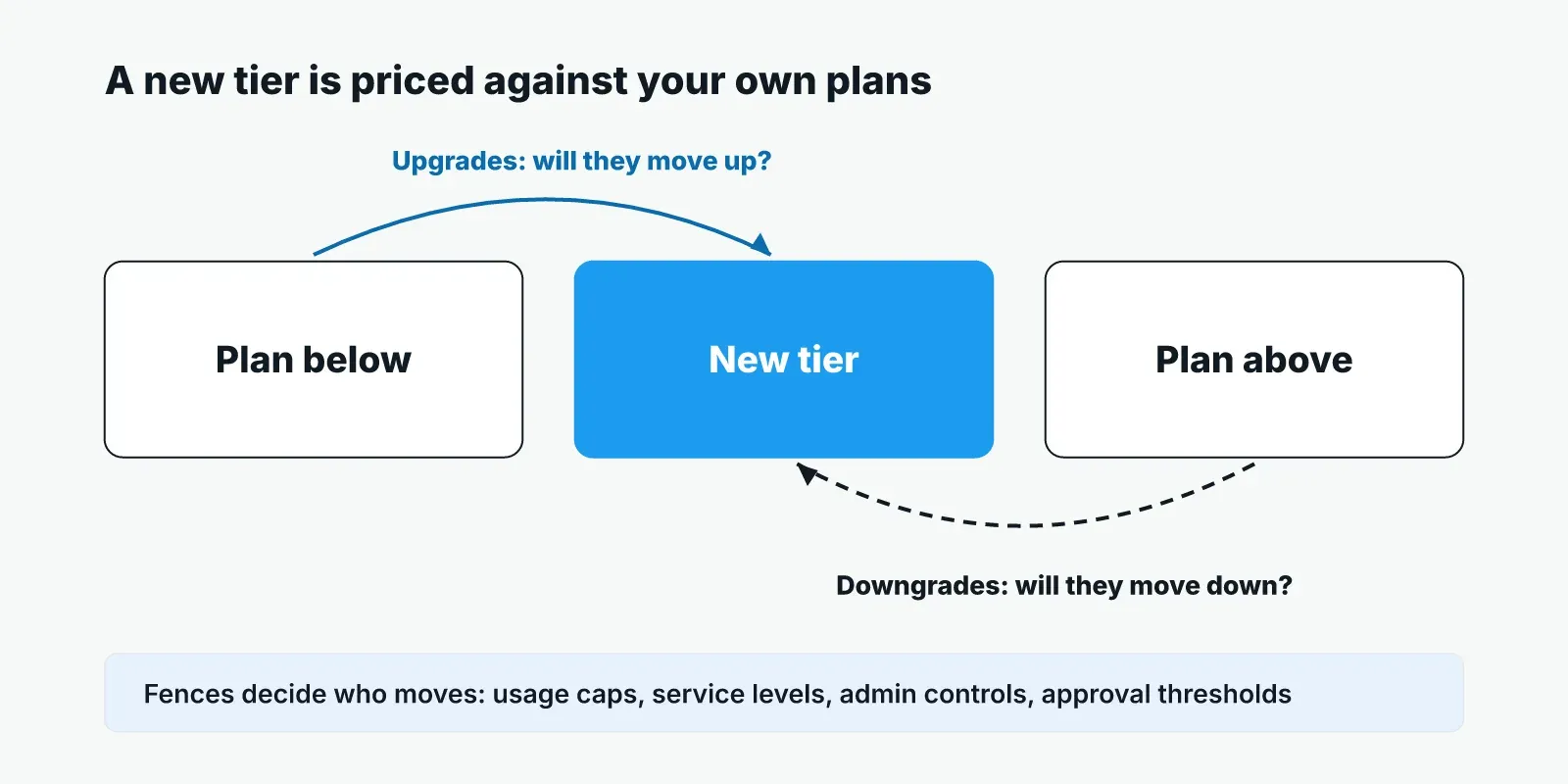
A new tier is priced against your own plans, so the buyer's first reference point is the plan they already pay for. The main risks are internal: accounts moving down from the plan above, or upgrades from the plan below stalling. Fences and approval thresholds decide who moves, so they are tested together with the price.
A buyer on your mid plan judges a premium tier by the gap to what they pay now and by what the extra money buys. A competitor's list price still matters, but the first comparison is internal.
A tier priced too close to the plan above invites downgrades. A tier priced too far above the plan below leaves the upgrade path empty. Neither risk shows in a survey that presents the tier on its own.
Fences are the limits that separate tiers: usage caps, service levels, admin controls, data retention. They decide which accounts choose the tier, so a price tested without its fences measures a different offer.
In many large companies, spend above a set amount needs another approval. A tier price that crosses that line can add a procurement step, and the interviews need to find out where those lines sit.
Start with what your organization already knows. Past studies, sales call notes, win-loss reasons, support requests for the features the tier would include, and upgrade and downgrade history all carry evidence about the tier. What they cannot answer becomes the interview objectives.
A research repository lets the new brief start from what earlier studies found, so interview time goes to the open questions.
Write those questions down before recruiting. For a premium tier they often include which fence matters most, who approves spend at the proposed level, and what accounts on the plan above would give up to save money.
Interview the accounts the tier will move: customers on the plans below and above it, recent upgraders and downgraders, and prospects lost on price. In each account, speak to the economic buyer and the procurement contact as well as day-to-day users, and keep segments separate in the analysis.
Keep each segment separate when you analyze, so one large account's view does not stand in for its whole segment.
Show the tier as buyers would meet it: a short card in their language, with its fences and the plans on either side. Ask about the job the tier would do and the alternative they would use before any price appears. Then ask what they would give up to stay inside a budget, and who would approve the spend at this level.
The following is an illustrative example. An insights team at a B2B payments provider is testing a premium reporting tier for merchants that sell in several markets. It interviews finance leads and operations users separately. Operations users describe the reports they would open every week. Finance leads raise something the feature list never mentions: any annual commitment above their delegated limit goes to a procurement committee that meets once a quarter. The team adds a question on approval limits to the survey and tests one price below the limit most finance leads described and one above it.
Pulse runs AI-moderated interviews with a company's own customers by link, asks a follow-up when an answer is vague, and traces each theme to its transcript, so the finance and operations findings can be checked against what each person said.
Use a choice-based trade-off exercise when buyers will pick between plans with different fences, because it mirrors the real decision. Use price-range questions when the range is still unknown, and direct questions at set prices when a few candidate prices exist. Bidding with real money suits products a respondent can buy on the spot, which an enterprise tier rarely is.
| Method | What it tells you about a tier | Main risk | Use it when |
|---|---|---|---|
| Price-range questions | Where the tier starts to feel cheap or expensive | Answers float without the plans beside it | The range is unknown |
| Direct questions at set prices | Stated take-up at each candidate price | Anchoring if one respondent sees several prices | A few candidate prices exist |
| Choice-based trade-off exercise | Which plan buyers pick when price and fences vary together | Needs careful design and a larger sample | Buyers will compare plans with different fences |
| Incentive-compatible bidding | Value with real money at stake | Hard to run for an enterprise purchase | The product can be bought on the spot |
| Revealed preference from a pilot | What accounts do when the tier is offered | A small, hand-picked set of accounts | Before general launch |
Each method has its own detailed treatment. For the tier, the interviews set the inputs: the range, the plans shown beside the tier and the wording. A survey answers only the questions it carries, which is what a fixed questionnaire leaves out and why the interviews come first.
Survey and interview answers are hypothetical, because nobody pays when they answer. Before general launch, offer the tier to a limited set of accounts through sales, track take-up, objections and approvals, and interview the accounts that decline. That pilot is the behavioral check a survey cannot provide.
Stated value shifts with context, even in studies designed to make it real. In a paper in Experimental Economics (2011), Laurent Muller and Bernard Ruffieux examined willingness to pay measured in laboratory auctions and found that participants revised their bids when they learned the product's price in shops, in proportion to how far their own estimate had been from it. For a tier, the shop price is the plan your buyer already pays for, which is one more reason to show the tier beside it.
Read the pilot against the survey. Where take-up matches the survey, the price holds. Where it falls short, the interviews with declining accounts can show why: an approval step, a missing fence, or a plan above that already covers the need.
Willingness to pay is the highest price a buyer would pay for an offer. Research estimates it from what buyers say in interviews and surveys, and confirms it with what they do when the offer is real. For a new tier, it is read against the plan the buyer already pays for.
Use interviews to find the reasons and inputs, such as the alternative, the fences that matter and who approves the spend. Use a survey method to put a number on it across segments. Then run a limited offer to see whether accounts buy at that price. Pulse runs the interviews and the survey side by side.
Use a choice-based trade-off exercise when buyers will choose between plans with different fences, price-range questions when the range is still unknown, and direct questions when a few candidate prices exist. Whichever you choose, follow it with a limited, sales-led offer before general launch.
No. Willingness to pay belongs to one buyer, while demand adds up many buyers' willingness at a given price. A survey estimate of either is stated intent, so a new tier needs a behavioral check, such as a pilot with a limited set of accounts, before the number goes into a forecast.
Willingness to pay is what a buyer would pay to get something. Willingness to accept is what they would need in return to give something up. In a tier launch, downgrade conversations touch the second: what an account on the plan above would need to save before giving up features it already has.
Concept test results overstate demand when a yes costs the respondent nothing. How to read them, what to check before launch, and what to ask after.
How do AI interviews work in customer research? Follow one session from screener to follow-up question to a theme traced to its transcript.
Jobs to be done research gets harder when one account has many roles and business units. How to recruit, interview and merge jobs across them.