Questionnaire question types and when to use each
Questionnaire question types compared: closed, scaled, ranking and open, what each lets you analyze, and how to pick one per decision.
Consumer product testing for brand teams: which test answers which launch question, how to recruit real users, and how interviews explain the ratings.
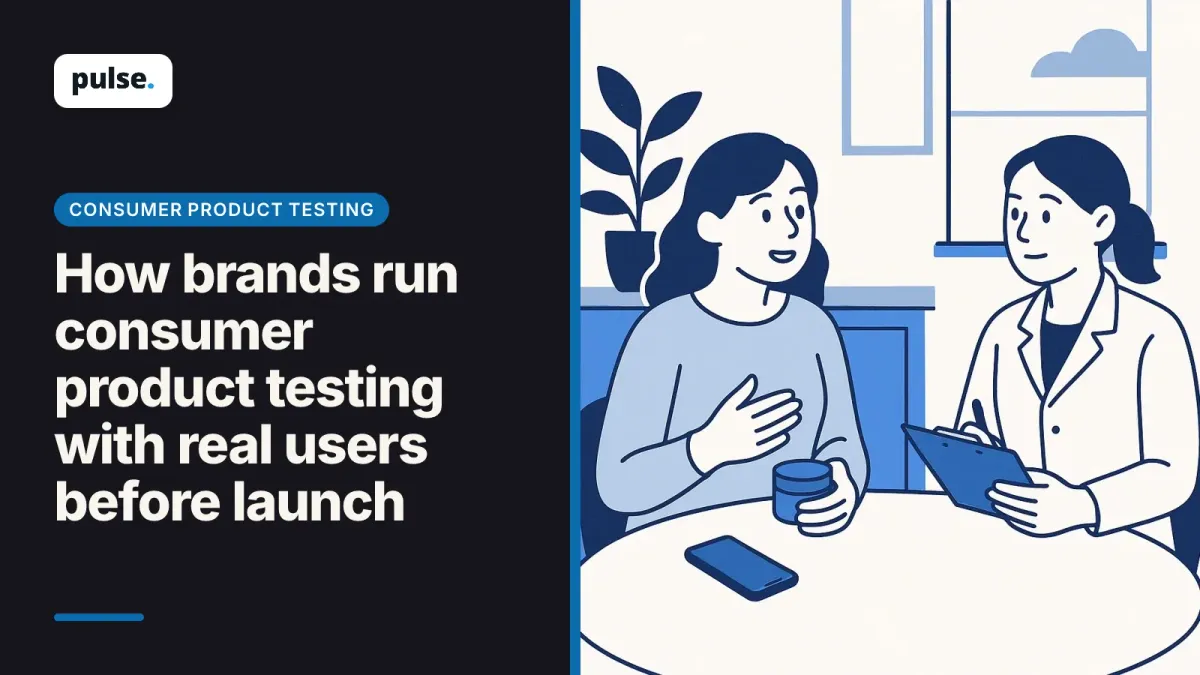
Consumer product testing puts a near-final product in the hands of real target users before launch, to learn whether they understand it, use it as intended, like it enough to buy or adopt it, and why. The work for a brand team is choosing the right test for the launch question, recruiting real buyers and getting the reason behind every score.
Consumer product testing is research in which people from the target market use a product, or a close-to-final version of it, and report what happened. It answers adoption questions: do people get it, can they use it, do they prefer it, and would they buy it. It applies to CPG formulations and packs, consumer apps, and consumer financial products such as a card feature or an investing flow.
It is a different job from lab testing. Safety, efficacy and compliance labs establish that a product is safe, does what the claim says and meets the rules. A consumer test establishes whether the people you are launching to will choose it. Most regulated consumer products need both, and passing one says nothing about the other.
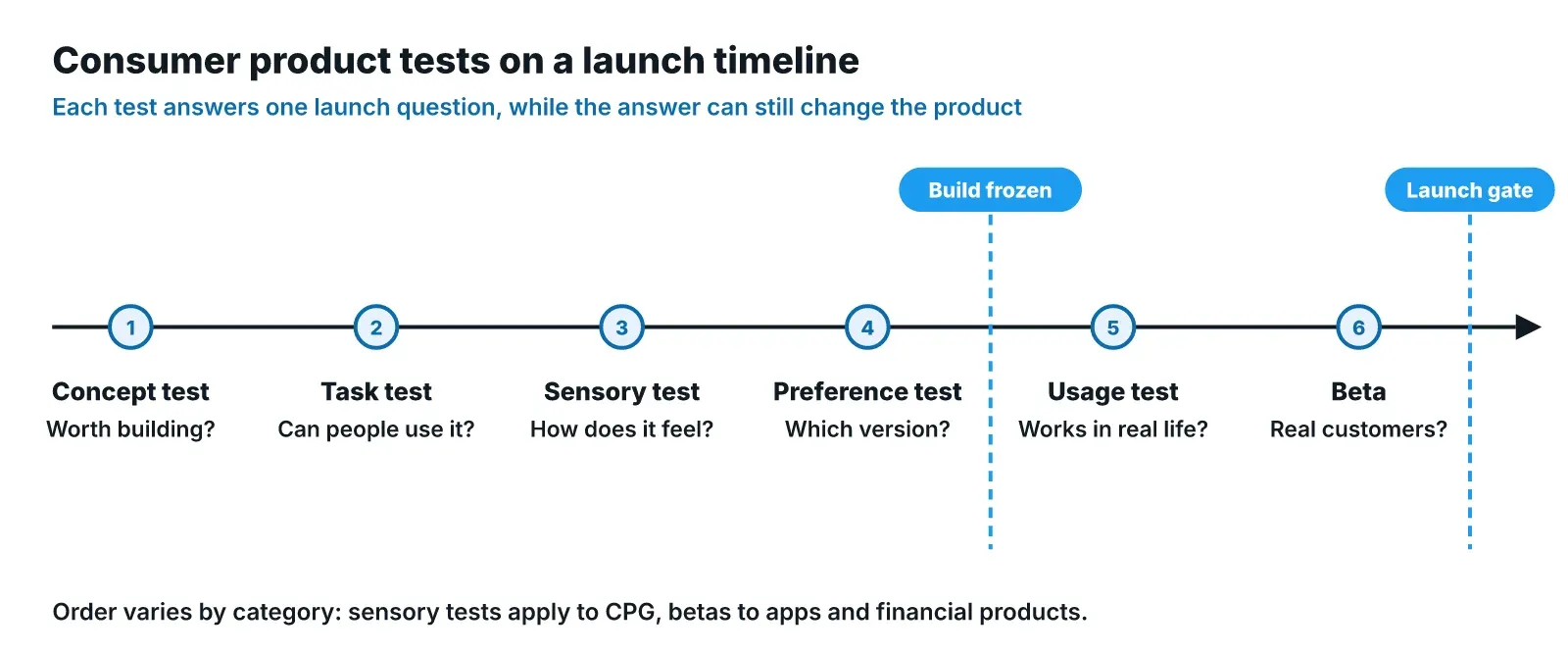
Each launch question has a test format built for it. A concept test checks whether the idea is worth building, a moderated task test checks whether people can use it, a usage test checks whether it survives daily life, and a beta checks whether it holds up with real customers. Pick the format from the question, then place it on the launch timeline.
| Launch question | Test format | Who takes part | What you get back |
|---|---|---|---|
| Is the idea worth building? | Concept test | Target buyers reacting to a description or mock-up | Appeal, understanding and objections, before build |
| Can people use it? | Moderated task test of a prototype or build | Target users working through set tasks | Where people get stuck, and why |
| Does it work in real life? | In-home or in-life usage test | Target users living with the product through normal use | How it fits routines, and what changes after first use |
| Which version do people prefer? | Paired comparison or sequential monadic test | Target users trying two or more versions | A preference, and the attributes behind it |
| How does it taste, smell or feel? | Central location or sensory test | Category users in a controlled venue | Sensory reactions under the same conditions for everyone |
| Will it hold up with real customers? | Beta or soft launch | Real customers in a limited release | Behavior at small scale, before full launch |
The table runs in launch order. Concept work comes first, and the guide to testing the concept before the product exists covers that stage. Task tests and sensory tests sit before the build or formulation is frozen. Usage tests and betas sit before the final launch gate, while the result can still change the copy, the onboarding or the pack.
Two formats in the table are methods in their own right: in-home usage tests, where people use a product at home for a set period and report back, and usability tests, where people attempt real tasks while a researcher observes. Either is a form of moderated testing when a researcher runs the session.
For an enterprise team, each format maps to a stage gate: "can people use it?" at the build gate and "will they adopt it?" at the launch gate are two different tests.
Recruit on recent behavior in the category: people who bought it, use a competing app or hold the card type in question. A screener on behavior keeps the sample close to your actual buyers. People who sign up to be paid for testing can differ from your buyers, and a behavior screener is what catches the difference.
Paid tester panels are useful for reach, and the risk is habit: a person who tests many products a month can learn what testers are expected to say. Screen on what someone did recently (bought the category in the last few months, switched provider, opened a savings account), and exclude people who work in marketing, research or the category itself.
Decide early whether you are testing with your own customers or with recruited category users. Own customers tell you how the product fits an existing relationship and whether it causes switching inside your portfolio. Recruited category users tell you about acquisition, because they have no loyalty to your brand.
When the launch spans business units or markets, set quotas by segment and by market so each one has enough voices to compare. Run fraud and quality checks on recruited participants as standard practice: duplicate sign-ups, mismatched screener answers and implausible usage stories.
Ask about expectations before use, then the context of use, then the rating, then the reason for the rating. Open questions come before closed ones so the scale does not frame the answer. That order captures first impressions before the product shapes them, and it ties every score to an explanation.
The order matters because a rating question asked early anchors everything after it. A tester who has already given a score can spend the rest of the session defending it.
Separate liking from intent. "Did you like it?" and "Would you switch to it from what you use now?" get different answers. Ask about the moment of first use, where confusion shows up.
Rewrite any question that suggests its answer:
| Leading version | Neutral version |
|---|---|
| How much did you enjoy the new rewards screen? | What did you expect to see on the rewards screen, and what did you see? |
| Wasn't the new formula easier to apply? | Walk me through the last time you applied it. |
For a longer bank, see the questions to ask after someone has used the product.
A rating or top-box score tells you how many testers liked the product. It does not tell you which attribute was behind the score or what would change it. Interviews supply that reason, and a follow-up question on a vague answer is where it usually appears.
"It was fine" is a common answer and an unusable one. A moderator who asks "what would have made it better than fine?" or "what did you do right after?" turns it into an attribute: the lid was hard to close, the confirmation screen came too late, the scent faded by evening.
Interviews also need enough coverage to show whether a reason holds across segments or belongs to two articulate testers. That is where consistent moderation helps. Pulse runs AI-moderated interviews with testers: every participant gets the same well-formed questions, thin answers get a follow-up, and the results arrive as themes with the quotes behind them, each traced to its transcript. Surveys can run beside the interviews for the counts.
The researcher frames the launch question, judges which reasons matter and decides what the product team changes.
This example is illustrative. The bank, the feature and the outcome are invented to show how the tests fit together.
A retail bank's app team plans to launch a rewards feature to two segments: mass-market salaried customers and premium cardholders. Product, compliance and a steering committee all sign off at the launch gate.
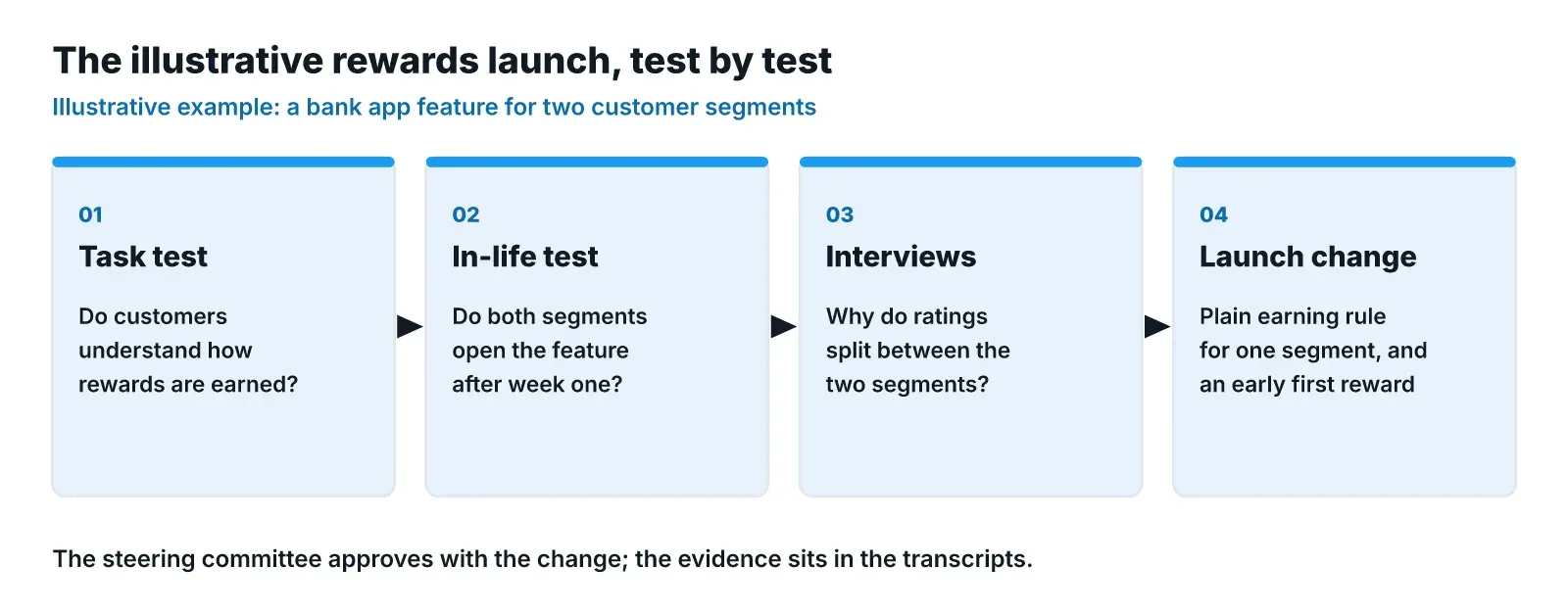
The team runs three tests in sequence. First, a moderated task test on the build checks whether customers understand how rewards are earned. Second, a short in-life test with existing customers from both segments shows whether they open the feature after the first week. Third, interviews with in-life participants explain the ratings.
The ratings split by segment. Interviews show the reason: mass-market customers read the earning rule as a condition they would fail, while premium cardholders read the same line as a benefit. The team rewrites the rule in plain terms for one segment and adds an onboarding step that shows a first reward early. The steering committee approves the launch with that change, and the evidence for it sits in the transcripts.
A CPG reformulation follows the same sequence: a sensory test, an in-home usage test, then interviews on why the ratings landed where they did.
Most misleading product tests fail on who took part, when the test ran or how the results were read. Each of these produces a confident result that the launch can then contradict.
Lab testing checks the product against standards: safety, efficacy claims and regulatory compliance, measured by instruments and trained assessors. Consumer product testing checks the product against people: whether target users understand it, use it as intended and prefer it. A product can pass every lab test and still fail with consumers, so most launches need both.
Paid panels give reach and speed, and they work best with a strict screener on recent category behavior and checks for habitual testers. For questions about switching or loyalty, your own customers are the better sample. For questions about acquisition, recruit category users with no tie to your brand.
It depends on the question. Nielsen Norman Group's usability testing guide (Kate Moran, 2019) recommends five participants for a typical qualitative usability study of a single user group, to uncover the majority of the most common problems. Preference tests, multi-segment launches and sizing questions need larger samples planned for that purpose.
Test at every gate where the answer could still change the product: concept before build, task tests before the build is frozen, sensory and usage tests before formulation and packaging are final, and a beta before full launch. A test scheduled after the launch decision cannot change it.
Questionnaire question types compared: closed, scaled, ranking and open, what each lets you analyze, and how to pick one per decision.
Types of bias in research, grouped by the stage where each enters a study, with how it shows up in a customer interview and how to check for it.
Voice of customer programs that stop at survey scores miss the why. Set the cadence, owners and interview waves that explain each score.