How to choose a sampling method for customer research
Choose a sampling method by the claim your customer study has to support, with a decision table for probability and non-probability sampling.
Brand lift shows a campaign moved recall or consideration among people who saw it. How to check the number, and the questions that explain why it moved.
Brand lift is the gap in survey answers between people who saw a campaign and a matched control group who did not, on measures such as ad recall, awareness or consideration. It tells you a measure moved. It cannot tell you which message people took away, or why, so this guide covers how to check the number and what to ask next.
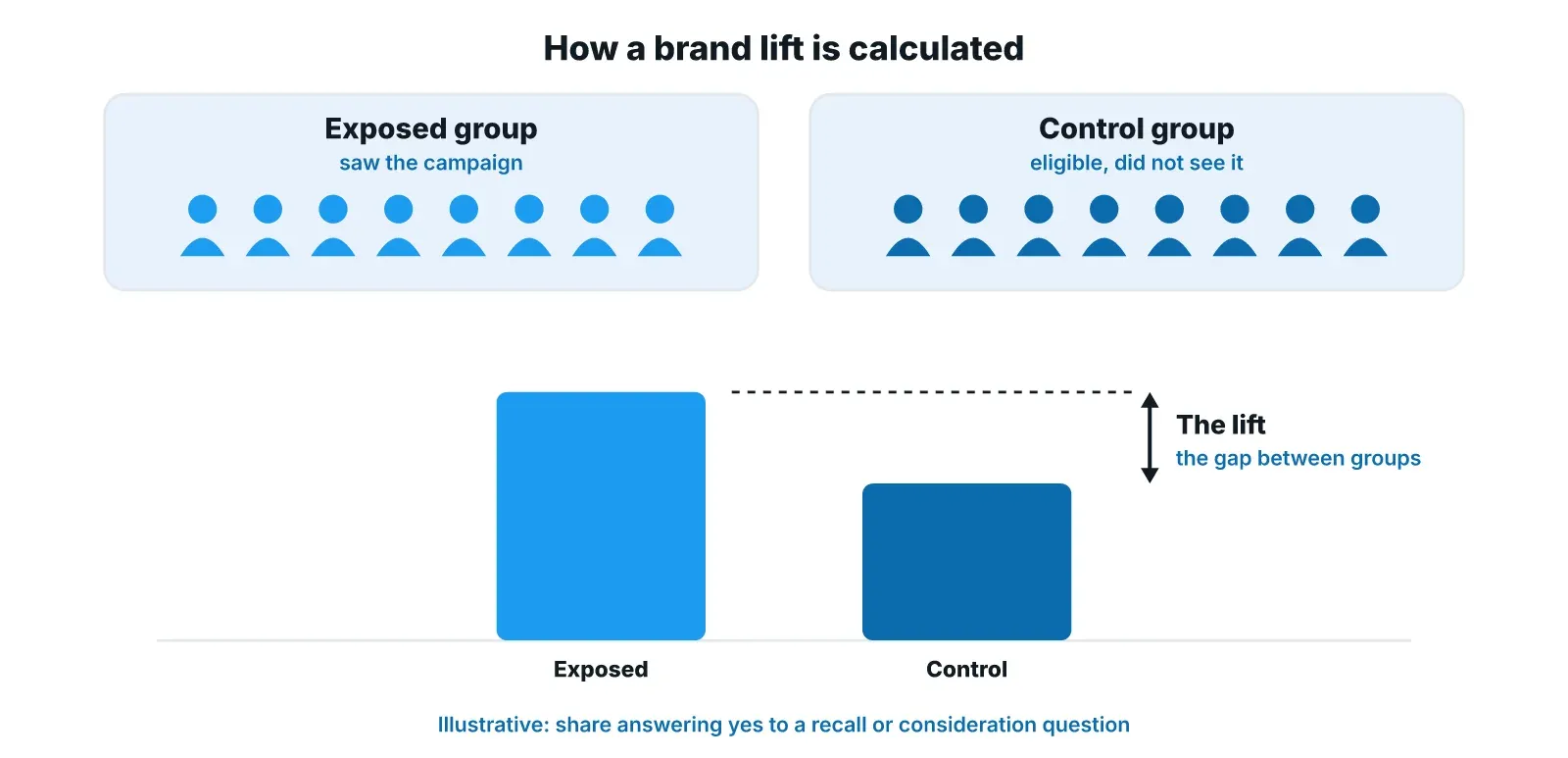
A brand lift measurement surveys two groups during or after a campaign: people exposed to the ads, and a control group who were eligible but did not see them. Both answer the same questions. The lift is the difference between the two groups' answers, read as the campaign's effect on that measure.
Ad platforms describe it in the same terms. Google's help page for its Brand Lift product, checked on 19 October 2026, says it measures the effectiveness of brand investments on goals like ad recall, brand association, brand awareness and consideration, rather than clicks, impressions or views.
That makes lift an attitude measure. It shows the campaign changed what some people remember or think, and the rest of this guide covers what it leaves unsaid.
Each lift metric answers one narrow question. Ad recall says people remember seeing an ad, and awareness says they know the brand, but neither says what they now think of it. The table sets out what a lift on each metric means and the question it leaves open, which is where a follow-up starts.
| Metric | Question it asks | A lift means | What it leaves open |
|---|---|---|---|
| Ad recall | Do you remember an ad for this brand? | More exposed people remember an ad | Which message they took from it |
| Awareness | Have you heard of this brand? | More exposed people know the brand | What they think of it |
| Brand association | Which brand do you link with this attribute? | More exposed people make the link | Whether they believe it |
| Favorability | How do you feel about this brand? | Exposed people rate the brand higher | What changed their view |
| Consideration | Would you consider this brand? | More exposed people would consider it | What still stands in the way of choosing it |
| Purchase intent | How likely are you to buy? | More exposed people say they would buy | Whether they will |
The gaps compound. Recall can lift while the message most people remember differs from the brief, and a questionnaire built around the intended message will not show it.
Check four things before you report a lift: whether the control group is comparable and unexposed, whether the difference is reliable and large enough to act on, how the study was designed, and whether the average hides segments that moved differently. A lift that fails one of these goes in the deck as an open question.
The control has to match the exposed group on audience and timing, and its members must not have seen the campaign through another channel. Survey both groups in the same window, so a news story or a rival's launch affects them equally.
A statistically significant lift can still be too small to change a media plan, and a large lift on a small sample can be noise. Ask for each group's sample size, the test used and the confidence interval, then judge whether the gap is big enough for the decision it is meant to support.
A study run by the platform or agency that sold the media is useful, and it deserves the same reading of design, sample and question wording as any other. Ask to see the questionnaire and how the control group was defined.
Read the lift by market, audience and frequency where the sample allows. A flat average can hide one market that moved and another that went backward.
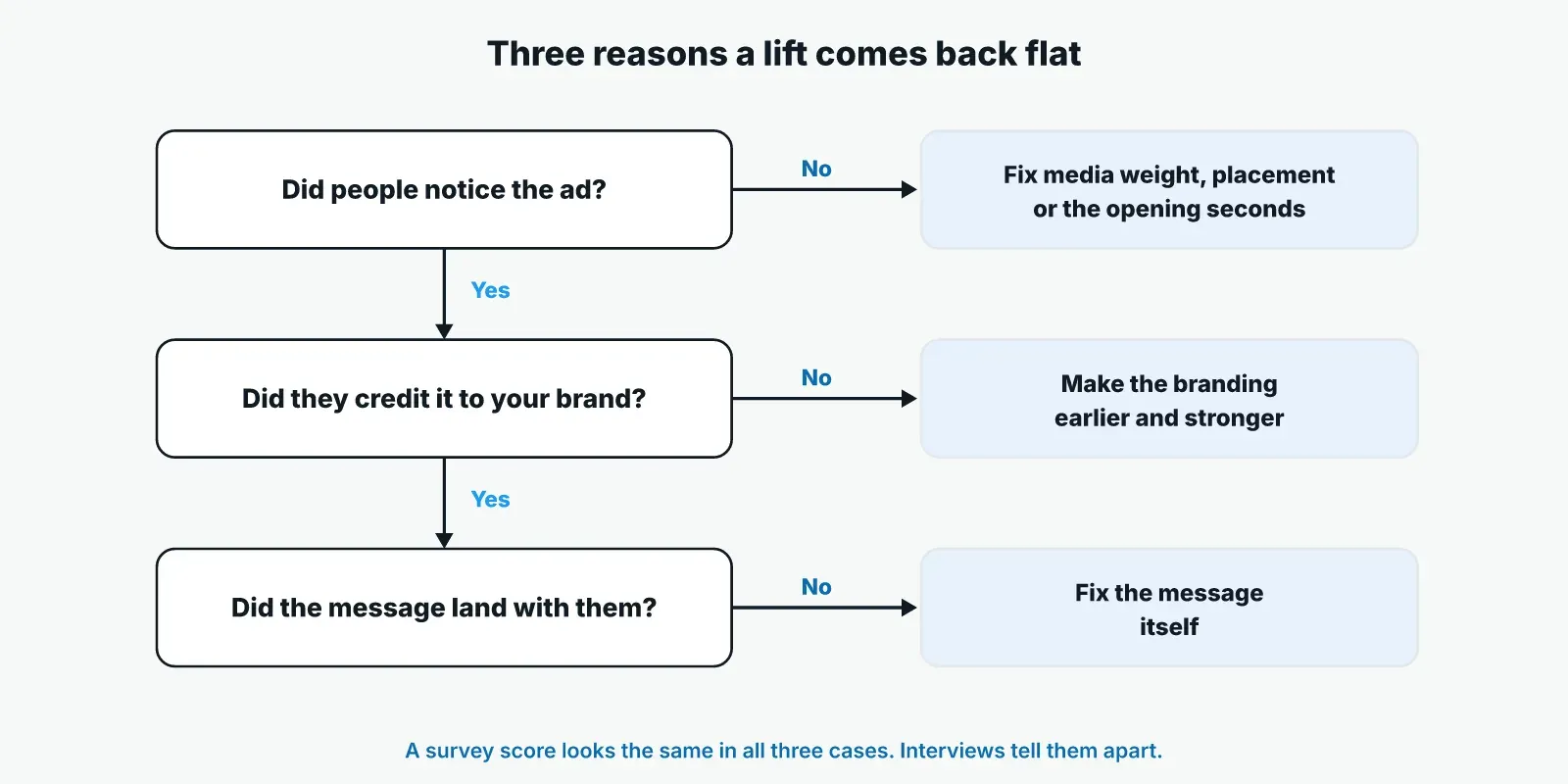
A lift number cannot say why a measure moved, which part of the ad people remember, or who moved and who did not. Nor can it say whether a flat result means the ad went unnoticed, was credited to another brand, or was noticed and rejected. Each explanation points to a different fix, so the number alone cannot choose the next step.
A flat result has at least three explanations. If people did not notice the ad, the problem is media weight, placement or the opening seconds of the creative. If they noticed it and credited a competitor, the branding came too weak or too late. If they noticed it, knew whose it was and did not care, the message missed. The survey score looks the same in all three cases.
A positive lift has the same blind spot. You know more people remember the ad, and you do not know which line or scene they carried away, or whether the association that moved is the one the brief intended.
Interview a small set of exposed respondents, and a few from the control group, soon after the readout while recall is fresh. Start with unaided recall, then ask people to describe the ad in their own words and say what it told them about the brand. Ask the control group the same questions, to separate the campaign from the baseline.
For a flat result, probe noticing, attribution and reaction as three separate questions: did you see an ad like this, whose was it, and what did you make of it.
| Survey-style question | Interview question |
|---|---|
| Do you recall seeing an ad for this brand? (yes or no) | Which ads in this category do you remember from the last few weeks? Tell me about one. |
| How much do you agree this brand is trustworthy? (1 to 5) | What did the ad say about the company? What made you think that? |
| How likely are you to consider this brand? | Next time you choose, what would put this brand on your list, or keep it off? |
The guide to interview questions that do not lead covers the craft of the follow-up.
The follow-up has to land before the next flight is locked. This example is illustrative. A brand team at a large financial services company gets a lift readout showing recall up and consideration flat across three markets, with two weeks before the creative for the next flight is final.
The team recruits exposed respondents to the campaign's audience profile, plus a smaller control group, and runs interviews in all three markets in the same week. In one market, people remember the spokesperson but credit the product to a rival bank. In the other two, people describe the offer accurately and say the rate does not compete. The first is a branding fix for one market. The second is a question for the product team, which no creative change would answer.
Pulse runs AI-moderated voice interviews that participants take by link, asks a follow-up question when an answer is vague, and traces each theme to the quotes behind it. The page on how Pulse runs a study shows the steps. Keeping each campaign's interviews in a repository of every study means the next brief starts from what earlier campaigns taught.
Creative pretesting asks, before launch, whether an ad will land. Brand lift asks, during or after a campaign, whether the campaign moved a measure among the people who saw it. Brand tracking asks, continuously, how brand measures change over time across all activity. Each needs its own design and supports a different decision.
| Approach | When it runs | Question it answers | Typical output |
|---|---|---|---|
| Creative pretesting | Before launch | Will this ad land with the audience? | Reactions to draft or finished creative |
| Brand lift | During or after a campaign | Did this campaign move a measure among the exposed? | The gap between exposed and control |
| Brand tracking | Continuously | How are brand measures changing over time? | Trend lines across all activity |
For the continuous version, see the post on continuous brand tracking and the page on tracking brand measures over time.
Pulse runs the follow-up interviews behind a lift readout and traces every theme to what people said. Book a demo to see a campaign follow-up run end to end.
In this context, brand lift is a change in attitude, such as recall or consideration, among people who saw a campaign compared with a control group. Incrementality usually refers to extra outcomes, often sales or conversions, attributable to the ads. Both compare exposed and unexposed groups, and they measure different things.
They survey an exposed group and a matched control group during or after a campaign, with the same questions, and compare the answers. Ad platforms offer this for the campaigns they serve. The design choices that matter are who counts as exposed, how the control is chosen, and when both groups are surveyed.
Audience fit, frequency, creative, timing and the design of the control group all affect the result. A campaign shown to people already loyal to the brand has less room to move them, and a control group that saw the ad through another channel shrinks the measured gap.
Change what the evidence points to, one thing at a time. Interview exposed respondents after each flight, fix the problem their answers name, whether noticing, branding or message, and read the next lift against the last. Changing creative, media and audience at once leaves no way to tell which change moved the number.
Choose a sampling method by the claim your customer study has to support, with a decision table for probability and non-probability sampling.
A representative sample of 20 interviews covers the segments a decision turns on. See what that lets you claim, and what only a survey can.
Design and run questionnaires that answer a real decision: set the objective, pick a mode, order and pilot questions, then analyze the results.