How to choose an AI assistant for research
Choosing an AI assistant for research? Match it to the evidence your question needs, then test whether every finding opens to the source behind it.
Advertising market research before media spend: check what customers take from the ad, whether they believe it, and if it speaks to them.
Your manager sends you the script for the company's new laundry detergent ad, with one question: will people get it? The ad says the detergent cleans well in cold water. The money to show it gets signed off soon. So what should you check with customers before then?
Checking an ad with the people it's meant for, before you pay to show it, is advertising market research.
If you want to know whether people get the message, ask them to say in their own words what the ad tells them. If you want to know whether it will work on them, ask whether they believe it and what would make them doubt it.
One more check finishes the job: whether the ad speaks to a problem these people have at all.
Once the media is booked, changing the message costs more. So these checks happen while the ad is still a script, a storyboard or a rough cut. Each check asks the customer something different: what the ad tells them, whether they believe it, and whether it speaks to a problem they have.
Media spend is the money paid to show the ad on TV, online or on posters. It's the money at risk if the message is wrong, which is why the checks come first.
Each check has its own question, and each has a warning sign in the answers that tells the detergent team something is off.
| Check | What you ask | A bad answer for the detergent ad |
|---|---|---|
| Takeaway | "What is this ad telling you?" | "It's about saving money." |
| Belief | "Would you believe this? Why or why not?" | "Cold water never gets stains out." |
| Relevance | "Is this a problem you have?" | "I always wash in hot water anyway." |
This research happens before launch. Brand lift studies and tracking measure an ad after it runs, and they answer a different question: did the ad change anything? Ranking several messages against each other, or scoring a finished ad, are separate jobs too. Here the job is one message, in one market, before the money goes out.
A wrong takeaway found now costs a rewrite. Found after launch, it can waste the media budget.
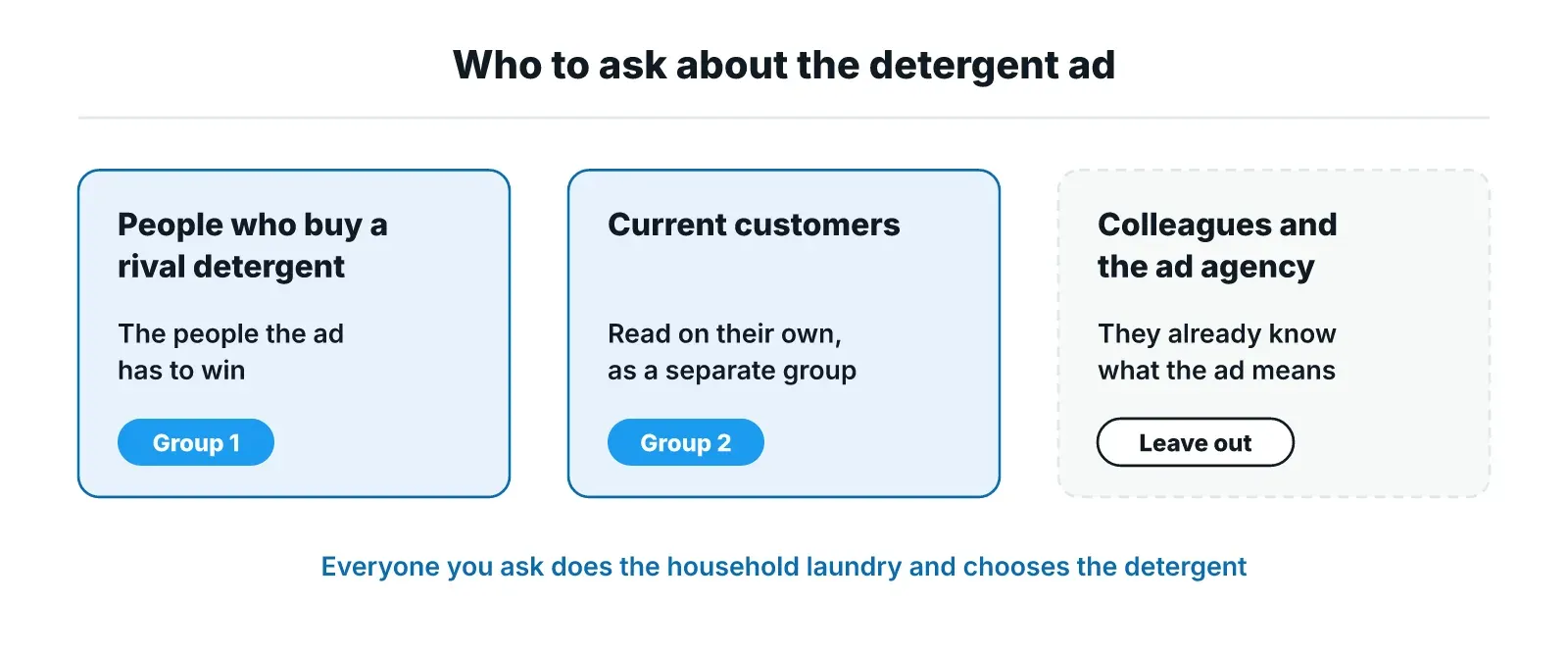
The answers only count if they come from the people the media plan targets. For the detergent ad, that means people who do the household laundry and choose which detergent to buy. Your colleagues and the ad agency already know what the ad means, so their takeaway tells you nothing about how customers will read it.
Include people who buy a rival detergent, because they're the ones the ad has to win. Keep current customers as a separate group, so each group's answers can be read on their own. A few screening questions at the start check that each person fits. That short set of questions is called a screener.
Before you test the line, hear how these people describe the problem it solves. Ask about their last wash, what went wrong and what they did about it. An ad is easier to follow when it uses the words customers already use.
Say people talk about clothes that "still smell after washing" far more than about cleaning in cold water. That changes what the ad should lead with, before anyone tests a line.
This open, early kind of research, where you explore a problem before you test an answer, is called generative research.
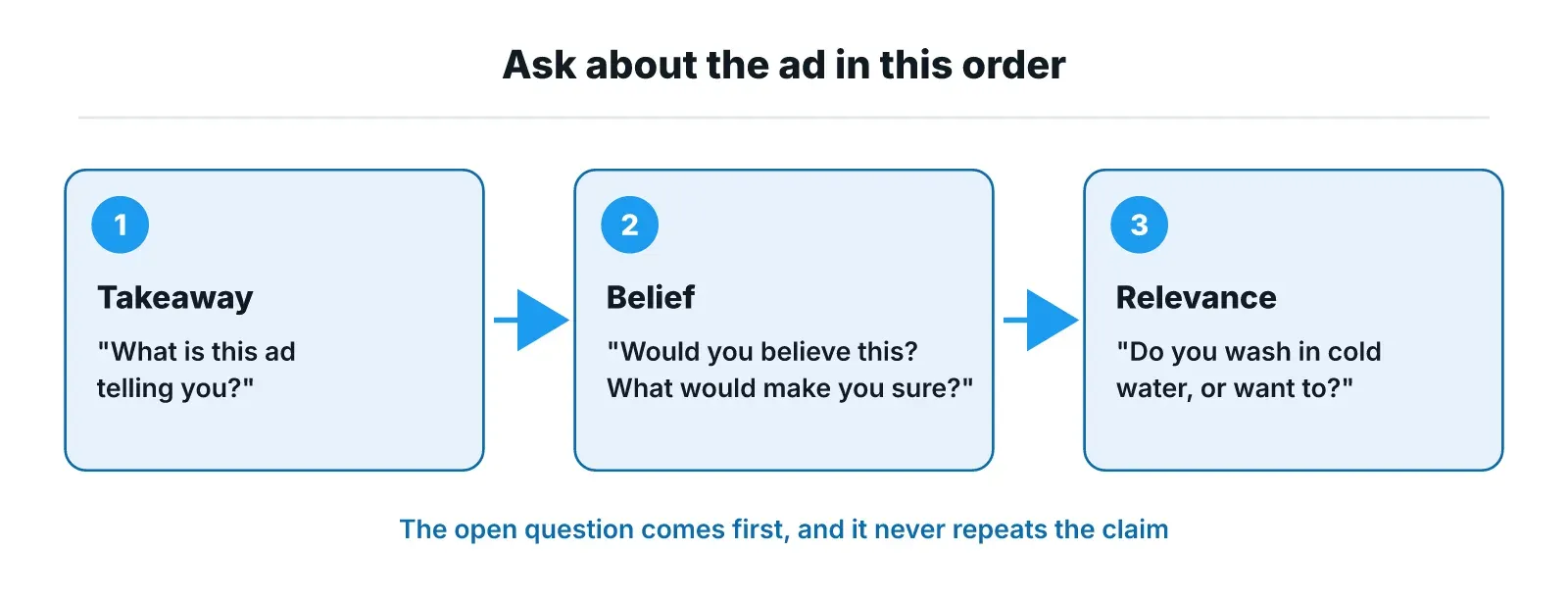
Show the script or the rough ad, then ask about it in a fixed order: first what it tells people, then whether they believe it, then whether it matters to them. The order protects the first answer. Once you mention the claim, people start repeating it back to you.
The way you ask changes what you hear. Pew Research Center's guide to writing survey questions says that wording, question order and whether a question is open or closed can all affect the answers people give. So the open question comes first, and it never repeats the claim.
Start with one open question before any rating: "What is this ad telling you?" Write down the answer exactly as said. Then compare it with the one sentence the team wanted people to take away.
Compare two ways to ask. "Does this ad tell you it cleans in cold water?" hands people the answer, so a yes tells you little. "What is this ad telling you?" leaves the answer to them.
When an answer is vague, ask a second question. "It's about being better" can turn into "it says I can stop using hot water" once someone asks what "better" means. A tick-box list of takeaways would miss the ones nobody on the team expected, and the post on what fixed questionnaires cannot hear explains why.
A message people understand but doubt won't change what they buy. So ask whether they believe the claim, then what would make them sure.
Collect the doubts in their own words, such as "cold water can't get grass stains out" or "it's probably weaker". Each doubt points to proof the ad may need, like a demonstration the company can show on screen.
Someone who believes the claim but always washes in hot water won't switch. So ask whether washing in cold water is something they do, or would like to do. If it isn't, the ad is answering a question these customers aren't asking.
Interviews tell you which takeaways and doubts exist. A short survey then tells you how common each one is among the people the ad targets. You need both, because a misreading that a few people share calls for a different fix from one that most people share.
Pairing the two combines two customer research methods: the interviews find the reasons, and the survey counts them. Each result then points to one next step for the detergent team.
| What you found | What to do |
|---|---|
| People take the wrong message | Rewrite the line before you make the final ad |
| They get it, but doubt it | Add proof, such as a demonstration |
| They believe it, but don't care | Lead with a different benefit, in the problem words you heard first |
| They get it, believe it and care | Book the media |
Say most people take "cleans in cold water" correctly, but many doubt it on tough stains. The line can stay. What the ad needs is proof, such as a shirt with a grass stain washed cold on screen.
If the ad will run in several countries, each market needs the same checks, in its own language, before you compare them.
If people can't say back what the ad means, don't pay to show it yet.
The detergent team needs to hear what customers take from the ad, and why they doubt it, before the media budget is signed. Pulse runs AI-moderated voice interviews that customers take by opening a link on a phone or laptop, so there are no calls to schedule. Participants can be shown the script or a rough cut during the interview and react to it.
The AI moderator asks every participant the same well-formed questions from one interview guide. Its follow-ups build on what each person said earlier, and a vague answer gets a second question. That second question is how "it's about being better" turns into a reason.
Surveys run alongside the interviews in the same study, so the takeaways and their counts arrive together. Pulse groups the answers into themes, each with the quotes behind it, and every quote links to its transcript.
To see how a check like this would run for your next ad, you can book a demo.
Advertising research checks an ad with the people it's meant for. Before launch, it asks what people take from the ad, whether they believe it and whether it speaks to them. After launch, it measures what changed, such as whether more people remember the brand. The two stages answer different questions, so they run at different times.
Fixing a message is cheapest while the ad is still a script. Advertising research tells you whether customers read the ad the way your team meant it, before you spend money showing it. It also gives the people deciding on the budget something firmer than the team's own opinion of the ad.
Advertising research is one part of market research. Market research covers any question about customers and markets, such as who buys, what they need and what they would pay. Advertising research narrows that to one ad or message: what people take from it, and whether it will work on them.
An AI chat tool can summarize what's already been written about a market, and it can help you draft questions. It can't tell you what your target customers take from your ad, because it hasn't heard from them. For that, you have to show the ad to those customers and ask.
Choosing an AI assistant for research? Match it to the evidence your question needs, then test whether every finding opens to the source behind it.
Jobs to be done interviews at scale: how to keep hundreds of interviews on track, sort what buyers say and check each reason across groups.
How to write a screener survey that lets the right B2B buyers into your interviews: role checks, hidden criteria, quotas and a test run.